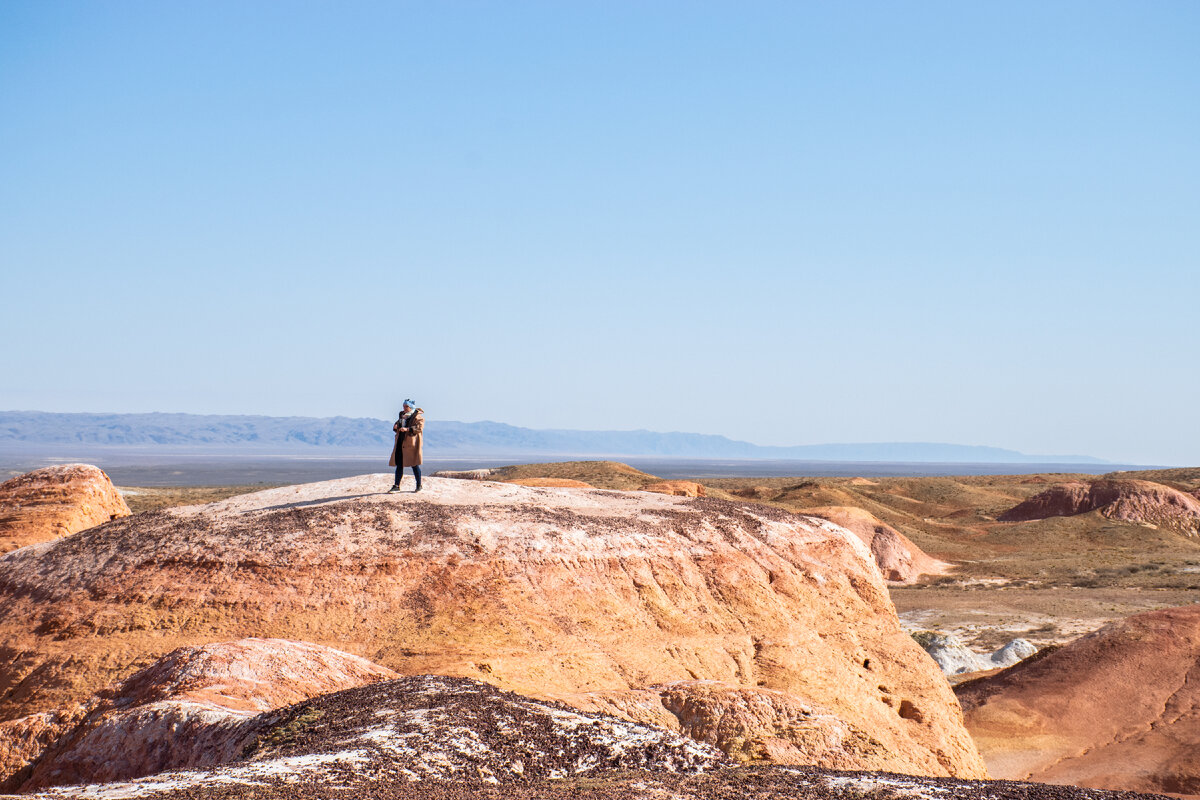
It is a compulsory condition to find a guide to the valley of the spirits of Kiin Kerish for traveling to the unknown world of East Kazakhstan region. They say that only a person with a pure heart can reach it. Even pointers do not help: it happens that travelers circle around the plateau and cannot get to a special brow, from which a view of the magical red-orange valley opens.
The valley hides from prying eyes on a strange part of the steppe – a gray plateau. It really is completely gray! Light gray clay soil is covered with fluffy bushes of all ashy shades, and you are driving along a hand-drawn map indicating the mileage of turns and you can't even imagine what will open up to you for the next one…
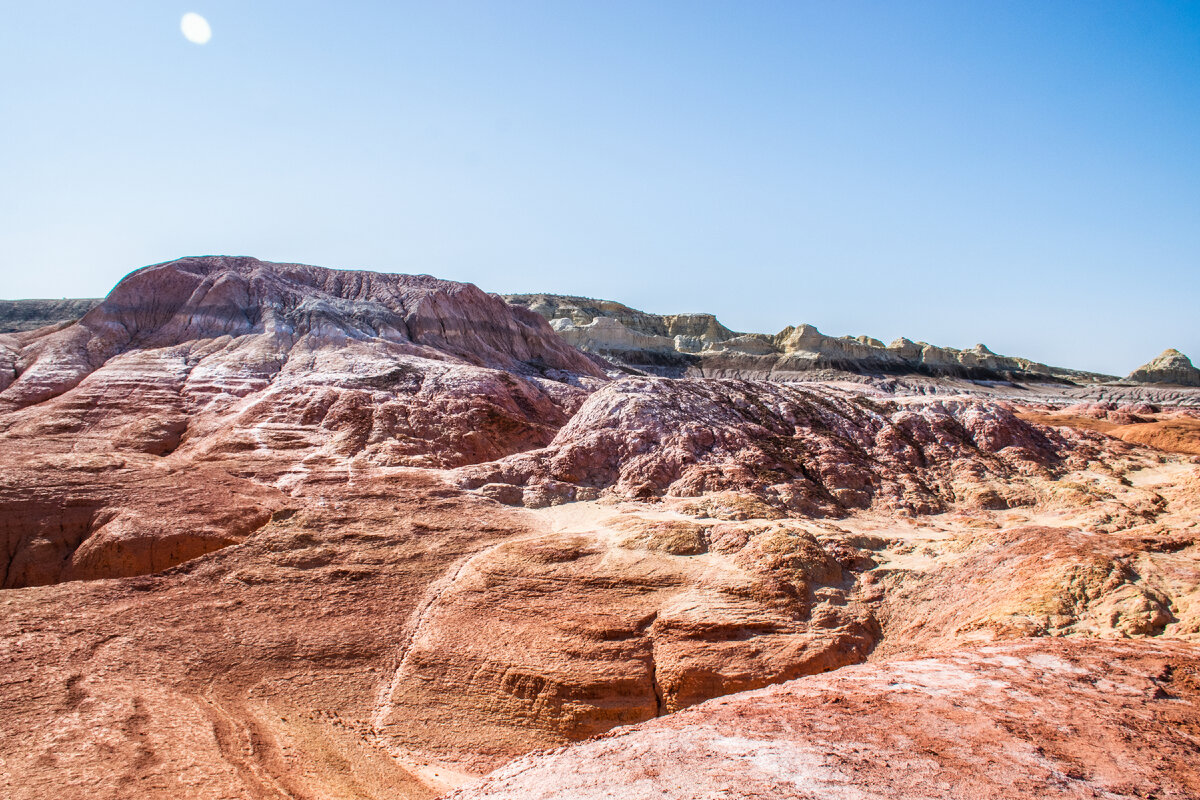
Suddenly, the clay under the wheels of the car changes color to the usual terracotta at first, and then to a bright red. And suddenly the driver brakes! The car stops in front of the grandeur and beauty of the Aeolian city, which stretches to the horizon.
As if the creator of this unreal composition received clay as a gift, and he really liked the red color. But in order to pile mountains and hills, he took a little more, a drop at a time, of other colors and added stripes and strokes, harmonious inclusions, crazy splashes. He did not even smooth the mountains: he arranged castles and palaces with columns, put openwork fences with gates, built a domed town with deep winding streets, caves and steps.
One of the legends of Kiin Kerish tells that this valley is the entrance to the underworld. Once upon a time, people were sure that here the fire of hell broke out from under the ground, the tongues of its flames soared up and petrified. It seems that this is true: the feeling of horror and delight simultaneously lives inside from the moment you meet Kiin Kerish and does not leave you for a long time after the journey.
Another legend strongly recommends not to spend the night among the "castles", "palaces" and "domes" of Kiin Kerish, because at night all this terracotta beauty comes to life and turns into the streets of an ancient city inhabited by spirits, and it is no longer possible to return from it.
Kiin Kerish terracotta Canyon is a rare paleontological monument, the twin brother of the Ustyurt space plateau in Mangystau, and they have a common parent – the ancient Tethys Ocean. For millions of years this territory was the bottom of the ocean, but over time the waters receded. During the periods when cataclysms dominated the Earth, the prints of paws, bones and fangs of saber-toothed cats and the remains of ancient horses were imprinted in rocky deposits. Geologists believe that the valley itself was formed a little later – 15-30 million years ago, in the hot and humid tropical climate of the Mesozoic, when dinosaurs reigned on Earth.
Since then, an endemic has been growing in the valley of spirits, one of the most ancient plants on Earth – atrafactis gray. Small branched bushes clinging to the clay have not changed over millions of years and remind of eternity with their love of life. It's not worth tearing it off, but taking a picture with dinosaurs of the same age is the very thing! And look carefully around: if you are lucky, you will meet the rarest representative of the desert fauna – the dwarf jerboa.
And in the valley of Kiin Kerish, the creator came up with silence with wind music. Have you ever heard the wind playing with silence without background noises? How each breath splits into notes in the turns-streets of the valley, and Kiin Kirish processes them with a reed pipe and bassoon. The wind is gently, invitingly, mysteriously refracted in a bizarre valley. Softly whispers-whistles: ask for everything you want, ask for everything, while the valley of spirits has accepted you…
Kiin Kerish Valley of Spirits occupies almost 300 hectares of territory, which is comparable to 300 football fields. If you want to inspect it all, daylight may not be enough.
The wind is able to move or roll sand and small pebbles for some distance. The grains of sand, lifted up, hit the rocks and rocks with their sharp edges, scratch and erase them, and the wind immediately carries away the separated particles. The process of blowing out particles, the destruction of rocks by wind is called deflation. For thousands of years, the wind can create real sculptural compositions in this way, which are called "Aeolian cities", in honor of the wind god Aeolus
How to reach
From Ust-Kamenogorsk, go to the Kaznakov ferry, this is the closest ferry to Kurchum town. From Kurchum to the Kiin Kirish Valley is still 120 km away, so it's worth refueling the car and stocking up on a can of gasoline and drinking water: there will be no more gas stations and shops.
At the exit from Kurchum, a new countdown of kilometer columns begins. When you reach "78 km" pole, you go to the right, onto a dirt road. Not far from the turn, a sign "Auyl Amanat 28" is 5 km away from the pointer. Look carefully, there should be a left turn – this is the road to Kiin Kerish.
The ferry crossing opens in early May. Until that time, you will have to reach Kurchum by a bypass road. The cost of a ferry crossing is from 1300 KZTto 3800 KZTper car (depending on the engine capacity). Ferries run from 06:00 a.m. to 09:00 p.m. daily
Photo and material: property of OMG Kazakhstan. www.omg.kz