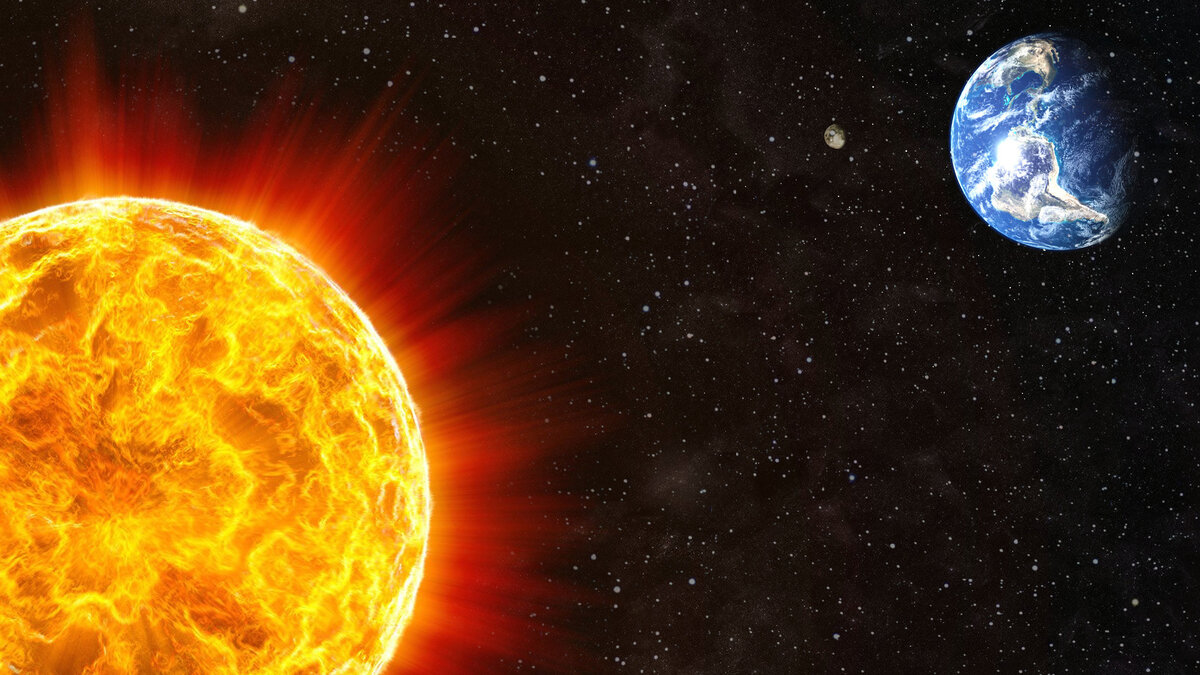
My Objection to NASA’s Solar Probe, Objections to My Objection, & My Responses | On Heat-Generating & Mass-Shifting Mechanics of the Sun & the Earth
by Nick Besher
INTRODUCTION
NASA recently launched a solar probe that added the probe's mass to the Sun, because of its views of solar mechanics — they think asteroids may be hitting the Sun anyway, adding to its mass, and they think the Sun burns because of nuclear fusion, a process that would cause the Sun to be losing billions of kilograms of mass per second (they think the Sun will die in around 8 billion years for this reason), so they think it may be safe to add the probe's mass to the Sun. However, I think there could be reasons why the Sun burns other than nuclear fusion, where the Sun would not be losing mass from nuclear fusion (I think the Sun may burn because of high material density and friction), so I think the Sun (and the Earth) could have perpetual reactions and a constant amount of mass.
Because I think the Sun could have constant mass, because the solar probe added mass to the Sun, increasing its gravity, and because the stable orbits of all the planets could depend on constant gravity from the Sun, I think solar probes could threaten planetary orbit stability, so I think they could threaten all life on our planet (increasing the risk increased gravity from the Sun could draw the Earth into the Sun).
I also have different and new views of the mechanics that cause Earth's core to be hot: I think Earth's core and the Sun may be hot for the same reasons, unlike NASA and mainstream scientists who say they are hot for different reasons (I think Earth’s core and the Sun may be hot because of high material density and friction, mechanisms that could go on creating heat forever — this is a different view than of mainstream scientists, who say both the Sun and Earth’s core will die in the future from depleted reactions).
I request that you read my document, that you give feedback about it, and that you help me with it if you think it could be correct. Thank you.
BODY
re: “NASA announced that the Parker solar probe went into the Sun’s atmosphere” (https://twitter.com/inversedotcom/status/1471580444932165633)
Me: “I don't like it. Gravity may prevent the probe from ever leaving the Sun. Adding mass to the Sun will increase its gravity, and the stable orbits of all the planets may be dependent on constant gravity from it.
If you're going to alter the Sun, there should be a planetary vote.”
Objection 1: “Asteroids keep on hitting the Sun (adding mass to it).”
My response: http://curious.astro.cornell.edu/physics/72-our-solar-system/comets-meteors-and-asteroids/asteroids/285-do-asteroids-hit-the-sun-beginner: “No asteroids have ever been observed to hit the Sun…”
Objection 2: “The Sun is losing billions of kilograms per second and you're worried about an orbiter increasing its mass?” (“The Sun is losing mass from nuclear fusion, the source of the Sun’s heat, and from solar winds”)
My response:
“Friction creates heat, and the Sun’s (and Earth’s core) heat may be because of friction and high material density (https://www.sciencelearn.org.nz/resources/750-heat-energy: “all matter contains heat energy,” so there will be many instances of heat energy per particle for many particles that are densely grouped together from gravity and pressure), and not nuclear fusion (mainstream scientists say the Earth’s core’s heat is not from nuclear fusion, but is mostly from residual heat and radioactive decay, that they say will one day deplete, so they say Earth’s core will one day go cold, though the main reasons for Earth’s core heat may be friction and high material density, as here discussed — mainstream scientists say there are different reasons for the Sun’s and Earth’s core heat, but I suggest they both may be hot for the same reasons of friction and high material density — the Sun and the Earth’s core could be hot forever, according to my explanations, unlike the explanations of mainstream science that say they will eventually die from depleted processes and go cold).
Pressure at the center could force friction and so heat — the center is the most pressurized so friction there could have the most force, which could explain why it’s hottest toward the center (the center is also the densest, with the most mass per square inch, also explaining why it’s hottest there). Also, gravity attracts, the Sun’s (and Earth’s) dense core attracts outer material to press inward, and as matter toward the core is denser it may be impenetrable by outer mass that drives inward from gravity and pressure from matter further out. Because matter more toward the center is denser and so maybe impenetrable to outer mass that drives inward from gravity and pressure, it may cause pressure from layers of outer mass to deflect into lateral flows that may create friction and so heat (my explanation of planetary mass shifts explained by layers of planetary mass pressure deflecting into lateral flows is different than that of mainstream scientists, who say planetary mass shifts are explained by heat from radioactive processes and not my explanations of pressure of layers deflecting into lateral flows (that explains a source of friction and so heat that’s not from radioactive processes that mainstream scientists don’t consider) — they say “the heat from radioactive processes within the planet’s interior causes the plates to move, sometimes toward and sometimes away from each other.” Source: https://oceanservice.noaa.gov/facts/tectonics.html — my explanations could also account for phenomena of plates moving sometimes toward and sometimes away from each other).
Mass has gravity, so the high amount of mass in the Sun creates a high amount of gravity (the Sun is the most massive body in our solar system, so it’s with the most gravity, so that everything orbits around it), and the high amounts of gravity and mass may create a high amount of pressure within the Sun, that may create a high amount of friction (many instances of highly forceful, so hotter, friction), that creates a correspondingly high amount of heat, that radiates out from it into our solar system (it radiates so much heat that the outer layer cannot form solids, hence the Sun’s outer burning appearance — conversely, the Earth is not as massive with as much gravity as the Sun, so the Earth doesn’t have as much inner pressure and friction (with fewer instances of less forceful, so less hot, friction than the Sun), and the Earth doesn’t have as much mass (with fewer instances of less dense mass), so it doesn’t have as much inner heat radiating out, so that the outer layers of the Earth can be cool enough to form solids). The heat may cause matter to rise, and gravity from the Sun may prevent its heat risen material from escaping, bringing it back down toward the surface from gravity for stable cyclic reactions, so the Sun may not be losing mass over time from solar winds. Because the Sun’s heat may be from friction and high material density as discussed, and not nuclear fusion, it may not be losing mass from nuclear fusion either — the Sun may have a constant amount of mass.”
Objection 3: Are these not equivalent?
a) F=G(m×M)/r^2
b) Where we remove some mass from m and add it to M:
F=G((m-X)×(M+X))/r^2
My response:
Are you saying if “State 1” of the Earth having X mass and the Sun having Y mass is changed to “State 2” where some mass from the Earth got subtracted from it and added to the Sun, that the forces of gravity drawing the Earth and the Sun together will be the same as the forces of gravity drawing them together in “State 1”, because the forces of attraction from gravity are functions of their combined masses, that would stay the same if mass is transferred from the Earth to the Sun?
I don’t know if that’s true, or if the force of gravity drawing the Earth to the Sun would be increased in “State 2”. Even if it’s true that the forces of gravity drawing the Earth to the Sun would be the same in “State 2”, solar probes could still be dangerous, as the forces of gravity drawing the other planets to the Sun would be increased in “State 2” since the Sun’s mass would be increased in “State 2”, which could cause the other planets to lose their orbits and be drawn into the Sun, that would further increase the Sun’s mass, so that the forces of gravity drawing the Earth to the Sun would be increased, so that the Earth could consequently be drawn into the Sun?
When probes from the Earth go to the Sun, subtracting from Earth’s mass and adding it to the Sun, when the Earth is positioned between the Sun and another outer planet, the new longer distance of the planet to the mass of the probe will decrease the gravitational force on that planet toward the Sun, however when the Earth is to the side, the amount of gravitational force on the planet to the side will be decreased and the amount of gravitational force to the Sun will be increased, from it having the mass of the probe, and when the Earth is behind the Sun relative the outer planet, the amount of gravitational force on the planet from the Sun will be increased, because the mass of the probe will be closer to it. These factors could cause outer planets to lose their orbits and be drawn into the Sun if probes subtract mass from the Earth and add it to the Sun.
When inner planets are on the same side of the Sun as the Earth, the amount of gravitational force pulling them away from the Sun will be decreased, since mass from the Earth is decreased by sending a probe to the Sun, and the gravitational force drawing them to the Sun is increased, since the Sun has the probe’s mass. When inner planets are on the opposite side of the Sun as the Earth, the gravitational force attracting them to the Sun will be increased, since the mass of the probe is closer. These factors could cause inner planet to lose their orbits and be drawn into the Sun.
If the inner planets are drawn into the Sun, there will be less gravitational force attracting the Earth to the sides, and more gravitational force attracting it to the Sun. If the outer planets are drawn into the Sun, there will be less gravitational force drawing the Earth away from the Sun and to the sides, and more gravitational force drawing the Earth into the Sun. Therefore the Earth could be drawn into the Sun if any of the other planets are first drawn into the Sun. Both inner and outer planet could be drawn into the Sun if mass is subtracted from the Earth and added to the Sun, so doing so (by sending probes from the Earth to the Sun) could be dangerous.
Saying probes from the Earth to the Sun won’t make a difference because the amount of mass taken from the Earth and added to the Sun is so small disregards the changes of mass (distributions), and so changes of gravity systems, that actually occur when mass is taken from the Earth and added to the Sun. Because the amount changed is so small, it could take a long time for orbits to change significantly, but since mass is subtracted from the Earth and added to the Sun, there could be eventually changes that could eventually crash the system, even if it would take a long time.
My other explanations show how the Sun’s (and Earth’s core) heat could be perpetual, so life on Earth could be potentially enabled by the Sun forever, so possibly disrupting that by causing system crashes that may take a long time could be significant.