The article was written on March 4th(2020). No judging.
For all his movies, Hayao Miyazaki takes inspiration from myths.
He usually doesn’t take a character from a myth as it is, but she merges the figure from the myth with his own ideas, creating a completely new character in the end. That’s why his movies are so interesting to study — you see a shadow of a Japanese mythical figure, but then it vanishes and appears to be a completely unique character.
I’m not an anthropologist, I wrote this post from a character designer perspective. It’s so interesting to see how a new character is made, especially by Hayao Miyadzaki. Let’s take the most known and beloved movie “Spirited Away”. It has been my all times favourite; I watched it at least 15 times.
But first, let’s begin with the Joseph Campbell’s archetype breakdown:
Hero — Chihiro, later Sen, later Chihiro again (luckily)
Herald — Yubaba
Mentor — Haku
Threshold Guardian — event: The Riddle of finding the parents at the end of the story
Ally — Kamaji, Lin, Susuwatari, later Boh
Shadow — feeling: fear, character: Yubaba
Trickster — No-Face, Otori-Sama, Boh, Stink Spirit-River Spirit
In every single story, these archetypes are present. It doesn’t matter if the particular archetype is a character, feeling or event, what matters is that the role of the archetype remains the same.
As you can see, there are quite a few main characters present, but many secondary characters which dilute and complicate the story at the same time. Their personalities are quite complex, changing their roles during the storyline — the transition of Boh’s mind and appearance, the constantly changing personalities of No-Face, discovery that Zeniba is actually a good character in the story — it’s truly interesting to see each character developing and changing trough the movie, gaining something in the end.
Yubaba is one of the most interesting characters in the story.
The word Yubaba is a literal translation from japanese meaning “Old bath woman”. She was inspired by yokai (japanese folklore spirit) Yama- Uba. This spirit may appear as an old woman or a beautiful twenty-year old lady. In japanese folklore, they usually appear as kind old women (at first) living in forests or mountains. Their true nature unravels when they shelter wanderer and then eat their flesh.
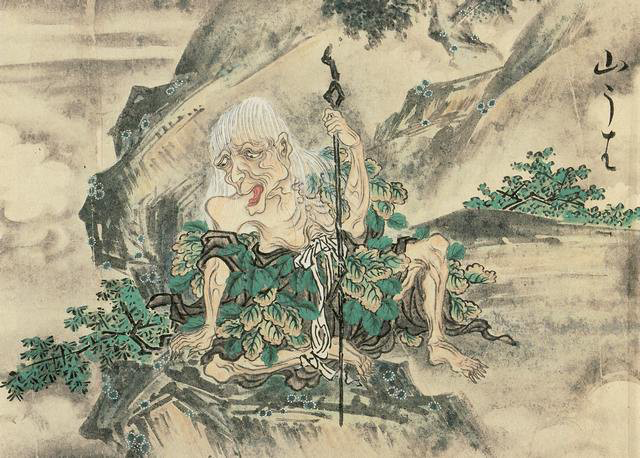
Similar characters can be seen in Nordic and Slavic folk tales. Interestingly, the Russian version Baba Yaga inspired Yubaba’s personality greatly. No wonder, why Russians like Spirited Away so much (and not only because of Baba Yaga ;) ). There’s one more proof Miyazaki knowing about Baba Yaga: In 2010, an actual Baba Yaga appeared in Miyazaki’s short movie called “Mr. Dought and the Egg Princess”. Also, Yubaba has a twin sister Zeniba, which is also a witch. This is also common to slavic tales, where the creator of russian myths literally tries to tell you “hold on, there’s always one more witch to fight.”
Also, here’s a great storytelling hack: Yubaba appears as a kind woman with a rotten soul, but Zeniba is rough on the outside but turns out to be kind and adequate.
The first time we got to know Zeniba was when Sen saw Haku trying to get rid of Shikigami . This made it possible to create a nice twist in a story — showing in the end, that Zeniba is a good character. You cannot have good without some evil, don’t you? That’s what brings a strong character to life.
Why is it great to add twins to the story? Especially, when we create a complex, layered character it’s great to add a twin sibling to it to make certain characteristics to stand out. Without Zeniba, we couldn’t understand Yubaba truly, as well as travel through the beautiful world the story takes place.
Yubaba and Zeniba are like Ying and Yang, but most interestingly, not black and white, but 2 tones of grey, one being warm, the other one cold.
“We’re identical twins and exact opposites.”-Zeniba
So, that’s how you can create a really nice unique character for your story: take the base from your favorite myth and add your own ideas — your imagination is the limit. Good luck on creating powerful characters!