The article was written on February 27th (2020). I still like to re-read my old articles and want to share them with you <3
What makes a good game? Well, there are so many factors, but, first of all, it’s the story.
Curiosity is one of the most important factors which defines a writer. You need to read everything; you need to be open in order to think of a fresh juicy story.
To be able to create something unique, you have to be a good thinker, generate tons of ideas, use your imagination to its maximal capacity. And, last but not least, you have to know how to find your own flow and inspiration at any time you need it.
So, where to get inspiration for your mindblowing stories, you may ask? One of the ways is to meet strange people you match to on Tinder app. The second way is more safe, and you don’t even need to leave your room. So, what should I do to burst my inspiration right now, you ask? The secret is quite simple. Reading myths and legends, of course!
My favourite myths are the myths from Japan. They are quite fucked up, as all the myths in the world, but in a mild & unique way.
Here’s an example:
"The Japanese once believed in water demons Kappa, which looked like small naked men with a tortoise shell and a bowl filled with water in place of the head. They scoured the water in search of lost passengers and dragged them to the depths. There were only two ways you could avoid them: the first involved writing the name on the cucumber and throwing it into the water, because kappa demons were very fond of cucumbers. The second way was to bow to the demons. The demon, in this case, had to bow in response and thereby empty his bowl-head. Without water, Kappa’s head was helpless.”
For sure, you can make a survival game where you play against Kappa and avoiding to be drawn under the water. Instead of weapons you can use cucumbers with your name written on them. The challenging part is that you need to find a knife or a pen first, otherwise how are you going to put your name on the cucumber? A pen will be a common used tool and it will have a limited ink capacity, like patrons in a gun. To refill a pen, you’ll need to get close to the water and fish out an octopus (Why not, the story is pretty fucked up anyway!). 1 octopus = 1 full pen refill. To balance things out, a bigger name won’t need more ink, to avoid short names — “Easy-Win” situation (Spanish would die immediately in that game.) Also, you would need to think about the overall feel of the game (you may create a horror game or a chill game like Undertale.) Think about animation, music, UI, side quests, monetization… Maybe you could add some legendary cucumbers which will kill any Kappa who eats the cucumber or a bomb-cucumber which will explode after 5 seconds? Or an electric cucumber which will paralyse kappas on a range of 5 meters once it gets into water? Or a golden pen which doesn’t need refill at all? Your own imagination is the limit, dear friend!
Myths and fables are the oldest forms of storytelling. They are stories which have a meaning for a particular culture. They promote cultural rules, existing orders and beliefs, making the life of a human being easier and manipulating the mind by telling a believable story. Joseph Campbell found, that all myths are basically the same story being told in an infinite variety of ways.
With that said, we can read myths from all over the world to understand the fears of a nation buried deep down in the roots of the culture. It can be used in localisation purposes, to make your story more relatable for a particular culture.
A water demon from this Japanese myth sounds creepy enough to imagine it. But here’s another thought: Sometimes some cultural details are unrelatable. When I read about the story with cucumbers, I thought: “Seriously? That’s how you get rid from a demon??”. After this, I’m not horrified by the demon anymore. Now it feels strange and unrelatable. If this story would be written for a cat, it might have worked, because some cats are damn afraid of cucumbers for some reason. I see an only logical solution: maybe cucumbers were so rare in ancient Japan that the probability of getting rid of a Kappa demon was quite low.
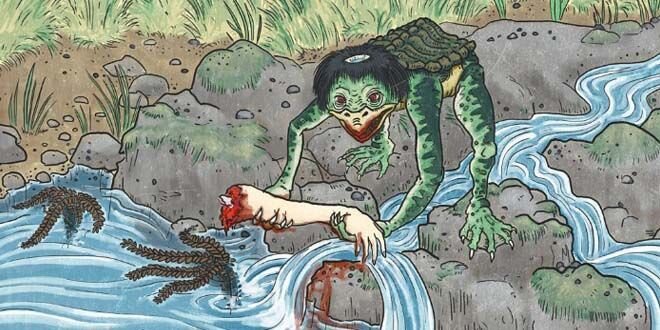
Anyway, the whole idea of using a cucumber as a weapon is mindfuck.
What’s also strange about South American mythology. Tapirs and anteaters are used as antagonists. Please, don’t cry.
Here’s a myth involving an evil anteater which I illustrated 3 years ago. Even then I imagined this as a great game idea. Oh my, as a newborn game designer, now I can fulfill my deepest dreams!
Myths still have a huge impart on the society. Just compare Achilles to Superman. Both have a weakness. The heel was replaced by kryptonite; it’s that easy. Or compare the old greek Hercules to Hulk.
This brings to a thought that good storyteller is the person who takes a story and can come up with his own at the end. This can be achieved though the fusion of the external information and imagination and experience of the storyteller. Tweak, fuse, cut, carve, deepen, elongate different parts of the story to change it’s taste.
Don’t you learn a recipe to make it the same over and over - learn to experiment and try different variations.