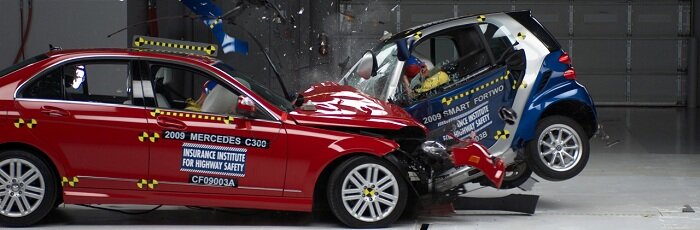
In this article we will discuss how safe cars are now? Why not make the car even more durable, and what did the engineers work on to prevent the deplorable consequences of an accident?
A liter of gasoline contains about 56 megajoules of chemical energy. This is more than the explosion of the same amount of TNT. And this energy would be enough for a whole day of toaster operation. The machines work by burning gasoline, which converts chemical energy into kinetic energy, contributing to the movement of the machine. Eighty percent of the energy is lost as heat in the engine, but 20 percent of the 56 million joules is still a lot. It takes only 5 teaspoons of gasoline to accelerate a 2-ton car from 0 to 60 km/h. It doesn't seem like a lot of fuel, but the energy of a car that moves at a speed of 60 km/h is comparable to the energy of an elephant, or rather a stegosaurus, dropped from the third floor. In order for the car to stop, all this energy must go somewhere. If the brakes stop the car, they dissipate energy by heating (and then cooling) the brake pads and discs. And in the event of a collision, the energy is dissipated by the deformation of the front of the car. And since a slow stop is better than a fast one, cars are carefully designed to crumple in a collision. This prolongs the collision time and stopping requires less intense braking acceleration.
High acceleration has a very bad effect on human brains and organs. But people don't really like driving cars with a long front. Most machines have 50 cm of crumpled space in which they must dissipate the energy equivalent. The deformation of the front part of the machine must withstand a force that is equal to a quarter of the thrust of the main engine of the shuttle. More than half of the controlled crumpling should be taken over by a pair of steel rails connecting the main part of the car to the bumper, which bend and deform to absorb energy and slow down the car. All the remaining energy should be absorbed by the deformation of the rest of the metal in front of the car. This planned destruction allows the car to slow down quickly, but at an acceptable and stable speed.
If the machines were very solid, they would stop so fast that the acceleration in them would exceed 15 or more times that experienced by astronauts in training. Such huge overloads are not compatible with life. Engineers have learned how to make machines with crumpled parts that create a safe zone inside. Completely solid cars are not suitable for the safety of the driver and passengers. In completely solid cars, even in a collision at a very low speed (30 - 40 km / h), people could die.