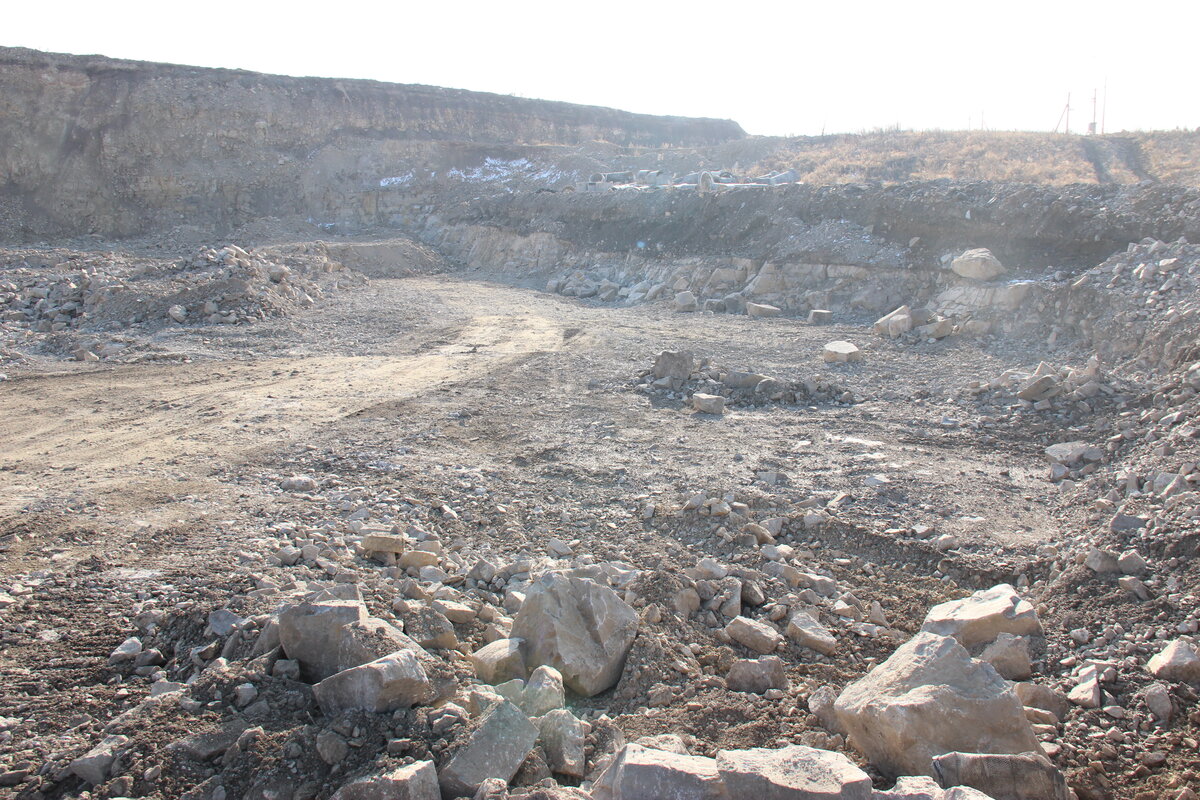
Abstract. An assessment of the state of quarry workings left after the extraction of building stone is given. The reasons hindering the process of natural restoration of vegetation on the sides and bottom of old quarries are revealed. The negative impact of scree formation on the growth of forest cover on non-working sides of quarries was determined. A method has been developed for modeling the process of scree formation with prediction of the scattering of rock pieces and scree parameters at the foot of the ledge. Dependences of the distance of scattering of rock pieces on the height and angle of slope of the ledge, on the height and angle of slope of the embankment are established, and formulas are proposed for determining the length of the scree. Technical solutions have been developed for the formation of a technogenic mixture on the platforms of ledges from scree rocks to intensify the process of restoration of forest cover and to prevent its subsequent destruction by crumbling rocks. Dependences for determining the parameters of a stone-catching trench and a stone-protective rampart are proposed.
1 Introduction
During the development of mineral deposits, primarily in an open way, the largest amount of land is disturbed, so the issue of their reclamation is very relevant. This issue is solved more effectively when developing reservoir shallow deposits, and reclamation is much worse when developing other types of deposits.
An analysis of the methods and technologies in the field of reclamation of quarries for the extraction of ores, non-metallic and building materials has shown that a huge experience has been accumulated in the implementation of work related to the restoration of disturbed lands and vegetation on dumps and tailings dams in the Urals, the Far East, Kuzbass, as well as abroad, where the greatest importance is given to the restoration of lands occupied by dumps. At the same time, various technologies are used according to the purpose of reclamation, taking into account local natural conditions, the specifics of technogenic substrates and technological processes of field development [1-12]. And much less known about technical solutions for the reclamation of mined-out area. The same thing is noted in production. If dumps are usually somehow reclaimed, then workings remain abandoned after mining is completed. Field studies carried out by us in the quarries for the extraction of building stone showed that reclamation was not carried out even in relatively shallow quarries. At the same time, in a number of cases, open pits overgrow quite well in forest areas, and sometimes the process of vegetation restoration is very slow.
The main reasons slowing down the process of revegetation in quarries for the extraction of building materials are the lack of a sufficient amount of loose deposits on the bottom and berms of the sides of the quarries, the slight moisture content of these deposits, and the long process of scree formation. At the same time, if for the first two reasons, there are some technical solutions to eliminate them, the application of loose deposits, including silt, on rocky areas of mountain landscape elements [13-16], the creation of a slight slope on the berms to prevent the flow of atmospheric water to the bottom quarry [17-19], there are practically no proposals to reduce the negative impact of screes formation on the overgrowth of berms. Therefore, the main objective of this work is to study the causes of scree formation on the ledges of non-working sides of quarries and to find ways to reduce its negative impact on the restoration of forest cover.
The intensity of the restoration of disturbed lands is determined not only by the creation of favorable conditions for self-overgrowing, but also by the minimization of negative factors affecting this process, one of which is scree formation [20].
Screes are a characteristic element of the mountain landscape. They are found everywhere and significantly affect the formation of vegetation cover. Screes are accumulations of debris that roll down a slope under the action of gravity and are deposited at its foot. The most important conditions for the formation and spread of screes are the steep slope of the earth's surface, the abundance of rock outcrops of bedrock, dry or frosty climate with intensive accumulation of weathering products, and the size of rock pieces [21]. Screes are very characteristic of the highland zone, i.e., where weathering products are not fixed by vegetation. Scree formation continues until their slope becomes less than the angle of natural slope. “Live” screes are typical for slopes steeper than 65°, relatively mobile - for slopes with a steepness of 45-65° [22].
Screes, being in their active phase, constantly collapse. The so-called “live” screes, being in motion, do not allow vegetation to gain a foothold on their surface, and those plants that nevertheless appeared on them are constantly destroyed by the rolling rock and covered with attle. Screes damage the pioneer vegetation that has appeared on the berms and, as they grow, prevent the self-recovery of the vegetation cover. Here, the distance of scattering of pieces of rock is of great importance. Flying a considerable distance from the foot of the ledge, the debris destroys young shoots along the trajectory of movement, which greatly affects the self-recovery of vegetation on the berms and depends on the slope angles of the ledges and the scree itself.
2 Research Method
In order to reduce the impact of scree formation on the self-overgrowing of the sides of the quarries, a physical modeling of this process was made, and field observations were carried out in the quarries for the extraction of building materials.
To simulate the process of scree formation, material in the form of stones of different fractions brought from quarries was used. The model ledge was assembled from 6 m long boards. The samples were dropped along a wooden guide beam onto a concrete base, similar in its characteristics to a rock one. To assess the effect on the scattering of stones of the scree formed at the foot of the ledge, multilayer plywood was used in the simulation, acting as the surface of the scree with different parameters of the latter. During the study, the height (H) and slope angles of the ledge (β) and scree (α), as well as the height of the latter (N) were changed .
When changing the above parameters (H, N, β, α), as well as the size of the dropped stones, the distance of scattering of the rock pieces (L) relative to the foot of the ledge was set. In total, more than three thousand measurements were carried out with the throw-off of about 2.5 tons of stones from different heights and various model parameters of ledges and screes.
The results of experimental modeling show that with the appearance of crumbling rock at the foot of the ledge, the scattering of falling debris from overlying horizons increases significantly, which will negatively affect young vegetation, which is damaged by falling stones.
3 Research Results
The results of studies of the influence of the ledge height and its slope angle on the distance of scattering of stones are shown in Figure 1 and Figure 2.
Data for ledges of 10 m and 30 m high were obtained from the results of field observations at the studied quarries, when the length of the screes themselves on the berm and the scattering of stones were measured, and the weighted average value was taken (Figure 3).
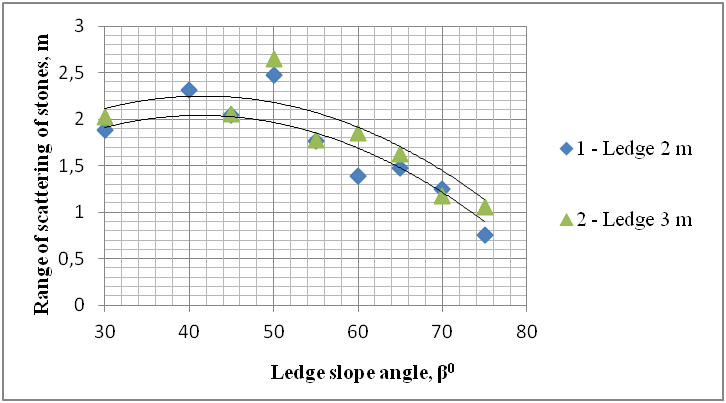
It follows from the results of the study that with stable rocks that allow the formation of steeper ledges, the spread of debris falling from overlying horizons is significantly reduced, and therefore the area affected by the debris is reduced. As the slope angles of the ledge decrease from 70-750, the range of scattering of stones gradually increases, reaching maximum values at angles of 40-500, and then decreases somewhat.
With an increase in the height of the ledge, the scattering of stones increases at any slope angles. In this case, the maximum scattering is observed at angles close to 500.
When processing the data obtained during the modeling process, we used the methods of mathematical statistics with the compilation of an equation for the relationship between the effective and factorial features, methods of correlation and regression analysis.
Based on the research results, formula (1) is proposed for calculating the range of scattering of stones along the berm depending on the angle of slope and the height of the model ledge:
L= - 0,0200+0,0804*β+0,1901*Н+0,0008*β*Н-0,0010*β2-0,0033*Н2, (1)
where L is the range of scattering of stones, m; β is the ledge slope angle, degree; H is the ledge height, m. The coefficient of determination of the revealed dependence is R = 0.614. The qualitative characteristic according to the Chaddock scale is noticeable.
It should be noted that the formula works in the range of slope angles of the ledge of 30-750 and its height from 1 to 30 m.
The coefficients that take into account the height of the ledge and calculated using formula (1) for the most common ledge parameters are shown in Table 1.
The length of the scree is proposed to be determined by the formula (2):
Lос= ʄ *Н, (2)
where Loc – scree length, m; H – ledge height, m; ʄ– ledge height factor.
Table 1. Factor taking into account the height of the ledge.
Ledge slope angle, β 0 Factor ʄ at ledge height, m
5 10 15 20 30
30 0.4980 0.3320 0.2660 0.2245 0.1670
40 0.5280 0.3510 0.2813 0.2385 0.1790
45 0.5280 0.3530 0.2840 0.2415 0.1827
50 0.5180 0.3510 0.2840 0.2425 0.1843
55 0.4980 0.3430 0.2800 0.2405 0.1847
60 0.4680 0.3300 0.2727 0.2360 0.1830
65 0.4280 0.3120 0.2620 0.2295 0.1800
70 0.3780 02890 0.2487 0.2200 0.1750
75 0.3180 0.2610 0.2313 0.2080 0.1687
The range of scattering of rock pieces directly depends on the slope angle of the ledge and its height. From Figure 1 and Figure 2 it follows that the greatest range of rock scattering is observed at ledge slope angles close to 40-500, and the smallest scattering will be at angles close to 70-750. The results of studies and calculations according to the formula for the effect of scree on the scattering of stones are shown in Figure 3.
The effect of scree on the distance of scattering of stones, L, m, for a model ledge with a height of H = 3 m at different angles of its slope is approximated by the formula (3):
L = 0,0122+0,1303*β - 0,0064*α + 0,0017*β*α -0,0016*β2-0,0017*α2, (3)
where L – range of scattering of stones, m; β – slope angle of the ledge, degree; α – slope angle of the scree, degrees. The coefficient of determination of the revealed dependence is R = 0.932. The qualitative characteristic according to the Chaddock scale is very high.
4 Analysis of Results and Development of Technical Solutions
The process of scree formation in quarries for the extraction of building stone is ongo-ing, and scree on the berms of quarries are in constant motion and change their profile over time. It was found that the formation process has three distinct stages. The first stage, when the scree grows in length to an angle α = 20 – 250, then the scree formation passes into the second stage, and the scree grows already up to an angle α = 250 – 400, after which the process passes into the third stage, where the scree grows evenly in length and in height. With the appearance of scree, the range of scattering of stones increases, and at slope angles of the ledge β = 55-650 and scree α = 250, the scattering L has a maximum value.
The performed studies on the influence of the parameters of ledges and the process of scree formation on the self-overgrowing of berms allow us to propose technical solutions and measures to create more favorable conditions for the natural restoration of forest cover, including by some control over the scree parameters.
In the presence of suitable rocks to cover the reclaimed surface of the safety berms and the bottom of the quarry and a sufficient amount of loose rock, a layer of loose sediments is created from them, the excess rock is moved to the lower horizons. With insufficient volume of loose rocks, this layer can be made combined, leaving a loosened mineral at the base of the layer.
To reduce the influence of the scree formation process on the formed layer of loose deposits at the foot of the ledge, it is proposed to create a stone-catching trench for collecting crumbling rocks with a depth h = M at some distance, e = C, from the slope of the ledge .
The trench width is proposed to be determined by the formula (4):
e= (bМ-S_sc)/М (4)
where e – trench width at the bottom, m; b – berm inter-ledge width, m; М – required thickness of loose sediment layer, m; Ssc – average cross-sectional area of scree, m2.
With a negative value of e, instead of a trench, a stone-protective rampart with a height h1 can be created, which is determined by the formula (5):
h_1=√(S_sc-bM) (5)
The distance C from the foot of the ledge to the rock-protective rampart in the absence or insufficient amount of rocks from the scree to apply a layer of loose deposits on the berms is proposed to be determined by the formula (6):
С = (ʄ *Н)/2 (6)
where C – distance from the foot of the ledge to the stone-protective rampart, m; H – ledge height, m; ʄ – ledge height factor.
With the simultaneous formation of a rock-protective rampart and a trench, the cross-sectional area of the trench is equal to the cross-section of the rock-protective rampart Str = Sram and is determined by the formula (7):
Str = 0.5 М(2е+М+Мсtgβ) (7)
The technical effect of the proposed method consists in the exclusion of transport operations for the delivery of the technogenic mixture to the berm due to the use of rocks from scree, and the environmental effect - in preventing the subsequent collapse of crumbling rocks on the surface of the created technogenic layer. The technogenic mixture is formed from the scree formed at the foot of the ledge slopes and laid on the surface of the inter-ledge areas, and a trench is created along the inner side of the areas to collect rocks crumbling from the slope.
With large screes, the depth of the trench can be taken less than the thickness of scree. The width of the trench is set based on the possibility of forming a layer of technogenic mixture with a thickness of 0.4-0.5 m from the outside of the inter-ledge platform. Taking into account the reverse slope of the inter-ledge platform towards the rock mass, the thickness of the technogenic mixture layer slightly increases with distance from the upper edge of the ledge (terrace).
It is advisable to carry out the proposed method of reclamation with side terracing from top to bottom, which is associated, firstly, with large scree on the upper ledge due to less strong and stable rocks and a longer standing period of this ledge, and secondly, with the possibility of overcasting parts of the rocks from the scree and from the massif of loose deposits to the underlying inter-ledge areas.
Reclamation activities are carried out according to a combined scheme in the process of developing a deposit when setting the sides of a quarry to the limit position using mining equipment still operating at this facility.
5 Conclusion
The main conclusions from the research results are as follows.
1. Quarries for the extraction of building stone are mainly abandoned man-made landscapes, where reclamation has not been carried out or has been postponed for a long time due to remoteness from large settlements, location in a forest, mountainous area, lack or insufficient amount of a fertile layer.
2. The density of forest cover fixed on the berms and the bottom of the quarries largely depends on the thickness of the layer of loose deposits formed on them and the stages of scree formation on ledges.
3. The range of scattering of rock pieces during the collapse of ledges is determined by their height and angles of slopes, as well as by the parameters of screes formed at the foot.
4. A significant reduction in the time for restoration of vegetation on the sides of the quarries is achieved by the formation of a layer of loose sediments on the berms and the bottom of the quarry with a thickness of 0.4 - 0.5 m, the creation of a stone-catching trench or a stone-protective rampart to minimize the negative impact of crumbling rock on pioneer vegetation.
References
- Alborov, I.D., Bekuzarova, S.A., Osikina, R.V., Khubaeva, G.P., Kachmazov, D.G., Lushchenko, G.V., Datieva, I., Dzampaeva, M.: Restoration tailings and recultivation of soil fertility. In: BIO Web of Conferences, vol. 17, p. 00260 (2020). https://doi.org/10.1051/bioconf/20201700260
- Cântar, l.C.: Renaturation of tailing dumps – short review. J. Hortic. For. Biotechnol. 18(2), 121–126 (2014)
- Kostadinov, L., Micevska, O., Krstev, B., Golomeov, B., Golomeova, M.: Modern Methods for Recultivation of Tailing Dumps. In: XV Balkan Mineral Processing Congress, Sozopol, Bugarija, pp.1049–1051 (2013)
- Androkhanov, V.A., Lavrinenko, A.T., Gossen, I.N., Kulyapina, E.D.: Experience in creating a pilot production reclamation of disturbed lands at the Zarechny open pit of SUEK-KUZBASS JSC Coal. 12(1125), 60–65 (2019). https://doi.org/10.18796/0041-5790-2019-12-60-65
- Pytalev, I.A., Domozhirov, D.V., Gaponova, I.V., Prokhorov, A.A.: The formation of man-made landscape with the use of wastes of mining and metallurgical production on the example of the “Vostochny” quarry. IOP Conf. Ser. Earth Environ. Sci. 272(2), 022179 (2019). https://doi.org/10.1088/1755-1315/272/2/022179
- Mormul, T.M., Terekhov, Ye.V.: Environmental and economic estimation of technological solutions in terms of land resource conservation in the process of open-cast mining. Sci. Bull. Nat. Min. Univ. 3, 122–128 (2017)
- Bortnikova, G.A., Mezhova, L.A., Lugovskoy, A.M., Evdokimov, M.Yu., Tkachev, A.Yu., Richardt, P.V.: Geoecological reclamation and rehabilitation of quarry territories for the extraction of building materials. Reg. Ecol. Issues 6, 40–45 (2018). https://doi.org/10.24411/1728-323X-2018-16040
- Cherniaiev, O., Pavlychenko, A., Romanenko, O., Vovk, Y.: Substantiation of resource-saving technology when mining the deposits for the production of crushed-stone products. Min. Min. Deposits 15(4), 99–107 (2021). https://doi.org/10.33271/mining15.04.099
- Chibrik, T.S., Lukina, N.V., Filimonova, E.I., Glazyrina, M.A.: Restoration of biodiversity on the dumps of the Cheremshansky Nickel depositю Industrial Botany 19(3), 45–48 (2019)
- Zhang, M., Wang, J., Feng, Y.: Temporal and spatial change of land use in a largescale opencast coal mine area. Complex Netw. Approach Land Use Policy 86, 375–386 (2019)
- Adeli, A., et al.: Age chronosequence effects on restoration quality of reclaimed coal mine soils in Mississippi Agroecosystems. Soil Sci. 178(7), 335–343 (2013)
- Fedorenko, K., Eliseeva, N.: Experience in using industrial wastes for reclamation of spontaneous junkyards. In: 18th International Multidisciplinary Scientific GeoConference SGEM 5.2, 421–428 (2018). https://doi.org/10.5593/sgem2018/5.2/S20.056
- Zenkov, I.V., Baradulin, I.M.: Results of the study of the conditions for the appearance and formation of vegetation cover in worked-out crushed stone quarries Coal, 12(1101), 69–71 (2017). https://doi.org/10.18796/0041-5790-2017-12-69-71
- Domnichev, M.V., Nesterenko, O.V., Bliznyukova, O.Yu. Elements of biological reclamation of roadsides as a way to reduce dust load on workers Kryvyi Rih National University. Min. Bull. 108, 50–56 (2020). https://doi.org/10.31721/2306-5435-2020-1-108-50-56
- Talgamer, B.L., Galayda, K.P.: Study of the conditions of self-overgrowing of disturbed lands during the extraction of building stone. In: Proceedings of the international scientific and technical conference “Geosciences—2020” Irkutsk: Publishing House of IRNITU, 172–178 (2020)
- Semina, I.S., Androkhanov, V.A., Kulyapina, E.D.: Experience in the use of coal enrichment waste for the reclamation of disturbed areas. Min. Inf. Anal. Bull. 9, 159–175 (2020). https://doi.org/10.25018/0236-1493-2020-9-0-159-175
- Galaida, K.P., Talgamer, B.L.: Study of the influence of climate on the process of self-healing of limestone quarries Technosphere Safety. In: XXI Century 6(2), 211–220 (2021). https://doi.org/10.21285/2500-1582-2021-2-211-220
- Shao, Q., Baumgartl, T., Huang, L., Weatherley, D.: A cellular automata-based run-off model and its application in mined land rehabilitation designs. In: Life-of-Mine 2014 Conference, pp. 81–96 (2014)
- Shao, Q., Baumgartl, T.: Estimating input parameters for four infiltration models from basic soil, vegetation, and rainfall properties. Soil Sci. Soc. Am. J. 78(5), 1507–1521 (2014)
- Anisimov, O., Symonenko, V., Cherniaiev, O., Shustov, O.: Formation of safety conditions for development of deposits by open mining. E3S Web Conf. 60, 00016 (2017). https://doi.org/10.1051/e3sconf/20186000016
- Nesmashnyi, E.O., Tkachenko, G.I., Gerasimova, K.V.: Development of a physical and mathematical model of rock rolling from solid slopes. Min. Bull. 107, 101–106 (2020)
- Galaida, K.P., Talgamer, B.L.: The process of formation of scree on the non-working sides of quarries and its impact on the restoration of vegetation. Earth Sci. Subsoil Use 44(3), 323–332 (2021). https://doi.org/10.21285/2686-9993-2021-44-3-323-332
Источник: Galaida, K., Talgamer, B., Zagibalov, A. (2023). Intensification of Self-overgrowth of Berms of Non-working Sides of Quarries. In: Beskopylny, A., Shamtsyan, M., Artiukh, V. (eds) XV International Scientific Conference “INTERAGROMASH 2022”. INTERAGROMASH 2022. Lecture Notes in Networks and Systems, vol 575. Springer, Cham. https://doi.org/10.1007/978-3-031-21219-2_287. 25 February 2023. pp 2556–2565.