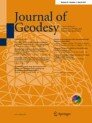
Уважаемые коллеги, доброго времени суток! Мы начинаем обзор изданий в области Компьютеры в науках о земле. Сегодня хотим вашему вниманию представить немецкое научное издание Journal of Geodesy. Журнал имеет первый квартиль, издается в Springer Verlag, его SJR за 2020 г. равен 1,78, пятилетний импакт-фактор - 4,781, печатный ISSN - 0949-7714, электронный - 1432-1394, предметные области - Компьютеры в науках о Земле, Геофизика, Геохимия и петрология. Вот так выглядит обложка:
Редактором является Юрген Куше, контактные данные - kusche@geod.uni-bonn.de, pxu@rcep.dpri.kyoto-u.ac.jp, gtoth@iag-aig.org.

Дополнительные публикационные контакты - Saritha.Anand@springernature.com, wiselin.stephil.1@springernature.com, journalpermissions@springernature.com, petra.vansteenbergen@springer.com.
Это международный журнал, посвященный изучению научных проблем геодезии и смежных междисциплинарных наук. Рецензируемые статьи публикуются по теоретическим или модельным исследованиям, а также по результатам экспериментов и интерпретаций. Помимо оригинальных исследовательских работ, журнал включает заказанные обзорные статьи по актуальным темам и специальным вопросам, вытекающим из выбранных научных симпозиумов или семинаров. Журнал охватывает весь спектр геодезической науки и сообщает о теоретических и прикладных исследованиях в таких областях исследований, как:
- позиционирование;
- опорная рамка;
- геодезические сети;
- моделирование и контроль качества;
- космическая геодезия;
- дистанционное зондирование;
- гравитационные поля-геодинамика.
Адрес издания - https://www.springer.com/journal/190
Пример статьи, название - Water vapour radiometry in geodetic very long baseline interferometry telescopes: assessed through simulations. Заголовок (Abstract) - The accuracy of geodetic Very Long Baseline Interferometry (VLBI) is affected by water vapour in the atmosphere in terms of variations in the signal propagation delay at the different stations. This “wet” delay may be estimated directly from the VLBI data, as well as from independent instruments, such as collocated microwave radiometers. Rather than having stand-alone microwave radiometers we have, through simulations, evaluated the possibility to use radiometric data from the VLBI receiver in the VGOS telescopes at the Onsala Space Observatory. The advantage is that the emission from water vapour, as sensed by the radiometer, originates from the same atmospheric volume that delays the VLBI signal from the extra-galactic object. We use simulations of the sky brightness temperature and the wet delay together with an assumption of a root-mean-square (rms) noise of the receiver of 1 K, and observations evenly spread between elevation angles of 10∘∘–90∘∘. This results in an rms error of the estimated equivalent zenith wet delay of the order of 3 mm for a one frequency algorithm, used under cloud free conditions, and 4 mm for a two frequency algorithm, used during conditions with liquid water clouds. The results exclude rainy conditions when the method does not work. These errors are reduced by a factor of 3 if the receiver error is 0.1 K meaning that the receivers’ measurements of the sky brightness temperature is the main error source. We study the impact of ground-noise pickup by using a model of an existing wideband feed. Taking the algorithm uncertainty and the ground noise pickup into account we conclude that the method presented will be useful as an independent estimate of the wet delay to assess the quality of the wet delays and linear horizontal gradients estimated from the VLBI data themselves. Keywords: Geodetic VLBI; VGOS; Microwave radiometry