Text 3
Part 18
Obstacles to our way to happiness
The only obstacle on the way to ourselves is ourselves. And this is not a philosophical statement - this is a reality, which, however, many people prefer to hide from themselves. Only we can deprive ourselves of happiness, freedom, and dreams. Not circumstances, not other people, but ourselves. Not everyone, of course, is ready to take on such responsibility, because it is much easier to say that life has not worked out, there is no strength, no talent ... etc. There can be infinitely many excuses, but in reality, there can be only one thing missing - the desire to change. We just don't want to be happy, free, and chasing our dreams. We don’t want to, because for this we need to try, change, work, and it’s much easier to live somehow like this ... when life has not worked out, there is no strength, there is no talent ..., but nothing needs to be done. It's easier to idle life away than to live it through.
Very often the easier way outweighs the way to happiness even though people seem to go for it. Most of us are looking for body comfort, not happiness. It is not surprising that there is so little happiness ... But before we talk about happiness, we should talk about what prevents us from being happy. What prevents us from even seeing the path to happiness? Or even admitting that happiness exists? And the first obstacle on this path is, of course, fear.
Part 19
Fear
Fear is a very broad topic, and to uncover it, we would need to delve deeper into psychology. Within the framework of our philosophical reflections, I do not set myself such a task. I think we should leave this to psychologists and psychotherapists. Here I would only like to touch upon a few points that are directly related to what was discussed above.
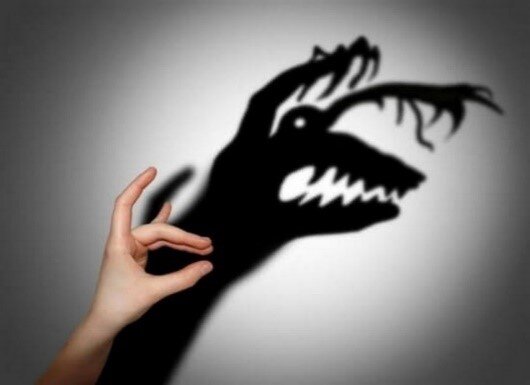
Fear is familiar to every person and sometimes it brings a lot of trouble. When exactly does it turn into a problem? What is fear and what is it for?
First of all, it should be outlined that from the point of view of psychology, fear is a negatively colored emotional process that arises as a result of real or imagined danger and serves as a signal for protection. In other words, fear is needed to keep a person's health and life in a dangerous situation. This is a basic instinct, inextricably linked with our physical body, which can suffer or die. From this point of view, fear is inherent in all living beings. Thus, many creatures are afraid of fire and extreme cold, unexpected loud sounds, flashes of light, and other signals or situations that they regard as potentially dangerous. These fears can be attributed to innate, or, in some cases, be acquired through experience, and they are necessary for normal existence. They are protective fear by nature. Here I would also like to draw your attention to the fact that most of these fears are short-lived, reversible, and arise only at the moment of immediate danger. These are kind of "animal fears", known to most living things.
Types of fears
When it comes to people, everything becomes much more complicated – as there are many other aspects. For example, there are more complex manifestations of fear, such as phobias, anxiety, and many others. I believe that a good classification of fears was proposed by the doctor of biological sciences V. Shcherbatykh. He divided fears into three groups: social, biological, existential. For example, fear of fire can be attributed to biological fears, fear of death, and other fears affecting the very existence of a person - to existential, and performance anxiety, for example, - to social fear. Many fears that fall into two or even three groups at once. Moreover, the reasons for such fears are both real and illusory. I would like to draw your attention to the illusory causes of fears because they turn fear into a problem.
During our childhood, we tend to have real fears. For instance, if a child fell and hurt himself, he becomes a little more accurate, because he is afraid to fall again. The stronger the negative experience is, the deeper the fear and unwillingness to face the problem again are. However, children fall, and more than once, and all because their fears are adequate. That is, though a child is afraid of falling and becomes more accurate, he still does not stop running. He takes risk into account, learns to avoid danger. This is precisely the direct function of fear - to allow us to adapt, gain useful experience. This kind of fear is useful - it is a necessary element of the self-preservation instinct. As we get older, fear tends to degenerate from a defense mechanism into something that prevents us from living and making the right decisions. It seems to me that this is what the well-known proverb says: “Once bitten, twice shy”. In other words, fear turns into a negative emotion. It causes unnecessary excessive anxiety and limitations. It is no longer aimed at a specific problem but becomes a problem itself. This is the point when we switch from experience into delusions. People often waste a lot of time and effort fighting such delusions.
Part 20
Illusory fears
Illusory fear usually stays with a person for a long time, and no longer has a clear cause-and-effect relationship. In other words, nobody bites you anymore, but you remain shy. For example, a well-known illusory fear is subconscious unwillingness to trust and love if you were once hurt or betrayed. Though such fears seem to have personal experience and logic they are based on, in reality, they are as irrational as being shy after being bitten once.
These fears are similar to prejudice, stereotypes, and other negative generalizations. A person creates a kind of illusion for himself, and it becomes a foundation for his fears. There are a lot of fears like that. The more you believe in your illusions, the more difficult it is to deal with them. Based on illusions, such fears lose touch with reality and cease to serve their natural purpose.
These fears become more dangerous if they are based on fears of other people or generally accepted "axioms". In simple words, imagine two people talking: “I will tell you a very scary story…. There was a black cat in a black street….”. In such a story the black cat and the black street are automatically presented as something scary, just because someone presented them like that. People usually just do not question why the black cat and the black street should be scary in the first place.
This is, of course, an oversimplified example, but in real life, everything works in the same way. For example, parents tell their child: "You should get married and have children, otherwise you will be lonely and unhappy".
On the one hand, this is the opinion of the parents, it’s a warning and they wish you all the best. Most probably, there is a negative experience behind it. On the other hand, it is just an opinion, and it’s not a fact that a person will feel lonely and unhappy without marriage. Why can’t a person live happily without a family? Time will show. However, the point is that such an opinion forced on a person can generate a painful fear of loneliness and even an inferiority complex.
Of course, all parents always teach their children and it’s absolutely fine, but I just want to point out that there is always another side of the coin. And above all, when we grow up, we should see the other side of our fears. Where do they come from?
Sometimes fears are imposed unintentionally. For example, if your beloved one says: “I am so afraid of pain,” “I am so afraid of getting fatally ill,” “I am so afraid of flying” “I am so afraid of big dogs,” etc., you might take his opinion for granted. Thus, his opinion turns into an affirmation: “There is nothing worse than pain”, “Being sick is very scary”, “Airplanes are dangerous”, “Big dogs are dangerous for people " etc. Affirmations turn to fears. Fears of flying, fears of dogs, etc.
Sometimes, it’s very hard to see what caused this or that fear. When we are asked: "Why are you afraid of this?", we just answer: "Because it is scary and dangerous".
I had a very similar experience myself. For a long time, I was afraid of pain. Gradually, this thought became more and more frightening. And I was genuinely surprised that other people were not afraid of pain. “How could it be?” – I questioned myself. At some point, I realized that this fear was not based on my personal experience. What is more: my personal experience suggests quite the opposite. I experienced pain, I went through operations and injuries. Thus, I asked myself: “What was I experiencing at that moment? Fear, panic, terror?” Not at all. Only the pain itself. Moreover, it was taken for granted: I was injured, I feel pain – this is how it should be. My conclusion was: the real pain never scared me. I was afraid of imaginary pain. The absurdity of my illusory fear is obvious, but for a long time, I could not understand its cause. In reality, it arose precisely because of the statement of my loved person. I took it for granted: "There is nothing worse than pain".
Might be pain is the worst thing for my beloved one, but not for me. My experience suggests the opposite: I am not afraid of pain. To be honest, it is very difficult to get rid of such fear, because when you accept something as an axiom, and you can no longer see anything behind it.
Similarly, I thought it was very difficult for me to take responsibility for other people, for their life and future; I was afraid of it. In reality, this fear again appeared because my beloved one said: "How difficult it is for me to carry such a weight on my shoulders, it is hard, it is scary". I took it for granted as well: “It is very difficult and scary to be responsible for others". Then I analyzed my life - I am not afraid to be responsible for myself and others. Ironically, fear and doubts arose even though my experience proved the opposite.
Part 21
Go away Fears
I would love to talk about my personal experience and show what helped me in the fight against fears. There are several important aspects to consider. First of all, you should be aware of your fear. You should ask yourself: "What am I afraid of?" and "Why am I afraid?" If the answer is "It's just scary", then that’s the heart of the matter. Sometimes, one fear follows another. For example: "I'm afraid to remain single because I don't want to be lonely". We run into the fear of loneliness. One fear provokes other fears. Thus, it’s very important to find the root of the problem. Here is another example: "I am afraid of losing my job because I cannot give the best to my children ...". There is no direct connection between the first and the second simply because “money” is not a direct equivalent to “the best”. Actually, what is “the best”? If we go deeper, we will inevitably see that everything ultimately depends on the picture of the world and understanding of "good" and "evil". What is “the best” for human beings? This is a serious question and it goes beyond this discussion.
Secondly, you should ask yourself: “Does this particular fear help to avoid what it is aimed at?” For example, my constant fear of pain did not help me to avoid pain. Life hurts sometimes, and it’s just a fact. What you should do is just be careful. If pain can be avoided, then there is no need to ask for trouble. If it is impossible to avoid paid or this avoidance leads to immoral acts, then fear is useless, but you should just be patient.
Fear is a defensive tool, and it is only relevant if it helps to defend yourself.
One should not be afraid of the inevitable, because it’s called inevitable for a reason - it cannot be avoided. Thus, as fear is aimed at preventing negative events, it’s useless when we talk about the inevitable.
For example, if an earthquake strikes, then fear is normal. It triggers certain reactions in our body, for example, an adrenaline rush. A person needs these reactions in an emergency. That is, he has more chances to react to a dangerous situation quickly and avoid death.
However, if a person is constantly scared of earthquakes, then he triggers certain reactions in his body without a reason. This is not healthy at all. Fear of death without real danger is an attempt to avoid the inevitable, fruitless, and harmful for our health. We see that the effect is the opposite – fear should help us to remain healthy, not the opposite.
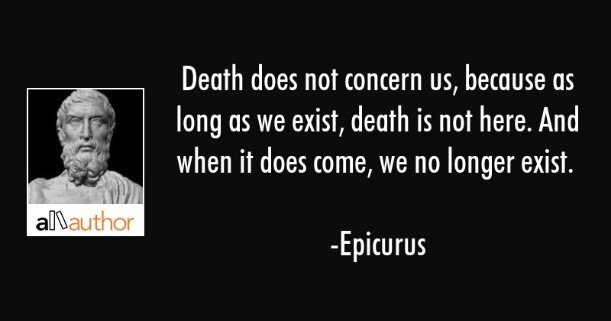
As Epicurus said: “Death does not concern us, because as long as we exist, death is not here. And when it does come, we no longer exist".
This is an absolutely wise approach. Every fear should have “physical utility”.
Thirdly, we should consider psychological utility. When our fears are reasonable, they make life easier for us, as we can avoid danger and prevent a real threat. If our fears are groundless – they make life more difficult, as they become a problem themselves and, in fact, change nothing for the better.
Part 22
Fears and awareness
There is a direct relationship between awareness and fear. The more a person understands, the less, all other things being equal, he fears. With a conscious approach, he gets rid of illusory fears and gains control over real fears. It should be pointed out that the complete absence of fears is something abnormal, endangering human life. Real fears benefit us, being part of the self-preservation mechanism, and therefore we do not need to get rid of them, it is enough to control them. For example, a rescuer trying to save a person may also experience fear, but he controls it, does not panic, and does what he should. Why does awareness help to control fears? There are many ways we can explain this.
First of all, fears, whatever they may be, are directly related to the physical body. Ultimately, it is the body that risks.
If we realize that we are much more than just a body, and our values are beyond primitive instincts, then we take control over the body.
The logic of our body is very simple: if it is dangerous - save yourself. This is how the self-preservation instinct works, and this is how it should work. However, a person should be able to control himself to make the right decisions. Otherwise, we would turn into miserable creatures who can abandon, betray, deceive, kill, and so on just to save their own lives.
Imagine billions of years of evolution aimed at creating such a miserable creature? It is possible? Of course not! Man is not like that. A man is a pillar of the Universe, a new force of evolution, and he has different values.
Our body is only a temporary tool that we can use for the benefit of developing our personality. A very important tool, but still just a tool. Our destiny is to work on our moral qualities, improve our personality, but not to spend lives pleasing our bodies. If we understand this aspect, fears automatically begin to fade, because our body is no longer the big boss. We decide what to do, not our bodies.
Secondly, understanding the scale of what is happening is vital. The development of the Universe, as well as the Being in general, has a certain trajectory. Evolution proceeds in a certain way, and the emergence of sentient beings is its new and necessary stage. Man is a part of this evolution, he does not exist in a vacuum, but is a part of this process. Man is necessary for Nature and he has his role. He is evolution itself, a fundamentally new force. His capabilities are enormous. Every person is like that, without exception, because everyone is necessary. We are all part of a single process, a single force, and this force is given to us for a reason. There are no weak people, no losers by default. Even the most complicated things are within our scope of abilities. There is no point in being afraid of failure.
We should understand that each person is a projection of the entire Universe, and he exists in unity with everything else. He is always one with the world, he is a part of the world, and the whole world is a part of him. We can say that each person is the active mind and Spirit of the Universe.
With this perception, your fears seem somehow petty and insignificant. What can the main force in the Universe be afraid of when it decides the future? The feeling of unity with the world makes us naturally psychologically healthy, and there is less and less space for fear. The focus of perception is changing. When a person feels like a tiny grain of sand, then everything is unknown to him and everything is scary. When he cognizes and sees himself as a force capable of changing the world for the better, there is no room for fear in him.
Thirdly, caring for others makes us stronger. When a person loves and cares about his loved ones, about people in general, about the world, then most of all he begins to worry not about his ego, but their well-being. You can overcome any fear for the sake of something greater than yourself. For the sake of the good and life of other people, a person can overcome not only fear but any adversity. If a person is not afraid to be a real Human, everything else is no longer scary. Love for the world, for people, for Life as a great principle, relieves fear. And this true love is achieved through knowledge and awareness. As the French poet Jean Marcenac once said: “The more I know people, the more I love my dog”, - said the fool. “The more I know people, the more I love them”, - said the dog. “The more I know, the more I love”, - said the real man".
Mindfulness
Mindfulness is a concept in modern psychology that is defined as tracking current experiences, when a person focuses on the experience of the present moment, without being involved in thoughts about events of the past or future. In other words, it is the ability to live each moment with maximum efficiency. This is a very useful skill that allows us to put away unnecessary things and concentrate on what is required at the moment. At the same time, this concept is often confused with what is called "live for the moment", although these two concepts are not the same.
Mindfulness, among other things, helps to get rid of fears. All living beings, including people, always live in the present moment. The difference between people and other living things is the ability to perceive the past, the future, and the present moment at the same time. This perception is a powerful tool, but it is important to understand that the past and the future should be viewed differently from the present.
Awareness of the past is given to us to gain experience, awareness of the future - to understand the purpose of our existence. Both of these aspects are necessary for development, but they should not interfere with actions in the present. Action is available to a person exclusively at the current moment, and at this moment his life is going on. We are always at the peak of creation, not ahead or behind it. An excessive shift in attention towards the past or the future leads to a decrease in awareness of the present and interferes with acting properly. In other words, it prevents us from consciously doing what we are doing now.
I think that every person knows the feeling when you are doing your job and thinking about something else, and thus everything goes wrong. Another example is when a person is trying to fall asleep, but endless thoughts are running through his head.
Experiences of this kind are unhealthy; they bring anxiety and create the basis for illusory fears. This happens because of the irrational attitude towards the past or the future. The past is not perceived as an experience, but as something happening at the moment. Thus, we try to live them through again although it is impossible. Of course, this is more related to negative experiences than positive ones. We try to live through the past by harming the present. We should analyze the past, but not substitute the present.
The same happens with the future: it has not come yet, and there is no need to live through it emotionally and experience it in advance. When the future becomes present, it will be completely different. I can share my example.
Once I stumbled on the stairs and injured my spine, which brought me to the operating table and then to a long recovery. If I knew about this even a few years before, I would have imagined a lot of scary things about this injury and the operation. I would have lived this future in advance, or rather, my illusion about the future. And it would seem real and scary to me. In fact, at the moment when this happened, I was not hurt badly nor scared. I was glad that I had this operation. I felt comfortable in the hospital. This experience was not traumatic at all. It was rather positive. What is more, I met my future husband at the hospital, and a year later we got married. It was a period of joy and change for the better. Illusions about the future have nothing to do with reality. The present is always different from the past and the future. The past no longer exists – we only deal with memories and attitudes. There is no future yet – only expectations and illusions.
And that is precisely why the past must remain with us in a form of experience, and the future – as a plan. We should live in the present moment. We should be aware that we are acting here and now, not yesterday and not tomorrow.
For example, it is vital to be able to relax and sleep when it’s time to relax and sleep. How can a person achieve that?
The simplest way is to focus on your real physical sensations. Use your body to stay in the present moment. Look at yourself objectively: here you are in this bed, and there is nothing else at the present moment, and this is the objective reality. Feel what your body is feeling at the moment: your head is on the pillow; your arms and legs are relaxed. There are many relaxation techniques. Use the one that suits you best. Accustom yourself to the ritual - when I go to bed I live only at the present moment. The body learns quickly enough, soon it becomes a habit.
There is another way to achieve mindfulness. Remember your destiny as a human being. Why are you here? You are here for personal development, spiritual evolution, and everything else is just an environment for this development. Remember what was written on the ring of King Solomon: "Everything will pass, and this too will pass". We can add that it will pass with benefit because evolution always goes forward and never backward. A person can simultaneously be aware of himself as a part of something larger and at the same time concentrate on the present. And this is a great power because it simultaneously embraces both eternity and the peak of creation. Man is an amazingly powerful being, capable of great things. Everyone is.
Part 23
Freedom
Fear is one of the main obstacles on your way to yourself, to happiness and freedom. Fear often stops us from following our dreams and living for the good of the world. The second obstacle is understanding freedom as such. What does it mean to be free? Is it possible to be completely free? Is it possible to take away freedom from a person? How does understanding freedom affect happiness? One philosophical article explains: “It is impossible to argue that freedom is one of the greatest values ... However, society tends to absolutize freedom. Many people and there are more and more of them every day, generally think that freedom is a complete absence of any restrictions. Freedom is confused with unrestrained willfulness and lawlessness. At the same time, the concept of "freedom" is always about physical freedom. To "incarcerate" means to be imprisoned or simply bound hand and foot. In reality, however, such associations are very superficial. True freedom has an evolutionary meaning, and it is not about being bound hand and foot.
So, let's look at the most important aspects of freedom as it is.
Firstly, the concept of "freedom" is hardly about physical freedom. The human body is extremely limited in its capabilities. Of course, we can talk about freedom within some framework; but these frames are so narrow that the conversation turns out to be very short. It is freedom when you just cannot do much physically? The restrictions are numerous. You cannot run faster than your body allows. You cannot breathe in more than your lung capacity; and at the same time, you can't help but breathe. You cannot jump higher than your muscle strength and gravity allow. You cannot fly. Perhaps you can fly by plane, but with many additional conditions. You cannot be anywhere you want. Even if you could, there are such limitations as illness or lack of money. You cannot stop growing old. You cannot take something in your hand if you do not have a hand. You cannot carve a statue out of marble if you have no talent, materials, tools. You cannot ... You cannot ... You cannot ... And apart from purely physical restrictions there are many laws and rules. For example, you cannot (you can physically, but you must not) cross the road at red lights, or enter someone else's land if the owners do not allow you. If we compare what we cannot with what we can, the advantage will not be in favor of the latter. Physically, we can do almost nothing. Our physical freedom is very, very limited initially, by definition. It depends on many factors beyond our control - that is we have almost no control over it. It certainly matters, but you cannot put it at the forefront.
Secondly, absolute freedom without any restrictions is impossible, though many strive for it and think it is something ideal. Moreover: it is unnatural since it contradicts the principles of Nature. Everything that exists, exists only as a part of the system. A complex system of the Universe, which includes many other systems. And every system is an order only when everything is in its place and interacts in the right way. Arbitrary changes in the system lead to disruptions in its functioning and death. What would happen if your liver decided to go to the place of the heart? Or if nuclear processes in the sun were changed? Or if all over the Universe things would stop working, for example, the laws of gravity?
Man is also part of the system of the world. He takes his place in it - and this is not the place that he chose for himself, but the one that is destined for him by evolution. It is determined by its evolutionary origin, structure, abilities, capabilities, etc. And most importantly - his role in the further evolution of his world and the Universe. That is his purpose. And this means that absolute freedom is not only impossible for him, but he does not need it either. And if you think about what exactly people put into the concept of "absolute freedom" or "complete freedom", then it becomes clear that most often they mean the ability to freely implement their desires. That is, the meaning of the great struggle for human freedom, turns out to be as primitive as it can be: that no one interferes with fulfilling your wishes. It is not even an animal level, but below. After all, animals take their place in the system of Nature, and what they want turns out to be exactly what Nature needs. Man, however, often wants bad things, bad for Nature, for the world, and the man himself. Freedom is freedom - but it does not justify evil. That is, no action is right and good just because someone had the freedom to do so. And when we act badly, then we cease to be an organic part of Nature, as if we fall out of its system. And it needs us. We (humans and other conscious beings in general) play a key role in evolution.
Therefore, our task is not to gain as much freedom as possible but to understand our role, our mission, and learn to follow it. That is, in essence, in learning to be ourselves. However, “being ourselves”, contrary to popular belief, does not mean at all to be able to freely fulfill all our desires. Quite the opposite: the ability to refuse them is a huge part of true freedom.
Part 24
Thirdly, the main manifestation of freedom available to us is freedom of choice. This is precisely its essence. Because this is what has an evolutionary meaning ... And it is always there. There is always a choice. In reality, man only chooses himself; no one can force him to make this or that choice. Some people can argue with this statement, pointing out that a person can be pressured, even tortured, and thus deprived of free choice. But I will answer: not at all. He always has a choice - to obey or not, endure or surrender, die or buy life at the price of what he is forced to do. Such a choice, to put it mildly, is not the most pleasant - but it is still a choice. If someone is threatened with death, then he chooses between life and his principles, decides what is more important for him. He chooses himself. Because although his body is under threat, no one but him has power over his will. And there were people, and quite a few, who chose principles in such a situation. They died, but they remained free. They remained truly free, and it had nothing to do with bodily freedom, which can hardly be called freedom. It’s very important to point out: you can try to force a person, but he cannot be truly forced. He surrenders only if he allows himself to surrender. Why is that? Because in reality, we are much stronger than we think. After all, man, like any sentient being, is the driving force of evolution. And this is connected with the freedom of choice. It would be strange if, given such a mission, such opportunities, and such responsibility, we did not receive enough strength to carry out this. The reserve of strength, due to the unity with the Universe, is practically inexhaustible. However, some people do not know this, some do not believe in their strengths, and others do not want to use them, looking for easy ways. Well: in the end, everyone is free to choose, and he decides for himself whether to use his power or not.
Let’s have a look at the following example. For instance, let’s imagine a slave. It would seem that a slave has neither freedom nor choice. But he does. He can obey. He can commit suicide. He can try to run away. He can rebel and fight. He may simply refuse to obey - and see what happens. In short, he has a choice. Even if you are sitting in a casemate without windows, and your arms and legs are chained. Physical conditions do not matter. As long as you have at least two options to choose from, you are a free person. And options, as already mentioned, are always there. This aspect of freedom - freedom of choice, free will - is the most important. It is at the heart of this concept. All other forms and manifestations of freedom are just its derivatives. Real freedom has an evolutionary meaning. Humans, along with other sentient beings, are carriers and implementors of freedom. It is vital to understand the following: it is impossible to take away freedom from a person. The real one. Ephemeral freedom of the body is out of this concept. If you were thrown into a dungeon, then this is your body's problem, not yours. You remain to be free because no one has power over your will except you ...
There is a beautiful illustration of this idea in a story: "The Lord of the Seven Lands asks Teacher Ilan to stay in the palace and talk with him, but Ilan does not agree. Attempts to force Ilan lead nowhere. “The Lord said: “It is not easy for me to ask you. You are not afraid of torture or death, and I cannot force you, but I don’t want to let you go. Buy yourself freedom: talk to me for a few days, and I will let you go. If you refuse, you will have to stay in the dungeon for ages. Do not be afraid of deception, for the ruler of Seven Lands will not deceive you". Ilan answered: “I am not afraid of deception, because I already know you well enough. I need freedom, but it has no price, and I cannot buy it from you. And the freedom that I have within me is enough for me to live: after all, I have the expanses of heaven within me. May I stay here as you said". Then the Lord thought for a long time and sat in silence. Then he said: “If so, then I let you go. I am cruel when there is a reason; but only a fool, a coward, or a madman is cruel for no reason”. (Fathers III, 34-44).
Ilan's body could have remained in the dungeon, but that was not the major factor for him. He had the expanses of heaven within him and he could feel it. He was free internally, even as a prisoner. He could continue to live a full inner life. Therefore, he could not be intimidated and forced by threatening with imprisonment. Internal freedom cannot be deprived. The Lord himself did not experience such a thing, but he saw a person who feels and lives like this in front of him. The Lord realized that he was powerless to oppose something to him.
Each person is internally free. There is even more than the expanses of heaven within us, - there is the entire Universe within us. This is a fact of life. The only problem people have, - they don’t know about this freedom and thus can’t use it. But if you know about this freedom, if you feel it, then you are truly free, and you cannot be forced to do anything or be imprisoned. Who can imprison the Universe?
Fourthly, another important manifestation of freedom is the right to restrict oneself. And only a person himself can do it. The ability to set limits for oneself is the realization of freedom in practice. After all, there can be no absolute freedom. We are limited anyway. And apart from what does not depend on us physically, then we decide what is possible and what is not.
A person obeys laws, customs, traditions, rules. However, he does this because he believes that it will be right, or that it will be better for himself. And a person who disagrees violates all these restrictions. He may be shown unpleasant alternatives - breaking the law will lead to prison, breaking custom will cause condemnation, and so on - but he cannot be forced to obey.
This is a principle that is formulated as follows: freedom is not the absence of restrictions, but the ability to set limits for oneself. And this opportunity is always there. It is realized most often as if by itself. In the sense that we usually are not aware of our choices and our decisions. These or those schemes are implemented, embedded in us through education, habits, and society. We make decisions without emphasizing them for ourselves. We simply agree to what we have been taught to and what is accepted by our environment. This is also a choice - but imperceptible for a person himself. He refers to this according to the principle “It cannot be otherwise and if it can, not for me". Only when something changes significantly for a person, then he begins to revise the realities of his life. He realizes that he has a choice between what is and what can be. This is how it becomes a conscious choice. And if earlier the boundaries were set “by default”, and he only reacted to them, now he begins to evaluate them. He asks himself: “Where did they come from?”, “What is their meaning?”, “What would happen if it was different?”, “Do I agree?”. And if he finds them wrong or meaningless, then he denies these boundaries for himself and accepts new ones.
It happens, because a person cannot live without boundaries. All worldviews imply that there is something that you cannot do because you should not. There is a line that you will not cross. More precisely, there is a set of such lines that is related to different aspects of life. This is normal and this is how it should be. And all adequate people have such restraints…. So, everyone sets limits for themselves. Usually, these limits are not invented from a scratch. Usually, a person chooses them from the already known options, somehow justifying them for himself. For example, to lie or not to lie? Most people lie; at the same time, everyone knows that lying is bad. A person asks himself: “What are my reasons for not lying? Why shouldn't I personally do this?” And so on. Man creates limits for himself, limiting his freedom. Or he accepts the restrictions, so to speak, in a package, accepting a religion or other worldview.
The important conclusion is that, firstly, it is impossible to live in complete permissiveness (it simply will not work), and, secondly, we set the limits ourselves, formulating them individually or taking them systemically. This is what a choice means - and it is always free. Someone can offer you something, but not force you. This is the crux of the matter: we exercise freedom of choice by limiting our freedom of action. This is one of the most essential aspects of freedom. It includes its limitation. And who, in principle, does not want to restrict himself in anything, fearing to lose his freedom, he has already lost it because he deprives himself of the opportunity to choose favor of restrictions. This is not allowed for him, and thus he is not free.
These are the main aspects of freedom. They are like the roots from which everything else grows. Of course, this is only a sketch, in the most general terms. However, what has been said is quite enough to understand the approach of the Teaching to such an important concept as freedom. Important not only for humans but also for the Universe, for its evolution and life. It is impossible to overestimate the importance of freedom. But it must be understood correctly. Otherwise, the greatest value can turn into the greatest illusion and the greatest disappointment. I will end with one more quote from the pandect: “Freedom is not lost, but only gained - this is its great property” (Eosphor I, 13).
Part 25
I know how to be happy
Understanding of freedom is directly connected to the feeling of happiness. If a person does not feel his inner freedom and focuses exclusively on his body, then he will rather feel bounded than free, and can hardly be truly happy. Happiness is found when a person lives in harmony with the world, and this implies freedom of choice towards the right, and the right is the best for us.
If a person lives for the good of the world, then he lives for the good of himself. Only in this way, the whole mechanism works correctly, and a person finds himself in the best conditions for himself, for his self-realization, for his future. This is how he lives freely in the best possible way for him. When we see our freedom and can get rid of our fears, we can finally do what we should do consciously. We are free, and we are no longer afraid to follow our dream and live for the good of the world. This is true happiness. We can not be happy on our own. A person is truly happy only and when he is happy with the happiness of the world.
I would like to emphasize once again that our life is determined by the place we occupy in the world. And we exist to be good for the world, and it cannot be otherwise. At a certain stage in life, we get to know ourselves, choose the path for ourselves, determine who we are and why we are in this world. And when we find ourselves, our true selves, the way we should be, a new stage opens for us: we want to do something for this world, because we see ourselves in this world, in every part of it, in every person. This is our freedom, and our happiness, and our future.
Bon Voyage!