Purified water was converted into metal for a few fleeting seconds in a mind-blowing experiment, allowing the liquid to conduct electricity.
Because unfiltered water contains salts, it can already conduct electricity, allowing negatively charged electrons to easily move between its molecules, according to a statement announcing the new study. Purified water, on the other hand, includes just water molecules, which have their outermost electrons linked to their designated atoms and hence cannot travel freely through the water.
In theory, pure water molecules would squeeze together and their valence shells, the outermost ring of electrons encircling each atom, would overlap if enough pressure was applied. This would allow electrons to freely travel between each molecule, effectively transforming water into a metal.
The difficulty is that it would take 15 million atmospheres of pressure (approximately 220 million psi) to squish water into this metallic form, according to research author Pavel Jungwirth, a physical chemist at the Czech Academy of Sciences in Prague. According to Nature News, geophysicists believe that such water-turned-metal may occur in the cores of massive planets like Jupiter, Neptune, and Uranus.
However, Jungwirth and his colleagues questioned if there was a way to transform water into metal without causing the insane pressures seen in Jupiter's core. They chose alkali metals, which have only one electron in their valence shells and comprise elements like salt and potassium. When forming chemical connections, alkali metals "give" this electron to other atoms because the "loss" of that lone electron makes the alkali metal more stable.
According to Cosmos Magazine, alkali metals can explode when exposed to water, and Jungwirth and his colleagues have previously researched these violent reactions. They hypothesized, however, that if they could escape the explosion, they could borrow electrons from alkali metals and use them to transform water metallic.
The scientists did just that in their latest experiment, which was published in the journal Nature on Wednesday (July 28). They used a syringe loaded with sodium and potassium in a vacuum chamber to squeeze out minute droplets of the metals, which are liquid at ambient temperature, and then exposed the metal droplets to a very small amount of water vapor. The water developed a 0.000003 inch (0.1 micron) film over the metal droplets' surface, and electrons from the metals began to flow into the water almost instantly.
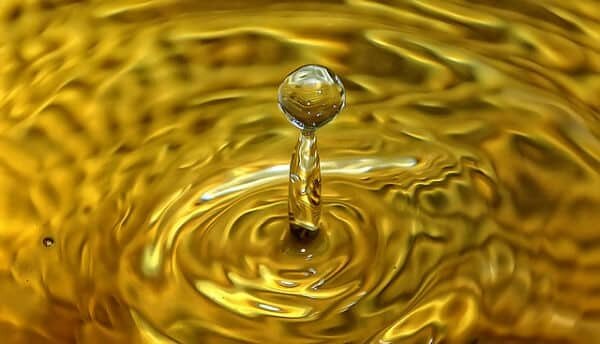
According to Jungwirth, the electrons had to flow faster than an explosive reaction could occur for the experiment to function. When the electrons jumped from the alkali metals to the water, something amazing happened: the water turned a gleaming golden yellow color for a few moments. The scientists used spectroscopy to prove that the brilliant yellow water was actually metallic.
In a statement, study author Robert Seidel, head of the Young Investigator Group at Humboldt University of Berlin, said, "Our study not only shows that metallic water can indeed be produced on Earth, but also characterizes the spectroscopic properties associated with its beautiful golden metallic luster." "With the naked eye, you can see the phase transition to metallic water," he continued.
Jungwirth told Nature News & Comment, "It was incredible, like [discovering] a new element."