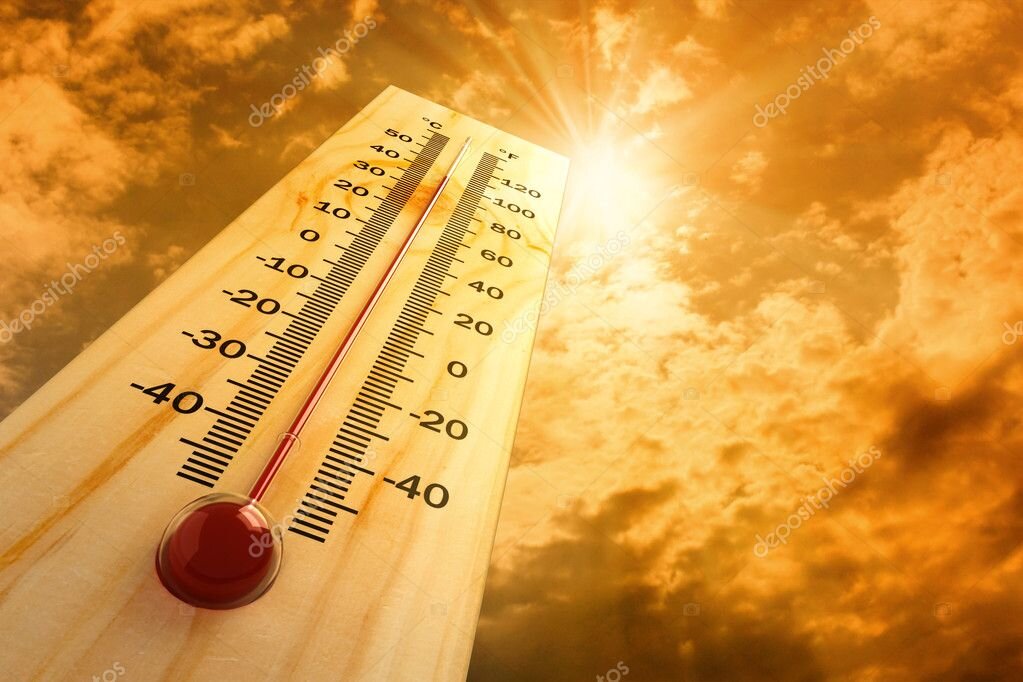
Extreme heat is becoming more of a health danger as global temperatures rise as a result of climate change. The human body is tough, but it only has so much stamina. So, what is the maximum temperature that people can withstand?
According to a 2020 study published in the journal Science Advances, the answer is simple: a wet-bulb temperature of 95 degrees Fahrenheit (35 degrees Celsius). The air temperature given by your local forecaster or favorite weather app is not the same as the wet-bulb temperature. A thermometer draped in a water-soaked cloth is used to measure a wet-bulb temperature, which takes into account both heat and humidity. The latter is significant since more water in the air makes it more difficult for perspiration to evaporate and cool a person down.
According to Colin Raymond, a postdoctoral researcher at NASA's Jet Propulsion Laboratory who studies intense heat, if the humidity is low but the temperature is high, or vice versa, the wet-bulb temperature will not approach the human body's tipping point. However, when the humidity and temperature are both extremely high, the wet-bulb temperature can rise to dangerously high levels. When the air temperature is 115 degrees Fahrenheit (46.1 degrees Celsius) and the relative humidity is 30%, the wet-bulb temperature is only about 87 degrees Fahrenheit (30.5 C). When the air temperature is 102 degrees Fahrenheit (38.9 degrees Celsius) and the relative humidity is 77 percent, the wet-bulb temperature is around 95 degrees Fahrenheit (35 C).
People can't survive in extreme heat and humidity because they can't control their internal temperature. "You can still sweat if the wet-bulb temperature climbs beyond the human body temperature," Raymond told Live Science, "but you won't be able to cool your body to the degree that it requires to operate physiologically."
The body becomes hyperthermic at this point, with a temperature of over 104 degrees Fahrenheit (40 C). According to the National Institutes of Health, this can cause symptoms such as a quick pulse, a change in mental status, a lack of perspiration, faintness, and coma.
A wet-bulb temperature of 95 degrees Fahrenheit, on the other hand, will not kill you right away; Raymond estimates that it will take around 3 hours for the heat to be unbearable. According to him, there's no way to tell for sure how long it took, although studies have tried to estimate it by submerging human participants in hot water tanks and removing them when their body temperatures became dangerously high. There's also no way to establish that 95 F is the exact unsurvivable wet-bulb temperature; Raymond estimates that the true value is somewhere between 93.2 and 97.7 F. (34 C to 36.5 C).
Although no one can survive a wet-bulb temperature of more than 95 degrees Fahrenheit, lesser temperatures can be fatal as well. It is easy to overheat when you exercise or are exposed to direct sunshine. Heat is easier to kill older individuals, those with specific health problems, such as obesity, and people who use antipsychotics because they can't control their temperature as effectively. This is why humans can die under heat that does not reach 95 degrees Fahrenheit on a wet-bulb thermometer.
Air conditioning, thankfully, may save individuals from the oppressive heat. However, not everyone has access to it, and even in areas where a large number of people have air conditioning, the electrical grid may be unstable, according to Raymond.
According to the Science Advances research, just a few sites have ever reached a wet-bulb temperature of 95 degrees Fahrenheit. The Indus River Valley in central and northern Pakistan, as well as the Persian Gulf's southern shore, have been hotspots since the late 1980s and 1990s. "There are locations where these circumstances are already being felt for an hour or two," Raymond added. "And as the world warms, that will only become more common." Northwest Mexico, northern India, Southeast Asia, and West Africa are among the areas at danger of these temperatures in the next 30 to 50 years, he noted.
"Unfortunately, even if we stopped generating greenhouse gases today, we'd still warm up a lot because of the climate change that's already happened," Raymond added. "I believe the areas I named will be dealing with this issue for the foreseeable future, and I hope that no additional places be added to that list."