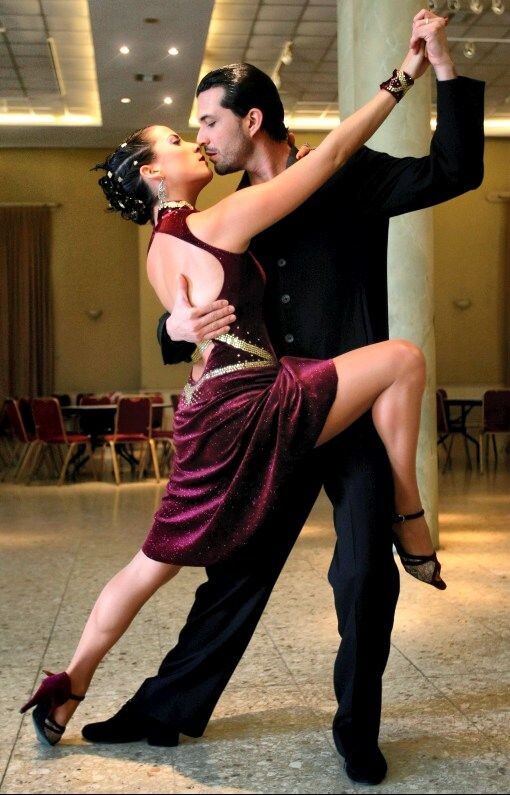
Sometimes salsa dance is called "social". This means that he originated not in the drawing rooms of the Creole aristocracy, but in the squares of Puerto Rico and Buenos Aires, in other words, his “folk” movements that do not require comprehending the secrets of “high” choreograph.
At the same time salsa is an aristocratic dance, a champion of street sophistication, a combination of overflowing emotions and expressive dynamics of partners' bodies (salsa is danced not only in pairs, but also in groups).
Salsa is a dance , passion, algebra and body poetry
Salsa is a dance of alternating fast and slow steps in four counts, and on the count of “four” they transfer weight to the other leg, freeze in a pause, throw the foot out or hit it on the floor. { {1}}
Due to the variety of styles, even choreographers disagree on whose dance is salsa. "London" salsa differs from "New York" - Londoners, like dancers in Los Angeles, begin to enter the shock count of "one", New York, Puerto Rico, Cuba - on the score of "two", in Colombia, Venezuela dance both "one" and "two", and change the rhythm, according to the introduction of new dance steps, within the same dance.
Salsa is one of the few dances that allow syncopation, otherwise in other words, completing the interrupted rhythm at the peak of the movement's difficulty until the next beat count.
Choosing your favorite style of salsa
The above about the technique of salsa is clearly demonstrated by video tutorials for beginners. Salsa is a dance, manuals on the technique of which you can find on different resources, obviously differing from each other.It's not about the unscrupulousness of the authors of the content, but about the variety of salsa - a dance in which every nation, having adopted it in their culture, has put a piece of their own soul and tradition.
Cuban Salsa
Cuban salsa is a dance, as we have already noted, related to the style of circular salsa. You can start it both on the first and on the second count (accompanied, as a rule, by vigorous shaking of percussion), partners almost all the time move in a circle, only sometimes performing linear movements, partially borrowed from the rumba.
{{1} } On the count of 4 and 8 in Cuban salsa, a tep is performed - a short fight in the floor with a toe or heel. Performed in a 4/4 rhythm, Cuban salsa is considered the most difficult in terms of rhythm and acceleration of the tempo.
Dominican salsa
Dominican salsa, which is especially popular in Europe, is an outlet for any counting, changing the count of the basic step within the dance, circular dribbling of the partner by a partner who is not obliged to strictly follow the rules, but can freely improvise.
Colombian salsa
Colombian salsa (learning salsa in this technique is also very popular) - going to count 1 or 2, changing the score (due to the fact that the Colombian technique includes unique steps). The main difference (and dignity, from the point of view of a number of dance masters, Colombian salsa is a bold combination of linear and circular movements), as well as the presence of footwork - elements that sometimes border on acrobatics in complexity.