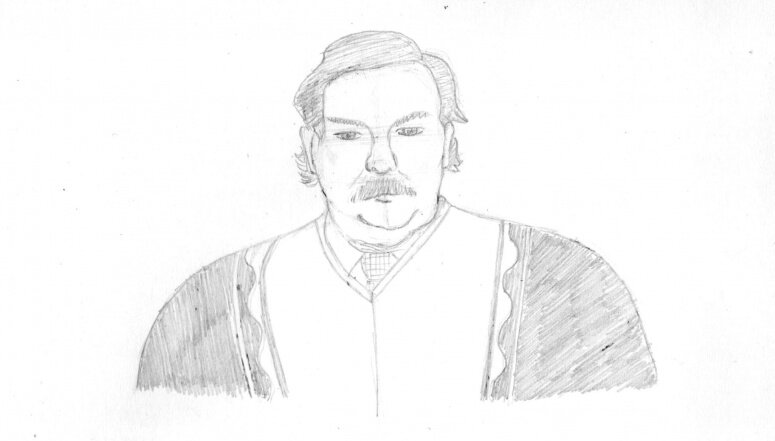
Chapter One. The Boy Who Lived.
Part 2 of 4 "Mr Dursley is at work": from “Mr Dursley always sat with his back to the window…” to “He was still determined not to mention anything to his wife.”
1. Find the English equivalent for:
1. от них ему стало не по себе, 2. эти люди, 3. резко остановился / замер, 4. если подумать, 5. Ему было труднее, 6. споткнулся, 7. Он совсем не казался расстроенным, 8. Он был потрясен, 9. отправился домой, 10. бросила на него суровый взгляд, 11. взять себя в руки, 12. полон решимости
2. Use the word combinations from exercise one to fill in each gap.
1. Mike made a bad joke and his teacher… . 2. Hold on, … , you are the only one who got the benefit of it. 3. He’d been through a lot that week and then he learned his sister had died, … , to put it mildly. 4…. , you must get on with your work! 5. I don’t wear cloaks, I don’t hold with such nonsense, I don’t mix with … . 6. We’ve been staying with my grandma for a long time, so now we should … . 7. Although she was … not to cry she couldn’t help bursting into tears at the sight of it. 8. My grandmother … to climb the stairs to the fifth floor. 9. He walked gazing at weirdos and suddenly … . 10. Those owls were very peculiar, … . 11. Though his secret was discovered … . 12. We all … and looked at it.
3. Express the same ideas changing the italicized words with the phrases from exercise one.
1. He dashed after the dog but suddenly stepped awkwardly and fell down. 2. The clock suddenly ceased to move and stayed still at five o’clock. 3. Mary had made a firm decision not to scold her son. 4. If you think about it carefully , music is a really strange thing. 5. Listen to me, you should calm down and stop crying. 6. After climbing the mountain Henry felt that it was difficult for him even to walk. 7. None of these people could bounce the ball properly. 8. They packed, put their stuff in the car and started their journey. 9. Being alone in that big house gives me the creeps . 10. She seemed nervous . 11. Mary looked at him with disapproval . 12. Alice felt unhappy and worried because of her cat having died.
4. Find the English equivalent for:
средь бела дня; в ночное время; накричал на пятерых разных людей; в очень хорошем настроении; купить себе булочку в пекарне напротив; сердито посмотрел на них; оглянулся на шепчущихся; сказать что-то им; передумал; поспешил; рявкнул своему секретарю; нет никакого смысла волновать миссис Дурсль; при любом упоминании; сосредоточиться на дрелях; в тот день; в пять часов; врезался прямо в кого-то; не расстроился из-за того, что чуть не упал от удара на землю; писклявым голосом; обнял за талию; ушёл; не одобрял воображение; подъехал к дому номер четыре.
Note the using of prepositions in phrases "no point in" and "the point of":
What’s the point of working if you don’t need money?
There’s no point in working if you don’t need money.
Fill in prepositions (particles, adverbs) where necessary.
1. She had a tantrum ... any mention ... him. 2. You never said ... me nothing personal. 3. ‘Don’t kill me, Ivanushka. You could use me later’, said the mouse ... a squeaky voice. 4. We’d better hurry … or else we miss our bus. 5. Charlotte heard her neighbour yelling … his daughter. 6. There is no point … our lessons if you don’t do your homework. 7. The ambulance was pulling … the driveway … five minutes after we called for it. 8. The man was ... to hug Mr Dursley ... the middle, but thought better ... it. 9. John looked back ... Sarah, she eyed him … scorn. 10. … that afternoon he got very upset ... his son setting ... home. 11. ... the morning she was ... a good mood, but … two o’clock her boss snapped ... her very angrily so she got very upset. 12. My mom will never approve ... being outdoors ... night-time. 13. It was ... broad daylight, a teenager came … ... me, knocked me ... the ground and fastly walked … ! 14. I am so clumsy. The other day I wanted to buy some milk ... the corner shop opposite, while I was walking there, deep in my thoughts, I walked right ... a passer-by. 15. We should concentrate ... reading. 16. We were happy to set off … our journey.
5. Find the English equivalent for:
с открытыми ртами, над головой, в ночное время, свободное от сов, прохожий.
When do we use hyphen in compound words? You could check this and this for information.
Should we use hyphens in these compound words? Please, check the spelling in a dictionary.
dog()friendly café, car()wash, book()store, the owl()free morning, the singer is well()known, ten()year()old()boy, beautiful()looking flowers, grand()father, open()mouthed, wind()powered generator, meat()fed cats, note()book, fire()man, your make()up is good, he is not well()respected, blue()berry, well()known singer, tea()spoon, living()room, thirteenth()century politics, a get()up, client()centred counseling, at night()time, same()sex children, a passer()by, over()head
Classify the words above into groups: 1) compound nouns with hyphen, 2) compound nouns formed with prepositions and particles, 3) compounds formed with present participle with hyphen, 4) compounds formed with past participle with hyphen, 5) compounds formed with nouns, adjectives and adverbs with hyphen, 6) compound words without hyphen written as one word, 7) “compounds” written as separated words.
6. Find in the text the English equivalents of these sentences:
Он оглянулся на шепчущихся, как будто хотел что-то им сказать, но передумал.
Он почти закончил набирать свой домашний номер, когда передумал.
What are the meanings of “to think better of it” and “to change your mind”? Are those idioms interchangeable in those sentences from the novel?
change (one's) mind - to change one's original opinion, choice, or plan. Politicians get criticized for flip-flopping, but I think we should value the ability to change one's mind on an issue. I guess he changed his mind and decided to go to the beach instead. (change one's mind. (n.d.) Farlex Dictionary of Idioms. (2015). Retrieved March 13 2021 from https://idioms.thefreedictionary.com/change+one%27s+mind )
think better of it/(something) - to decide against doing something because one realizes it is not a good idea. I was going to try to steal the other team's mascot costume, but I thought better of it when I saw the security guard at the entrance. I'm glad you thought better of dying your hair white. It would not have been a good look for you. (think better of. (n.d.) Farlex Dictionary of Idioms. (2015). Retrieved March 13 2021 from https://idioms.thefreedictionary.com/think+better+of )
These are some more examples.
- It would be a terrible blow to us all if you were to leave us. My dear boy, think better of it - stop where you are. (C. Reid. A Child of Mary).
- “Oh no, no, Mr. Grimes. I couldn’t marry any one in such a hurry, and I don’t wish to marry at all; and I won’t, indeed I won’t”... “Well then, if you won’t you needn’t,” the farmer called after her; “But you’ll think better of it , I know.” (Mind Your Own Business from The Boy’s Own Annual, Vol. I, London, 1879).
- No; if you persist in this cruel treatment of two unoffending persons, I will myself protect her, and assist her in accomplishing the union she desires; but I entreat you, uncle, to think better of it , and to give yourself a sweeter peace than you have ever known, perhaps - in making this dear Lilias happy… (The Hairs of Randolph Abby from The Dublin University Magazine, Vol. XL, Dublin, 1852)
- Yes; - you refused him. But he hopes that perhaps you may think better of it … If you can make up your mind to like him you will please all your family. (A. Trollope. The American Senator)
- “It is not in my power to delay my journey for one day!”... “There is no persuading you to change your mind, Brandon, I know of old,” said sir John, “when once you are determined on anything. But, however, I hope you will think better of it . Consider - here are two Miss Careys come over from Newton, the three Miss Dashwoods walked up from the cottage, and Mr. Willoughby got up two hours before his usual time, on purpose to go to Whitwell” (J.Austen. Sense and Sensibility)
- “Remember that you entreated me to take you away to live with me […] and now […] you [...] tell me that you cannot fulfil your part of the proposition.” “Very true, Mr. Tresillian; but you see I also have had five years to deliberate, and I have thought better of it …” (Lady Wood. Sabina)
- Don’t talk nonsense, Tom. I don’t ask you to change your mind ; it is I who come round to your way of thinking. (A. Calthrop. A Match Maker, from Home Chimes, Vol. II, London, 1885)
- “You can change your mind a dozen times ; it is perfectly orthodox in your sex.” (E. Bassett Washington. Found Faithful, from Potter’s American Monthly, Vol.XIV, No. 97, 1880)
- “I hope you have changed your mind a little since we last met.”(M. Oliphant. The Perpetual Curate.)
- However, if you are all to be there [...] I believe I must change my mind and go. (A. Lothrop. Speculation; or, the Glen Luna Family.)
Which of these idioms is/are appropriate in the examples below.
1. ..., young man, while there's still time. 2. We wanted to go sailing but ... because there was a hurricane on the way. 3. I wanted to buy a watch for $15,000, but then ... as I needed to pay my debts. 4. I was intended to specialize in philosophy but then I ... and took up psychology.
7. What is the difference between the verbs eye , gaze , stare ?
eye - to look at someone or something with interest. I could see her eyeing my lunch. (Definition of eye from the Cambridge Advanced Learner's Dictionary & Thesaurus © Cambridge University Press)
gaze - to look at something or someone for a long time, especially in surprise or admiration, or because you are thinking about something else. He spends hours gazing out of the window when he should be working. (Definition of gaze from the Cambridge Advanced Learner's Dictionary & Thesaurus © Cambridge University Press)
stare - to look for a long time with the eyes wide open, especially when surprised, frightened, or thinking. Don't stare at people like that, it's rude. (Definition of stare from the Cambridge Advanced Learner's Dictionary & Thesaurus © Cambridge University Press)
Choose one of those verbs:
1. He stopped ... at people in peculiar get-ups when his mother told him that it’s not polite. 2. We ... the procession with interest. 3. She was standing at the window ... thoughtfully at the clouds while her father was telling how he’d spent his day. 4. Don’t ... at me as if I have horns on my head growing. 5. She fussed trying to pick up all the toys from the floor and didn’t notice us ... her actions in amusement. 6. Mary stood in the museum, deep in her thoughts, ... at a terrible picture.
8. What is the difference between the verbs dash and rush ?
dash - to go somewhere quickly. The dog ran off, and she dashed after him. (Definition of dash from the Cambridge Advanced Learner's Dictionary & Thesaurus © Cambridge University Press)
rush - to (cause to) go or do something very quickly. I've been rushing (about/around) all day trying to get everything done. I rushed up the stairs/to the office/to find a phone. When she turned it upside down the water rushed out. (Definition of rush from the Cambridge Advanced Learner's Dictionary & Thesaurus © Cambridge University Press)
Choose the verb; in which cases both verbs are acceptable?
1. She saw a bus about to leave and ... across the street. 2. We saw a dog ... after a squirrel. 3. My essay is due tomorrow morning and I’m not even close to finishing, I need to … ! 4. They really ... my son to sign the papers.
9. Translate into English.
1. Он чувствовал себя неловко, потому что знал, что его дочь может закатить истерику прямо в магазине. 2. Мне нравится быть с народом, я человеколюбивый. 3. Мистер Дурсль увидел рыжевато-коричневую сову и замер, глядя на нее с открытым ртом. 4. Если подумать, совы, порхающие над головой средь бела дня, не являются большой проблемой. 5. В пять часов я обнял бабушку за талию, и мы отправились домой. 6. Нет смысла волноваться, скорая уже подъезжает к дому. 7. Секретарша сидела неподвижно, уставившись на телефон, когда вошел ее босс и рявкнул, чтобы она продолжала работать. 8. Он был потрясен, но постарался взять себя в руки и поспешил с работой. 9. Он бросился за автобусом, но споткнулся и упал. 10. К Джону подошел человек, крикнул ему что-то о рептильных пришельцах, ударил его кулаком в лицо, повалил на землю и ушел, а прохожие делали вид, что ничего не замечают. 11. Диана хотела покинуть свой дом, но потом передумала, так как ее мать вряд ли одобрила бы это, а отец очень расстроился бы из-за этого. 12. Она вряд ли одобрит пребывание на улице в ночное время. 13. Ей стало труднее быть в хорошем настроении с тех пор, как ее любимая булочная напротив закрылась, и она не может купить там свои любимые булочки. 14. Он перестал пялиться на людей в странных нарядах, когда мать сказала ему, что это невежливо. 15. Они не казались расстроенными тем, что потерялись в новом городе. 16. Она одарила меня таким взглядом, что я почувствовал себя вдохновленным. 17. В тот день он был полон решимости рассказать обо всем родителям, но после того, как мать накричала на него за то, что он пролил молоко, он передумал. 18. Как им удалось переубедить тебя в этом вопросе? Ты был так тверд и полон решимости не приходить? 19. К чему ты клонишь? Может, тебе не стоит торопиться? Вы соберете информацию и, возможно, передумаете.
Key.
1.
1. they made him uneasy, 2. this lot, 3. stopped dead, 4. come to think of it, 5. He found it harder, 6. stumbled, 7. He didn’t seem at all upset, 8. He was rattled, 9. set off home, 10. gave him a stern look, 11. pull himself together, 12. determined
2.
1. gave him a stern look, 2. come to think of it, 3. he was rattled, 4. Pull yourself together, 5. this lot, 6. set off home, 7. determined, 8. found it harder, 9. stumbled, 10. they made me uneasy, 11. he didn’t seem at all upset at it, 12. stopped dead
3.
1. stumbled, 2. stopped dead, 3. was determined, 4. Come to think of it, 5. pull yourself together, 6. found it harder, 7. this lot, 8. set off on, 9. makes me uneasy, 10. rattled, 11. gave him a stern look, 12. was upset at/about/by
4.
1. at … of, 2. to, 3. in, 4. up, 5. at, 6. in, 7. into… in, 8. about… around … of, 9. at … with, 10. none… at/ about/ by … off, 11. in … in … at … at, 12. of … at, 13. in… up to … to … off/ away, 14. from … into, 15. on, 16. on
6.
1. Think better of it / Change your mind, 2. thought better of it / changed our mind, 3. thought better of it / changed my mind, 4. changed my mind
7.
1. staring, 2. eyed, 3. gazing, 4. stare, 5. eyeing / eying (US), 6. gazing
8.
1. dashed / rushed, 2. dash(ing) / rush(ing), 3. rush, 4. rushed.
9.
1. He felt uneasy because he knew that his daughter might throw a tantrum right in the shop. 2. I like to be around a lot, I’m a people person. 3. Mr. Dursley saw a tawny owl and stopped dead eyeing it open-mouthed. 4. Come to think of it, owls fluttering overhead in broad daylight are not a big problem. 5. At five o’clock I hugged my granny around the middle and we set off home. 6. There’s no point in worrying, the ambulance is already pulling into the driveway. 7. The secretary was sitting still gazing at the telephone when her boss came in and snapped at her to get on with her work. 8. He was rattled, but tried to pull himself together and rushed his work. 9. He dashed after the bus but stumbled and fell. 10. A man came up to John, yelled at him something about reptilian aliens, punched him in his face, knocked him to the ground and walked off while passers-by were pretending not to notice anything. 11. Diana wanted to leave her home but then thought better of it, as her mother would hardly approve of it and her father would get very upset at it. 12. She will hardly approve of being outdoors at night-time. 13. She has been finding it harder to be in a good mood since her favourite baker’s opposite was closed so she can’t buy her favourite buns from it. 14. He stopped staring at people in peculiar get-ups when his mother told him that it’s not polite. 15. They didn’t seem upset at having lost in a new town. 16. She gave me (such) a look (that) I felt inspired. 17. That afternoon he was determined to tell everything to his parents but after his mother yelled at him for spilling milk he changed his mind. 18. How did they manage to change your mind on this subject? You were so firm and determined not to come? 19. What are you getting at? Maybe you shouldn’t rush. You will collect information and may think better of it.
Vocabulary notes
(definitions and examples are from the Cambridge Dictionary © Cambridge University Press 2021, URL: https://dictionary.cambridge.org/ )
swoop - to move very quickly and easily through the air, especially down from a high position in order to attack. The eagle swooped down to snatch a young rabbit. (Definition of swoop from the Cambridge Advanced Learner's Dictionary & Thesaurus © Cambridge University Press)
gaze - to look at something or someone for a long time, especially in surprise or admiration, or because you are thinking about something else. He spends hours gazing out of the window when he should be working. (Definition of gaze from the Cambridge Advanced Learner's Dictionary & Thesaurus © Cambridge University Press)
speed (sped, sped / speeded, speeded) - to (cause to) move, go, or happen fast. This year is speeding by/past. (Definition of speed from the Cambridge Advanced Learner's Dictionary & Thesaurus © Cambridge University Press)
opposite - facing the speaker or stated person or thing. If you want to buy tickets, you need to go to the counter opposite. Who owns that house opposite (= on the other side of the road)? (Definition of opposite from the Cambridge Advanced Learner's Dictionary & Thesaurus © Cambridge University Press)
eye - to look at someone or something with interest. I could see her eyeing my lunch. (Definition of eye from the Cambridge Advanced Learner's Dictionary & Thesaurus © Cambridge University Press)
uneasy - slightly worried or uncomfortable about a particular situation. I feel a little uneasy about asking her to do me such a big favour. (Definition of uneasy from the Cambridge Advanced Learner's Dictionary & Thesaurus © Cambridge University Press)
clutch - to take or try to take hold of something tightly, usually in fear, worry, or pain. Clutching the money to his chest, he hurried to the bank. (Definition of clutch from the Cambridge Advanced Learner's Dictionary & Thesaurus © Cambridge University Press)
think better of sth - to decide that something is not a good idea. Originally we were going to buy John's old car, but we thought better of it. (Definition of think better of sth from the Cambridge Advanced Learner's Dictionary & Thesaurus © Cambridge University Press)
dash - to go somewhere quickly. The dog ran off, and she dashed after him. (Definition of dash from the Cambridge Advanced Learner's Dictionary & Thesaurus © Cambridge University Press)
snap - to say something suddenly in an angry way. There's no need to snap at me - it's not my fault that you lost your wallet. (Definition of snap from the Cambridge Advanced Learner's Dictionary & Thesaurus © Cambridge University Press)
seize - to take something quickly and keep or hold it. I seized his arm and made him turn to look at me. (Definition of seize from the Cambridge Advanced Learner's Dictionary & Thesaurus © Cambridge University Press)
grunt - to make a short, low sound instead of speaking, usually because of anger or pain. "Too tired," he grunted and sat down. (Definition of grunt from the Cambridge Advanced Learner's Dictionary & Thesaurus © Cambridge University Press)
stumble - to step awkwardly while walking or running and fall or begin to fall. Running along the beach, she stumbled on a log and fell on the sand. (Definition of stumble from the Cambridge Advanced Learner's Dictionary & Thesaurus © Cambridge University Press)
knock - to hit, especially forcefully, and cause to move or fall. He accidentally knocked the vase off the table. The blast knocked him off his feet. (Definition of knock from the Cambridge Business English Dictionary © Cambridge University Press)
split (split, split) - to (cause to) divide into two or more parts, especially along a particular line. The teacher split the children (up) into three groups. (Definition of split from the Cambridge Advanced Learner's Dictionary & Thesaurus © Cambridge University Press)
squeaky - making a very high sound. (Definition of squeaky from the Cambridge Advanced Learner's Dictionary & Thesaurus © Cambridge University Press)
middle - waist. Those trousers look a bit tight around your middle. (Definition of middle from the Cambridge Advanced Learner's Dictionary & Thesaurus © Cambridge University Press)
rattled - (informal) worried or nervous. Walter got rattled when they didn’t call. (Definition of rattled from the Cambridge Advanced Learner's Dictionary & Thesaurus © Cambridge University Press)
set off - to start on a trip. What time do we set off tomorrow? (Definition of set off from the Cambridge Academic Content Dictionary © Cambridge University Press)
pull - to move in the stated direction. We waved as the train pulled out of the station. Our armies are pulling back on all fronts. (Definition of pull from the Cambridge Advanced Learner's Dictionary & Thesaurus © Cambridge University Press)
stern - severe, or showing disapproval. A stern look/warning/voice. She is her own sternest critic. Journalists received a stern warning not to go anywhere near the battleship. (Definition of stern from the Cambridge Advanced Learner's Dictionary & Thesaurus © Cambridge University Press)
determined - wanting to do something very much and not allowing anyone or any difficulties to stop you. I'm determined to get this piece of work done today. She will get the job she wants - she's a very determined person. (Definition of determined from the Cambridge Advanced Learner's Dictionary & Thesaurus © Cambridge University Press)