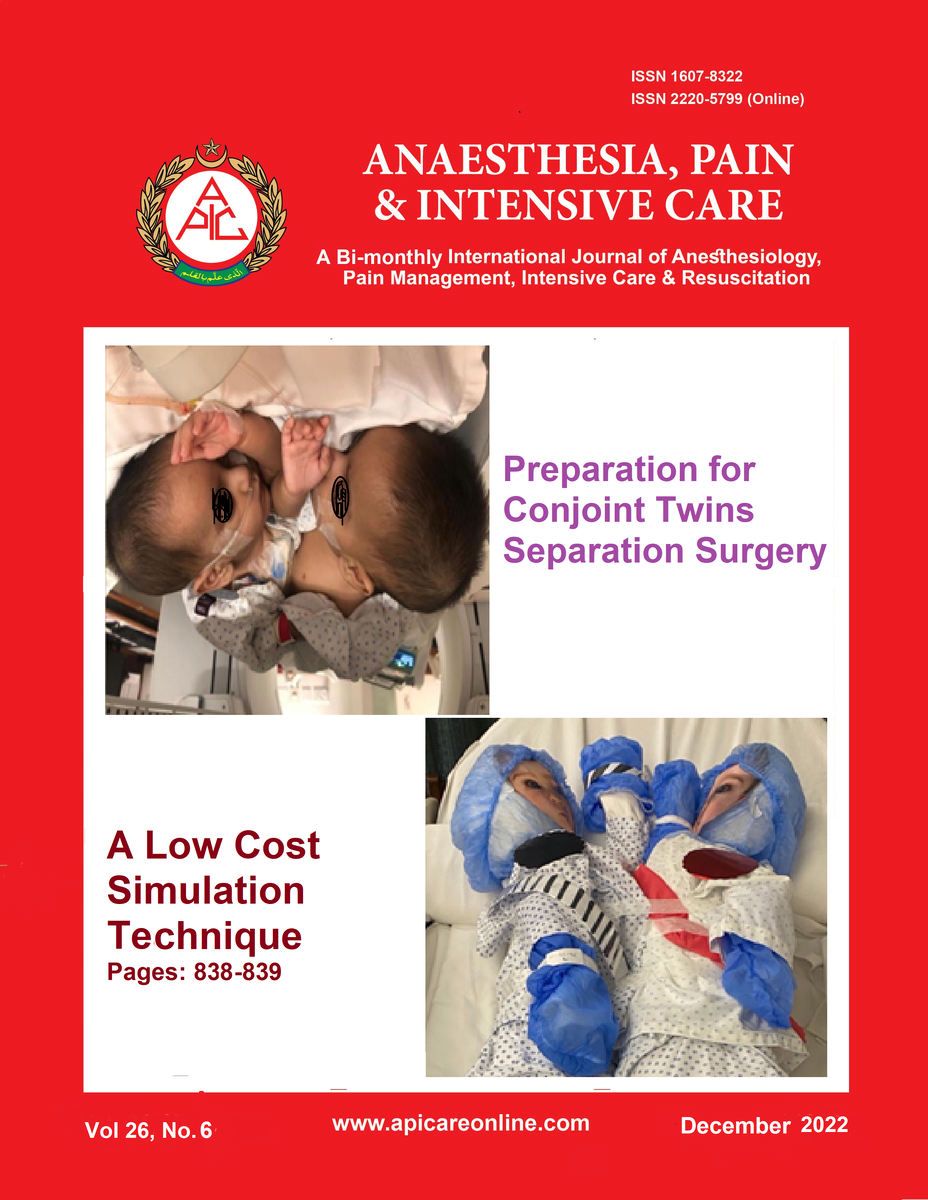
Уважаемые коллеги, доброго времени суток! Представляем вам пакистанское научное издание Anaesthesia, Pain and Intensive Care. Журнал имеет четвёртый квартиль, издаётся в Faculty of Anaesthesia, Pain and Intensive Care, AFMS, находится в открытом доступе, его SJR за 2021 г. равен 0,127, электронный ISSN - 1607-8322, предметные области - Анестезиология, Интенсивная терапия и медицина. Вот так выглядит обложка:
Редактором является Тарик Хайят Кхан, контактные данные - apicarejournal@gmail.com, fauzia.khan@aku.edu, apicjournal@gmail.com, apicare@yahoo.com, brigsaleem1@gmail.com.

Цель заключается в предоставлении практикующим врачам в целевой области информацию о научных исследованиях и текущих разработках, связанных с четырьмя родственными специальностями анестезиологии, обезболивания, интенсивной терапии и реанимации. Журнал внедрил всеобъемлющую систему рецензирования для продвижения стипендий. С тех пор он развивался, несмотря на множественные ограничения и сегодня является одним из ведущих научно-ориентированных журналов региона. Область распространения охватывает всю Южную Азию и Ближний Восток и журнал индексируется большинством международных агентств по индексации.
Адрес издания - https://www.apicareonline.com/index.php/APIC
Пример статьи, название - Comparative study between bupivacaine 0.5% vs. bupivacaine 0.5% plus lidocaine 2% vs. lidocaine 1.5% in ultrasound guided axillary brachial plexus block for brachiocephalic fistula formation in chronic renal failure patients. Заголовок (Abstract)
Background: Patients with chronic renal insufficiency need to have arteriovenous fistula (AVF) for hemodialysis.Ultrasound guided axillary brachial plexus block is a good substitute to general anesthesia or local anesthesia as it causes vasodilatation and minimum hemodynamic derangement, besides offering prolonged postoperative analgesia. We compared three types of local anesthetic solutions; bupivacaine 0.5%, bupivacaine 0.5% plus lidocaine2% and lidocaine 1.5% for onset and duration when used for axillary brachial plexus block.
Methodology: Sixty-six patients were randomly allocated to one of the three different groups: Group B: patients received 30 ml of bupivacaine 0.5% for the block; Group BL: received 15 ml of bupivacaine 0.5% with 15 ml lidocaine 2% and Group L: received 30 ml of lidocaine 1.5% for the block under US guidance. Onset of sensory and motor anesthesia were registered, and the time to first analgesic demand postoperatively was noted. Statistical analysis of the results was undertaken.
Results: Results showed that regarding the onset of sensory anesthesia, lidocaine group had the shortest time and the results were statistically significant compared to the other two groups. A statistically non-significant difference was found between Group B and Group BL, where Group BL had shorter time of onset than Group B, e.g., 9.05 ± 1.36 vs. 9.77 ± 0.97 min. The onset of motor block was the earliest in Group BL and the result was considered nonsignificant between Group L and Group B being shorter in Group L; the difference in results was also non-significant between Group BL and Group L. Significantly longer duration of motor and sensory blocks was noted in Group B and compared to the BL and L groups. As regards the timing of first analgesic need, there was statistically significant difference between all groups being longest in Group B (608.68 ± 21.74 min)
Conclusion: This study revealed that using 30 ml of bupivacaine 0.5% in axillary brachial plexus block with ultrasound guidance in ESRD patients for AVF creation gives much better results than 30 ml of lidocaine 1.5% or a mixture of Abdelhady ISM, et al local anesthetics for axillary brachial plexus block www.apicareonline.com 744 Open access attribution (CC BY-NC 4.0) bupivacaine 0.5% with lidocaine 2% as regards to onset of anesthesia, postoperative analgesia and patient satisfaction.
Trial Registry: PACTR202208582938205
Abbreviations: AVF: arteriovenous fistula; BPB: Brachial plexus block; ESRD: End stage renal disease; GA: General anesthesia; NRS: Numeric rating scale; RA: Regional anesthesia
Key words: Bupivacaine; Lidocaine; Hemodialysis; Brachial plexus block