How to understand? What to do? How to control?
(Only you, the patient, will be able to control your doctor! To do this, use the knowledge from our clinic. We are always ready to help with this).
In the Ultrasound Protocol, the doctor can write about the "vascularization" of the thyroid gland. This parameter can be amplified or normal. What is evidenced by the change in "vascularization" and what needs to be done when it changes. Is there any need to worry and urgently treat this "vascularization"?
"Vascula" in Latin means - a vessel. Therefore, the literal translation of "vascularization" is vascularity. But vascularity, i.e. the number of vessels in the thyroid gland cannot "increase", be "normal" or "decrease" in a disease like this. In fact, it is not the number of vessels that changes, but the BLEED INTENSITY!
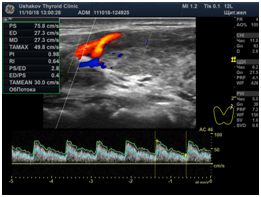
"Vascularization" came into the professional routine of uzists from foreign scientific literature. But English-speaking (Latinized) foreign specialists tend to set out in abbreviated form. For example, we write and say two words in Russian: THYROID GLAND, and colleagues from abroad often use only one word instead of THYROID GLAND - THYROID. Therefore, for the English language, “vascularization” turned out to be a natural designation of blood flow, and our specialists introduced a foreign formulation, distorting the essence of the process.
All vessels in the body are accompanied by nerves - this is the law of biology! There is no vessel that is not accompanied by a nerve. Even the smallest capillaries have a nerve conductor.
From these nerves, which are processes from nerve cells (that is, nerve cells are the main sources of influence), fibers extend to the walls of the vessels. It turns out that the nervous conduction system controls the tone of the vessels, their filling and the intensity of blood circulation. In this case, inside the thyroid gland.
In the "Clinic of the thyroid gland" Dr. A.V. Ushakov never used the word "vascularization." Instead, the concept of "blood flow (circulatory) intensity" was used. In the reference guide for doctors "Clinical ultrasound diagnosis of benign thyroid pathology" (2018) A.V. Ushakov writes about the intensity of blood flow in the gland, and in the section on terms, he explains to sonologists (that is, ultrasound specialists) about the different meaning of the term "vascularization".
There is a LOWER, NORMAL, and HIGH blood circulation in the thyroid.
(how do you perceive without the word "iron"?).
ENHANCED blood flow in the thyroid gland can be SMALL, MODERATE (i.e. medium) and SIGNIFICANTly activated (sometimes it is VERY SIGNIFICANT).
BLEED INTENSITY (or, as sonologists say, vascularization) reports the SIGNIFICANCE of the NERVOUS STIMULATION of the thyroid gland, namely the part of it where this parameter was determined.
If "vascularization" is enhanced, then it should be understood that the peripheral nervous system intensively affects the gland and thereby increases its production of hormones. Those. the amount that the body needs.
Compare with the effect of TSH (from the pituitary gland) on the thyroid gland. TTG in English - thyroid stimulating hormone (TSH). Those. Excessive stimulation for the production of thyroid hormones occurs both from the side of the nervous system (directly to the cells of the gland), and from the pituitary gland - stimulation by the TSH chemical substance.
The intensity of blood flow not only reports on the magnitude of the stimulation, but mainly on the fact that, with increased overstrain, thyroid cells are depleted and may die. Those. excessive overstrain (under the influence of nerve impulses) leads to depletion of the thyroid gland.
During the treatment process, it is important to periodically evaluate the intensity of blood flow ("vascularization") during an ultrasound scan.
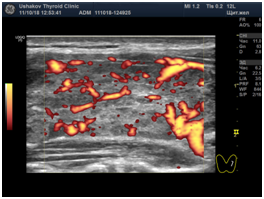
Moreover, the determination of the state of blood flow with ultrasound is MANDATORY !!! If the doctor has not determined and indicated in the Protocol the state of blood flow stress in the gland (separately for each lobe!), Then the usefulness of such an ultrasound is much less.
Note that the written Ultrasound Protocol must accompany the images, some of which must be in the "vascular" mode, which are called CDK (color Doppler mapping) and EDK (energy Doppler mapping).
In addition, in order to accurately assess the magnitude of blood flow during ultrasound of the thyroid gland, the sonologist must correctly configure the ultrasound machine. If the settings are incorrect, you can get a distorted result, which often happens in medical facilities at any level (from laboratories to the ESC).
In addition to determining the INTENSITY of blood circulation in the gland, the doctor must determine the SSS (peak systolic blood flow velocity), i.e. the speed of blood flow in the vessels of each lobe. Normally, it is from 20 to 30 cm / s. From 30 to 50 cm / s - a small increase in blood flow, 50-80 cm / s - moderate, more than 80 cm / s - significant. PSSK also allows in figures to estimate a thyroid gland tension.
(I draw attention to the fact that in no manuals and articles on thyroid ultrasound (except from our Clinic) the authors do not report anything about the nature of the “vascularization” change, because they use the erroneous old (hundred years ago) distorted conclusion about the alleged absence of the influence of the nervous system on the thyroid gland, which contradicts the laws of nature. Increased blood flow can be seen to varying degrees with euthyroidism, hypothyroidism and hyperthyroidism. This is not explained by colleagues. It is only fixed.).
If you need a highly professional ultrasound of the thyroid gland - you can contact our clinic. Recording - by phone +7495 3462038.
Our gratitude to Natalia Startseva for interest in "vascularization".
Head physician of the Thyroid Clinic,
Ph.D. A.V. Ushakov.