The XXI century is the time of globalization and strong connections between Western Countries. In 2020 the European continent celebrates 70 years without global conflicts on its territory. However, people, adjoining this peaceful land in the Middle East, suffer from wars and “Oil Wars” between neighbors. In this respect, it’s very important to understand the nature of these conflicts; are they chaotic or is there a logical process of evolution of conflict. American sociologist and political scientist Samuel Huntington wrote an article “Clash of the Civilization” in 1993. It is about the theory of nature of the future wars which will be on the grounds of the question “who you are?” (Huntington, 1998). Based on his theory, this essay will evaluate two conflicts which took place in the Middle East in the last five years. Also, this essay will challenge the applicability of the idea of the present conflicts.
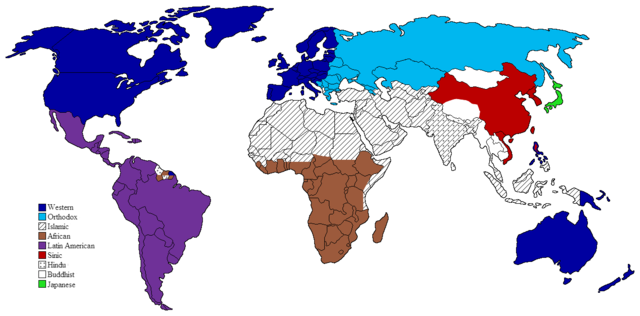
In the beginning, the Samuel Huntington’s theory is founded on the idea of division of people under the criteria of civilization. According to his article “The Clash of civilization” (1993), he identified civilization as the highest level of cultural identity of people. The civilizations are divided by history, language, culture, tradition and religion, the last of which plays vital importance. The Huntington’s (1998) world is divided into eight civilizations. The first civilization is the “Sinic”, which includes the common culture of China, Vietnam, Korea and communities in Southeast Asia. The second civilization is the Western civilization, which includes Central Europe and North America. The third one is the Japanese nation, which contains only the culture of Japan. The fourth one is the Orthodox, which is centered in Russia. The fifth is the Latin American including cultures of Central and South American communities. The sixth is the Indian civilization or Hindu. The seventh is the African but this civilization is hard to identify clearly. The last civilization is the Islamic civilization, which is spread across North Africa, Iberian Peninsula and the Middle East.
Due to the number of civilizations, the occurrence of different disputes and even conflicts between them is inevitable. Therefore, Samuel Huntington distinguishes three main motives for the clashes between civilizations. The first is the basic difference of the diverse cultures. History, culture and especially religion have a huge impact on shaping the perception of reality of every civilization. From the historical point of view, these basic diversities are crucial elements of conflicts. The second reason for clashes is globalization of the world and the interactions between each civilization. These aspects cultivate population to find differences between people of distinctive civilizations and to raise civilizational-consciousness in nations. Nevertheless, this factor also affects the youth’s separation from local identities, through the social and economic changes. The final point is the provocation from the West to other civilizations. Those cultures have to protect themselves from the hegemony of the West. The desire of the West to impose their values about socialism and democracy contradicts with the beliefs of the non-Western nations. An example of such occurrence is “The War on Terror”, when the US sent its troops to Iraq for elimination of the terroristic group in 2003.
The Islamic civilization, as Huntington described it, is the most bellicose for several reasons (Brooks, 2011). To begin with, the Middle East is the core of opposition to westernization of the world. The leaders of the Arabic world are criticized by the Western countries for their incapability to adopt certain liberal values, such as pluralism and democracy. Another cause of the rebelliousness is the selfless attitude towards religion. The core is that Arabian people do not need the nation-state because the main criteria for them is to which religion you belong. This leads to many inter-civilizational conflicts within Islam. However, this civilization has the right for self-determination and to discover their own way towards democracy, without invasions from the outside. The main reason this should be considered is, so that people need take into account the different historical experiences of each civilization. In comparison to the previous decades, currently, the majority of Muslim countries show high preferences to democracy. Countries, such as Turkey and Egypt had 92 to 99 percent of public appreciation of the democratic institutions (Norris, 2009).
Many conflicts in the Middle East are based on blames from the Western states in aggressive behavior towards the Islamic States and invasions of their territories. The latest conflict between the US and Iran was after the assassination of the Iranian general Qasem Soleimani in the beginning of 2020. This person was the second most powerful figure in Iran (BBC, 2020). Solemani supported Hezbollah and pro-Iranian military groups and organized Syria’s attack on rebels in the Syrian civil war. In result, the USA imputed him with collusion of terrorism and made him responsible for the death of hundreds of the US personnel. The Iranian government identified this elimination as international terrorism and conducted revenge against American crimes (BBC, 2020). This situation shows how effortlessly western civilization, which are represented by the United States, interfere into the internal affairs of Islamic countries without warnings. From the perspective of Huntington’s theory, the more advanced the civilization is the easier it violates the territorial rights of other, less developed nations. Moreover, the US showed absolute entrammeling from the side of other Western countries. This fact has created a disruption between the Western and non-Western countries, such as Russia which described the USA actions as being a “murder”.
Another type of conflict which prevails in the Middle East is the “intercivilizational” war. According to Huntington (1998), such conflicts can take place on the local level, when the territory of the state belongs to population of different civilizations or different states of diverse civilizations. The example of such conflicts is the Civil war in Yemen, where two directions of Islamic religion are fighting over control on Yemen’s territory. The first side of the conflict is the Sunnis, which contains about 65 percent of the Yemen’s people (Renaud, 2018). The Sunni had the privilege under the territory of south Yemen before the unification with north in 1990. Another side is the Houthi insurgents, which compound about 35 percent of Yemen’s population (Renaud, 2018). This war between them has started because of the corruption of the Sunnis government and high prices on fuel. In 2014 the Houthi took control over Yemen’s capital city and declared the resignation of the government and the decreasing of fuel prices. In 2015 after failed agreements between Houthi insurgents and the officials of the president of Yemen, the president was forced to resign by the rebels. In March the coalition of Gulf States decided to interfere through an economic isolation. Also, Saudi Arabia conducted air strikes with the support from the US against the rebellions. In response to this attack the Houthis conducted several strikes on the Saudi Arabian infrastructure of the oil production. Apart from this civil war, Yemen is under the influence of the USA in their counterterrorist operations. The US helped the coalition of the Gulf States, in the war with rebels, by sending Special Forces under cover of counterterrorist campaign (CFR, 2020). In this ongoing war have been died or injured about 15000 people. Also the war was one of the reasons for the migration crisis in 2015 (CFR, 2020). From the perspective of Huntington’s theory this conflict can be evaluated from two sides. Firstly, the clash between dissimilar sides after unification shows the consequence of the Cold War. The part of the Islamic civilization was under the various spheres of influence, North Yemen was under the Western coalition and the South was supported by the USSR. After five decades their perceptions of self-determination have dispersed with accordance to their direction of Islamic religion. Thus, conflicts on this field were predictable. Secondly, Western countries participate in coalition of Gulf States in disputes between Arabic States. In this respect, such presence can only lead to the creation of new conflicts on the grounds of identity crisis of the civilization. The Yemen Civil war is an example of how important religion is in the Islamic world and how it is vital to create an opportunity for the state to solve the problem without any third parties.
The “Clash of Civilizations” is one the theories of the future regarding the development of the world and the interactions of different nations between each other. However, in the examples which are provided in this essay, the parallels of behavior and interactions between the represents of different civilizations can be seen. The consequence of clashes in the Middle East can only lead to the rise of movement against the Western presence in other non-Western civilizations. This could result in misbalance in relations between such countries as China and the USA, Russia and Europe. In conclusion, currently, the situation in the Middle East is unpredictable from the perspective of the future conflicts. Nevertheless, the advanced countries do not have the right to neglect the sovereignty in the non-democratic states, even with the intentions to spread the liberal points of view. Power is not about forcing to act but about having wisdom to assure and inspire the action.
Bibliography
Global Conflict Tracker (2020) War in Yemen [online] available from https://www.cfr.org/interactive/global-conflict-tracker/conflict/war-yemen [1 May 2020]
The Conversation (2018) Who are Yemen’s Houthis? [online] available from https://theconversation.com/who-are-yemens-houthis-106423 [3 May 2020]
BBC News (2020) Qasem Soleimani: US kills top Iranian general in Baghdad air strike [online] available from https://www.bbc.com/news/world-middle-east-50979463 [2 May 2020]
Foreign Policy (2009) The True Clash of Civilizations [online] available from https://foreignpolicy.com/2009/11/04/the-true-clash-of-civilizations/ [6 May 2020]
The New York Times (2011) Huntington’s Clash Revisited [online] available from https://www.nytimes.com/2011/03/04/opinion/04brooks.html [6 May 2020]
SOAS (1996) The Middle East in the 21st Century: An agenda for reform [online] available from https://www.soas.ac.uk/cimel/materials/21st.html [10 May 2020]
Associated Press (2018) Yemen’s Dirty War, Explained [online] available from https://www.youtube.com/watch?v=0jCdym4SmMM&t=72s [12 May 2020]
Council on Foreign Relations (2006) Is there a Clash of Civilizations? Islam, Democracy, and U.S.-Middle East Policy [online] available from https://www.cfr.org/report/there-clash-civilizations-islam-democracy-and-us-middle-east-policy [11 May 2020]
Charlie Rose (1997) Samuel P.Huntigton [online] available from https://charlierose.com/videos/17838 [15 May 2020]
Huntington, Samuel. P (1998) ‘The Clash of Civilizations?’. In The Geopolitics Reader. ed. by G. Ó Tuathail, S. Dalby, & P. Routledge. London and New York: Routledge, 159-169. [10 May 2020]