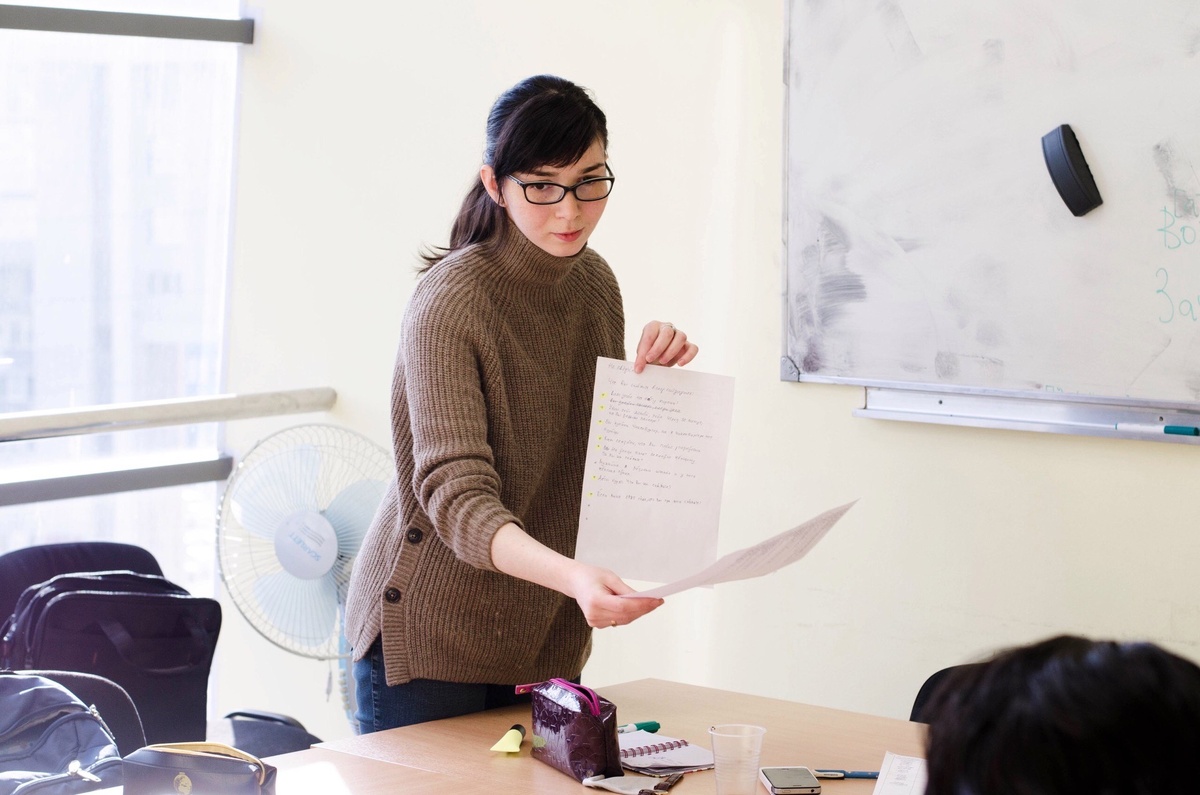
When you graduate from a pedagogical university, no matter how many lectures you've listened to and how many lessons you've prepared as a part of your practice project, it cannot be compared with real teaching experience.
So, it's your first lesson with a foreign student, and although theoritically you should know how to prepare for it and what material can be given, you HAVE NO IDEA HOW to serve that material to the student.

- Make your student comfortable about making mistakes and laughing.
+ How? Make fun of yourself, laugh at yourself, encourage the student to speak no matter how many mistakes he/she'll make. When they make a mistake, say it's OK and without mentioning names (you don't need your student to lose trust in you) say that one/couple of/many/most of the students make the same mistake and that after a while the mistake is gone.
Example:
Teacher: "Здравствуйте! Я Даляль, я преподавательница" (students always start laughing at the word "преподавательница" because it's very long and difficult). Then the student to say about him/herself.
Student: "Здравствуйте! Я name, я студент/инженер/менеджер".
Teacher: "Я студент?" (here either you hear a laughter or see bewilderment, don't hesitate or feel uncomfortable, bewilderment will be gone in a couple of lessons and the student will feel more comfortable and open by each lesson).
Student: "Нет".
Teacher: "Я преподавательница?"
Student: "Да".
Teacher: "Вы студент?"
Student: "Да".
Teacher: "Вы преподавательница?"
Student (depends on sense of humour): "Нет/Да".
- Use as minimum interlanguage* as you can.
+ How? From the first "Hello" start speaking Russian. Every communicational unit say in Russian. If it's a rule you want to explain start from the first day saying the words "if" (если) and "then" (тогда) in Russian, gradually emitting the translated "ifs" and "thens". If the student asks for a translation make his mind work, don't translate (they have internet to translate and apps), you're not a translator here, your aim is to make student's mind start visualising and absorbing words with all it's environment. Instead, draw a picture, show a picture, show the meaning with a gesture, use the word in a situation where it'll fit perfectly. Yes, it's taking time, but the word will stick - TRUST ME. And from the moment you showed the picture or made a situation with that word, with everytime the student need a reminder of the meaning of that word when you just start the same situation or start drawing the picture, he'll scream happily the word.
Example:
Teacher: "If O is without a stress, then pronounced as sound [a]", then repeat: "если О is without a stress, тогда pronounced as sound [a]", the next time you'll mention it, change it more: "если О минус stress, тогда говорим звук [a]". Then ask the student to say the rule.
- Use maximum of attachement to their lives.
+ How? Instead of just explaining the rules and doing exercises to consolidate it, use it instantly in a situation that is taken from the student's life. It doesn't have to be something personal (some of the students like to keep their personal life to themselves, and it is their right to), may be from their work, daily trip to the lesson, news, events. The more the exampes and practice will be attached to their lives, real events in their lives, the more the language will be a part of them. Now their life events are pictured in their minds, and heard with their ears and articulated with their mouths in Russian language. Sometimes, students say they have dreams in Russian and their minds start to put labels on things in Russian.
Example: Instead of using "she"/"he" in examples use names from the student's life: name of his dog, cat, friend, president. his favourite popstar, author etc. Instead of using names of towns and cities in the exercise book, use his own city's name.
- Use communication method.
+ How? So, you have standard phrases like: "Здравствуйте!", "Спасибо!", "Как дела?", "До свидания!", etc. but it is not enough for communication. With every new word, don't just give it and move, use it instantly. You can use it in a form of a one-word-question.
Example: You are teaching today colours. Point at items and ask the student: "красный?" (of course, you'll need to analise first the grammatical gender of the item, adjective's gr.gender must correspond to gender of the item). The student will have to answer: "Да, красный"/"Нет, синий". What's important here as well is to make it funny, so ask illogical things, like pointing at a thing that cannot be red at all. Then ask the student to ASK YOU the same question (minimum of 3), and he'll find out how difficult it is to start a dialogue and how useful it is to practice initiation of a dialogue.
I always say that a good teacher is a tutor, friend and kind of a psychiatrist to his students.
Remember that, "There's no bad students, only bad teachers": every student is a project (no matter who he is, from where, how long it takes him to speak), and 99% of it depends on you to make it succeed in whatever his aim was to study Russian language.
*interlanguage https://www.thoughtco.com/what-is-interlanguage-1691074
Photos used in this article were taken by Ksenia Spiridonova and Lance Cridge.
Some of the photos were taken in one of the language centers I worked at in Saint Petersburg.
© Dalal Ismail, 2020