Уважаемые коллеги, доброго времени суток! Представляем вам еще одно голландское научное издание Bijdragen tot de Taal-, Land- en Volkenkunde. Это один из старейших в мире востоковедческих журналов, был основан в 1852 году. Он имеет второй квартиль, издается в королевстве Нидерланды группой Brill Academic Publishers, SJR согласно данным за 2018 г. равен 0,151, печатный ISSN 0006-2294, электронный - 22134379, предметные области - Языкознание, Лингвистика, Общие вопросы социальных наук, Культурология, Антропология. Редактором является Фрек Коломбин, контактные данные - f.colombijn@vu.nl.

Вот так выглядит обложка журнала:
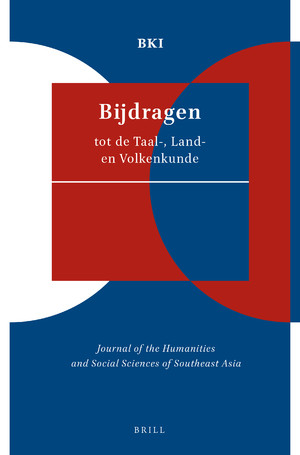
Для подачи статьи в журнал необходимо воспользоваться Contact Form, которая находится в разделе About. В настоящее время это ведущее междисциплинарное издание по Юго-Восточной Азии и Индонезии. Редакторская группа особенно приветствуют статьи из области антропологии, истории, политологии, права, социологии, социальной географии, исследований развития, урбанистики, литературы, социолингвистики и экономики. Статьи, требующие специальных знаний от читателей (например, некоторые экономические или лингвистические исследования), считаются неподходящими и не будут приняты к публикации.
Журнал находится в открытом доступе и, следовательно, все статьи в интернете свободны для прочтения, таким образом, обеспечивается максимальное распространение контента по всему миру в обмен на публикацию статьи.
Поскольку журнал получает субвенцию на публикацию от ученого общества Vereniging KITLV (NL), плата за публикацию статьи не взимается. Для получения дополнительной информации можно посетить сайт Brill Open.
Пример статьи, название - Indonesia and its Others. Заголовок (Abstract) -
This special issue seeks to explore connections and relationships between Indonesia and its ‘others’, both within and beyond national borders. Identity politics, based on nation, race, class, gender, and religion, as well as complex and sometimes contradictory combinations of these, have been powerfully influential in many spaces and periods, and this collection grew out of a shared interest in the politics of difference and othering. The collection brings together scholars working across several disciplines—including anthropology, cultural studies, media studies, education, literature, and translation studies—to examine the politics of inclusion and exclusion in transnational perspective. The articles trace historical and contemporary diasporas, pilgrimages and exchanges, flows of people, ideas, stories, and media, as well as popular representations of different social identities, both within and beyond the borders of Indonesia.
‘Indonesia’, in this case, is understood as a socially discursive construct and imagined community created through interactions with various ‘others’. This collection, therefore, departs from perspectives that take the nation-state of Indonesia as if it is a clearly demarcated, bounded entity, fixed geographical location, or socially cohesive group of people, traditions, and history. We began to develop this project following an October 2017 conference at Monash University, Australia, titled ‘Other Asians, Asia’s Othering’, which featured a wider regional focus beyond Indonesia. The conversations stemming from that conference have continued to inform our approach, so although this special issue is concerned primarily with Indonesia, we also hope that the broader discussion points raised in these articles will contribute meaningfully to ongoing scholarly efforts to build new approaches to the study of Asia in a rapidly changing global context in general.
The four articles that make up this special issue all respond in different ways to the project’s central themes. Maria Myutel’s article on the ‘Sindhi element’ in Indonesian commercial television demonstrates that this industry is far more culturally and ethnically diverse than the official ethnonationalistic historiography might suggest. Her research reveals that since the late 1950s, a tiny community of Indonesian Indians (Sindhis) has in fact been one of the major financial and creative drivers of Indonesian media production. This small and often barely visible community of ‘others’ has shaped the form and content of Indonesian national television in very specific ways, as Myutel illustrates in her detailed account of the development of the national television industry.
Meghan Downes’s paper turns our attention to the publishing industry, looking particularly at Indonesian literature in translation. Downes charts Indonesian author Eka Kurniawan’s rise to global literary prominence and the power relations involved in the processes of translation, exoticization, and international reception, which subsequently influenced his local reputation. Paying close attention to shifts in marketing, cover art, and media representations as the translated novels became popular in the international market, Downes uses this case to reflect on the ‘othering’ of certain entertainment genres and on how this process can contribute to patterns of inclusion and exclusion from local and global literary canons.
Turning from the global publishing industry to the global pilgrimage industry, Mirjam Lücking’s piece examines the tensions and contradictions that arise when Indonesians travel to Jerusalem. Both Christian and Muslim Indonesians travel to this shared holy site, and, in doing so, craft contrasting images of Israeli and Palestinian ‘others’. Lücking’s study explores the complex Muslim-Christian tensions as well as intra-Muslim and intra-Christian tensions that emerge in pilgrimage narratives and practices, ultimately blurring and complicating our understandings of otherness in this context.
Agnieszka Sobocinska and Jemma Purdey’s paper provides another perspective on inter-cultural engagement, in this case looking at recent Australian government investment in ‘in-country’ study experiences that facilitate Australian university students to travel to Indonesia. Their article investigates an intensive-mode undergraduate unit titled ‘Australia and Asia’ to assess the pedagogical merits and the potential for increased mutual understanding between ‘others’ offered by this kind of formal student mobility programme. Sobocinska and Purdey’s in-depth analysis of this programme and the experiences of the students involved ultimately reveal some of the limits to genuine engagement during study tours.
The authors included in this collection all share overlapping concerns around otherness, intercultural engagement, and representation, both within and beyond the national borders of Indonesia. By bringing these articles together, with their diverse geographical and political contexts, this special issue seeks to highlight recurring themes and sometimes unexpected resonances across different times and spaces, and contribute a unique perspective to the field of contemporary Indonesian studies.