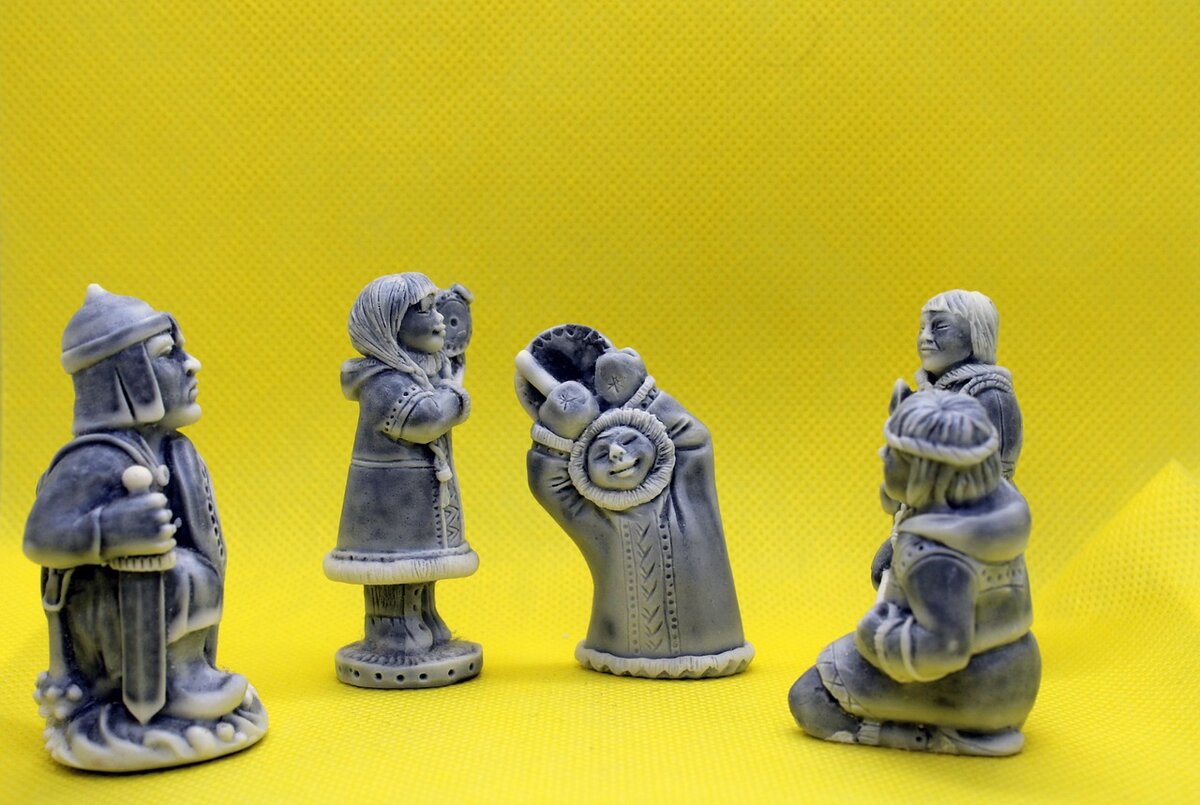
A kind of Japanese art that is not found in other countries is a folk sculpture - Netsuke. According to their purpose, Netske played a very utilitarian role, served as a pendant, with the help of which the kimono belt was attached to the wallet, pouch, keys or a box for the storage of personal seals or drugs.
The first Netsuke was very simple and inexpressive in shape, usually in the form of a decorative button or stick. But later on, the forms of Netsuke began to change and became more intricate and refined.
It is believed that Netsuke is a traditional Japanese sculpture, but its homeland is not the Land of the Rising Sun, but China. In China, much earlier than in Japan began to wear on the belt small items called jui-tzu. By the 14th century, Japan had borrowed many customs from China, including the way it wore clothes. The first Japanese Netsuke was called simply "Chinese thing" or "Chinese carving". But it was in Japan, by the XVII century, that the production of Netsuke turned into high art, which did not happen in China with the keychains of jui-tzu.
The golden age in the development of Japanese Netske - the second half of the XVIII and the beginning of the XIX century, when their hobby took on an unusually wide scale. Netsuke was made of a variety of materials: ivory, deer horn, buffalo horns and rhinoceros, boar and bear fangs, wolf and even a tiger, walrus bone, as well as wood roots. This is where the name Netske came from ("neh" is the root and "tze" is attached). Elegantly carved wooden Netsuke was worn by small merchants, craftsmen, peasants, and Netske's finest work in the form of an animal or ivory figurine could be seen only on the belt of a rich man.
Then came porcelain and lacquer items, made of coral and nephrite, petrified wood and amber, turtle shell and glass. Also, small pumpkins, beautiful shells and other objects, which previously had a completely different purpose (for example, knife and sword frames), were used as Netsuke. However, the most famous figures were still carved from wood and ivory.
As a rule, the wood remained unpainted, it was only carefully polished. The master carver tried to reveal and emphasize the natural beauty of the material, its texture, and color. But no matter what material was made of, these figures should not have been heavy and large in size. Netsuke should have been smooth, durable, streamlined and without projections, sharp corners and edges. The hole through which the cord passed should not spoil the Netske, so the masters masterly included it in the composition of the sculpture. These conditions could not be ignored by any master, everything else depended on the creative individuality of everyone.
- It is customary to distinguish between three types (or forms) of Netsuke. The most numerous species are catabories (figured Netsuke), which are sculptural images of people, animals, birds, flowers, fruits, etc. It is simply not possible to list all the subjects on which Netsuke was created. First of all, the masters depicted national literary and fairytale heroes, and first of all the characters of Netsuke were seven gods of happiness... There were figures depicting the struggle of folk heroes with demons, famous archetypes were depicted - students of Buddha, Netsuke in the form of a favorite folk hero Kintaro - a very strong child... And some of the Netske depicted domestic urban scenes: At a reception with a masseur, children's games, images of funny foreigners, such as a figure of a Dutchman in a short coat and with skinny legs ... depicted and evil demons, the god of hell Yama, a fish-som, from which, according to popular belief, and occur all the earthquakes.
Animals and people are often depicted with great humor. One famous Netsuke shows an octopus flirting with a mermaid; the other is a goulaka, who woke up after an evening drink. Taken together, the players wore Netsuke in the form of skulls or snakes, which are believed to bring them good luck. And, of course, a lot of Netsuke represented the beloved god Daikoku in Japan - the god of happiness, kindness, and fun. Usually he was portrayed as a cheerful and fat man with a bag of rice behind his back and a few rats. An ancient Japanese legend says that the rat once saved Daikoka. When the gods got angry and wanted to burn him at the stake, the rat advised Daikoka to bury herself in the wet ground...
- The second type of natzke is the kaghibut, which literally means "mirror in a case". Usually, it is a small round, flat box (made of bone) with a skillfully decorated metal cap.
- The third type is the manju, whose shape resembled rice cakes. This Netsuke was mainly valued for the pattern on its surface.
Creating their works, Japanese masters often proceeded from the aesthetic category of "wabi-sabi" - the beauty of simplicity, which is generally one of the characteristic features of decorative art of the Land of the Rising Sun. Guided by this principle, they created truly expressive masterpieces.