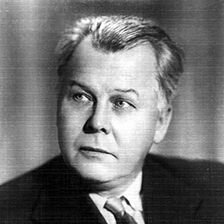
A bright page in the history of the development of editing in the Soviet period was entered by A.T. Twardowski. Editorial and Publishing Activities A.T. Tvardovsky as editor-in-chief of the New World (from 1950 to 1954 and from 1958 to 1970) became a notable phenomenon in the country's public life and was aimed at restoring the rights of free expression of views and ideas regarding contemporary spiritual and material issues culture.
Tvardovsky gained experience in literary work during the years of World War II, in the editorial office of a front-line newspaper.
A well-known poet, he enjoyed the authority of readers and the confidence of the party and government: he was elected a deputy of the Supreme Soviet of the USSR, a member of the CPSU revision committee, secretary of the board of the USSR Writers Union, was vice-president of the European Writers Community. Twardowski in 1940 joined the Communist Party.
He was awarded seven orders, including three orders of Lenin - this is the highest award of the country. Both on a post, and on a occupied position he was obliged to support and approve the official point of view on events.
A.T. Tvardovsky can rightfully be attributed to those large editors who were able in many ways (although maybe not in everything) to overcome their own subjectivity of philosophical, ideological and artistic and aesthetic assessments, to rally around themselves a team of like-minded people who acted on a clear and firm public position .
Thanks to this, they saw the light on the pages of the "New World" and received enormous public outcry such, for example, works "unthinkable" before that time, such as the novels by A.I. Solzhenitsyn's “One Day of Ivan Denisovich” and “Matrenin Dvor”, the military novels of the Belarusian writer V. Bykov, which made the reader take a completely new look at the face of the war, “District Everyday Life” by V. Ovechkin, travel essays by V. Nekrasov and many others.
A.T. Twardowski, as an editor, critic, literary critic, left behind a great legacy. This is not only manuscripts stored in archives with his own revision, but also a huge correspondence with his correspondents (more than 12 thousand letters of authors to him and over 2 thousand answers of the writer), and his articles and speeches devoted to literary mastery of the AU. Pushkin, I.A. Bunina, A.A. Blok, S.Ya. Marshak et al. A.T. Tvardovsky, of course, had the right to his own literary predilections. In addition, the features of the time could not but affect his editorial experience. However, in general, his editorial legacy gives an idea of a holistic system of genuine literary and artistic values, which served as guidelines for him in working on the original author.
In the statements of A.T. Twardowski’s editor appears not only as an employee performing his duties, but as a living person, capable of emotional empathy:
“A person who, by the nature of his work, is acquainted with a particular literary novelty ...,” he wrote, “does not deprive his ability of purely reading to perceive what is read, to be excited, moved, or delighted. In other words, the editor is also a reader, and above all, a reader. " However, in the understanding of A.T. Twardowski, the editor is at the same time a person with a genuine artistic flair, sharpened social vision, a kind of gift for perceiving reality.
“This is a precious gift - a sense of the essential in life, the eye and hearing for everything that is inaccessible to the eyes and hearing of authors writing not from the need to tell the truth, but from considerations to say what will be“ in line. ”Speaking against the misunderstood“ social order "in literature, market motivation in creativity, the primacy of an ideological beginning in it, A.T. Tvardovsky repeatedly emphasized that oblivion of the laws of literary skill in favor of the" novelty of life material "in evaluating a work, that is, the writer’s inattention to form in when thou able to turn to the lack of attention of the reader and content.
Particular attention as an editor of A.T. Twardowski devoted to the problem of author's personality. Moreover, he considered this problem not in a narrow, but in the broadest sense. It is in its focus that, in his opinion, all other questions lie related to the evaluation of a literary work and the principles of its transformation into a printed publication, the intonation-rhythmic organization of the text to its figurative system. This explains his close attention to the personality of the author.
On the one hand, his assessments are correctly cold and may even seem ruthless when it comes to the futility and futility of literary exercises devoid of the talent of New World correspondents.