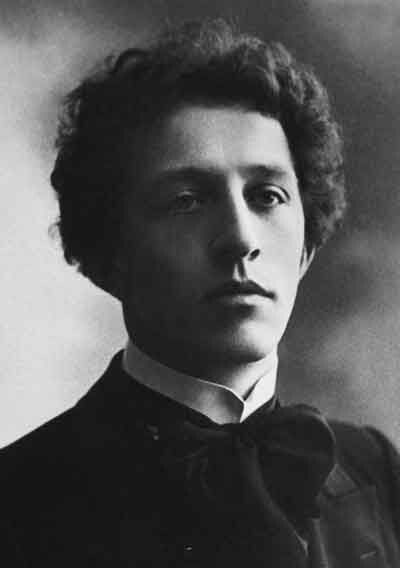
The editorial activity of A. A. Blok (1880 - 1921) is noteworthy. Before the revolution, Blok participated in the work of the private publishing house "Sirin" (1912 - 1914). The poet briefly acted as editor of periodicals. Before the revolution, he headed the poetry department in a magazine published by an original Russian theater director V.E. Meyerhold - “Love for Three Oranges” (1914-16). After the revolution, in 1918 he was the editor-in-chief of the periodical Repertoire, the organ of the repertoire section at the theater department of the People's Commissariat for Education.
However, under his editorship there is only one issue, since A.A. Blok was convinced that he would not be given the opportunity to realize his publishing ideas. Basically, his editorial activity is related to the preparation and release of individual publications or collected works of literary masters. In the history of editing A.A. Blok took his place mainly as an editor of original poetic works and a translation editor.
In the pre-October period, his most significant editorial work was preparation for the publication of the works of A. Grigoriev at the publishing house of K.F. Nekrasov.
The book was published in 1916 under the title "Poems of Apollo Grigoriev. Collected and supplied notes by Alexander Blok." The block owns both the plan of this publication as a whole and the specific development of the composition and compositional solution of the collection, its scientific and reference apparatus and decoration. At the same time, the ability of the Block Editor with the help of editorial and publishing means to recreate for the reader the individual image of the author, taking care of his creative will.
For example, Blok included 6 parts in the book, the first two repeating in compositional terms the collection “Poems of Apollo Grigoriev”, published during the author’s lifetime in 1846.
The editor only allowed himself once to move the “story in poems“ Olympius Radium ”to the section“ Poems ” , where works of a similar genre were collected, since the term of the poem was never found by A. Grigoriev.
The remaining 4 parts are completely composed by Blok himself, who did a great job of searching for and attributing the poet’s journal publications. Lok also worked on a scientific and inquiry apparatus: selection of options, verification of texts, notes, etc. However, the important thing in itself is not even the fact of such work performed at a high professional level, namely the editor’s desire to reveal to the reader a full-blooded image of the poet, whose work was undeservedly forgotten by that time. In one of the letters to his friend, poet, translator, memoirist V.A. The block wrote to Piast (Pestovsky): "... my Grigoriev is moving, 10 pages have been printed (and there will be up to 35 in total!). These are not only complex corrections, but also keeping the whole book (that is, his whole life) in his soul ) and impact on publishers. So far it’s coming out cleanly. "
In developing a plan for the publication of works by G. Heine, Blok dwells on the principle of a selected collection of works, which, in his opinion, allows the poet to be presented to the new reader by the best creations of the great master and to convey the uniqueness of his poetic manner. Although at the beginning of the XX century. 4 collected works of Heine were published in Russia, Blok believed that the Russian language still almost did not know him. Therefore, the main meaning of his litter on the translation fields is the need for a deep knowledge of Heine’s work, preservation of the poetic size and rhythm, removal of the Russified plaque during the translation of German vocabulary (two volumes of G. Heine — the 5th (1919) and 6- th (1922) - after the death of the poet.
In the Soviet years, Blok was a member of the editorial board of the World Literature publishing house, and was editor-in-chief of the cooperative publishing house Vremya, which existed in Petrograd-Leningrad from 1922 to 1934. As a member of the repertoire section of the Petrograd Theater Department of the People's Commissariat for Education, Blok becomes the editor-in-chief of the Repertoire publication. He edited only one issue. Subsequently, he was engaged in the preparation and release of individual publications and collected works, and was also an editor of translations. In 1919 and 1922, two volumes of G. Heine's translations were published in the editors of Blok. In his work on translations of Heine and Goethe, Blok strove to convey the natural sound of the author’s speech, to preserve the poetic size and rhythm. He is far from rethinking, modernizing, reexpressing poetry texts.
Blok chose the type of selected collected works to show the Russian reader the best works of the great poet, the originality of his creative manner.