By the end of the XVIII century, Tula continued to maintain its leading position in the Russian arms industry, but in 1811 the idea arose to organize another arms center, which would "unload" Tula, taking over the production of a certain type of weapons. Because of the outbreak of the Patriotic War of 1812, this project had to be postponed and returned to it only after its completion. It was necessary to find a new center, which would be located in close proximity to the raw materials for the production of weapons, and, of course, it was necessary to provide it with qualified personnel.
The choice of the Russian government fell on the Ural town of Zlatoust, as here since the second half of the XVII century on the basis of local ore deposits the iron-making plant operated. To organize the production of "white" (cold) weapons it was decided to invite foreign masters, as in Zlatoust it was planned to produce only bladed weapons. From Germany - from Solingen and Klingenthal - initially expected to invite 35 families with a total number of more than 100 people. Agreements were concluded whereby foreign craftsmen pledged not only to participate directly in the production of cold weapons but also - and this is especially important - to pass on their experience to local craftsmen. Each foreigner was assigned "the number required to train Russian craftsmen".
The "white" weapons factory was founded in Zlatoust in 1815 near Mount Taganai, and a year after its opening the first products were sent to St. Petersburg. The main mass of weapons produced by this factory was combat weapons, but no less important direction of production was the production of artistic weapons, or, as it was then called, "decorated". Partly for this purpose, and invited then experienced foreigners.
However, foreign masters were reluctant to share their secrets. One of them, N. Shaaf, leaving in 1824 in St. Petersburg, left the secret of his production in a sealed envelope, which was soon lost among a lot of stationery. It was discovered only at the end of the century, but by then the Russian masters had already far outstripped their foreign teachers.
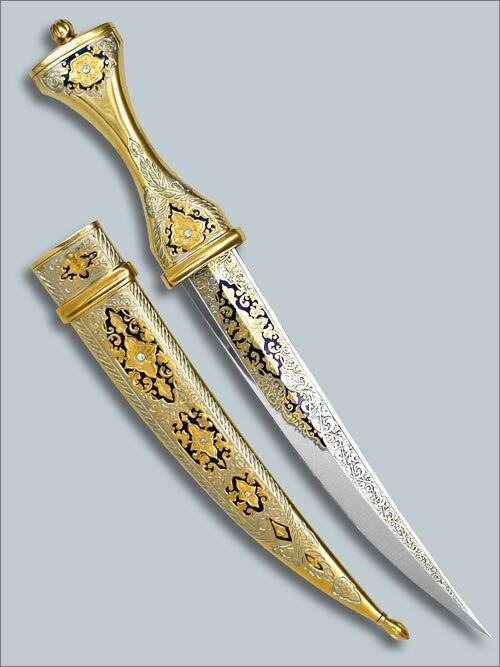
Now, assessing the art of Zlatoust, usually mark the magnificent decoration of blades, and the old gunsmiths are said to be unsurpassed masters of "engraving on steel". Indeed, the Zlatoust blade is always distinguished by its combination of gilding and deep-colored blueprints, against which there are usually complex and elegant ornaments or a whole plot composition.
Along with gilding and blunder, the Ural masters-gunsmiths revived the etching (or "etching") forgotten in the XVIII century, and in the aggregate of all these methods they received the basic components for decorative decoration of their products: blades were decorated with gilded, blued and engraved with etching.
The earliest of the Zlatoust products is considered to be the ceremonial saber made for a gift to Prince G.S. Volkonsky, a famous Russian general who served under A.V. Suvorov and P.A. Rumyantsev. In 1803-1816 G.S. Volkonsky was the governor-general of Siberia, which at that time included the city of Zlatoust.
The rich decoration of sabers allows us to carry it unmistakably to the "decorated weapon". Its length is 106.5 centimeters, the length of the blade is 89.3 centimeters. The blade is decorated with the image of the winged goddess Nika and heads of ancient warriors, as well as stylized floral ornament, the coat of arms of princes Volkonsky and a monogram of letters GBS - Grigory Semenovich Volkonsky. The saber etymology is made of engraved steel, the handle is made of ebony with superimposed silver stars and a monogram in a wreath, and the sheath is iron polished. Excellent technique of execution and allowed the gunsmiths, varying different techniques, to implement their plans by the most expressive means.
Meanwhile, the capital city of St. Petersburg demanded the delivery of "decorated weapons" annually. In 1820, a new batch of artistic weapons was sent to the Russian capital, which included an officer's sabre with battle scenes etched on the blade, two swords with "high gilt", two ploughshares also with "high gilt" and with images of battles, as well as two infantry swords and two cavalry ones. After receiving this "white weapon", the Mining Department gave the Zlatoust Weapons Factory the following instruction: "It is required that there be such delivery every year, and the honor and duty of the superiors should be that the subsequent delivery exceeds the previous one in perfection".