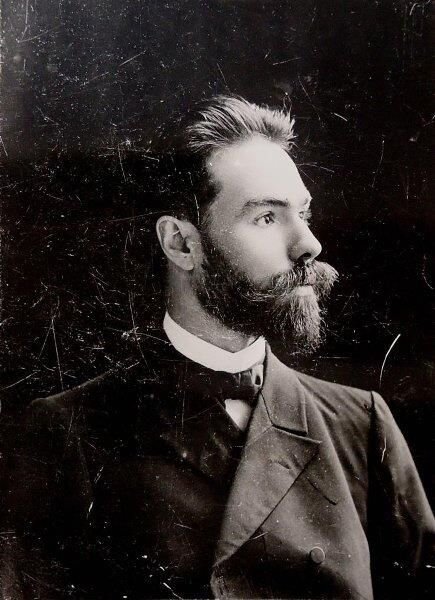
In 1915, V. Ya. Bryusov began to collaborate with the Parus publishing house. For the first time, Bryusov appeared in print at the age of ten when his journal “Letter to the Editor” was published in the magazine “Sincere Word” (1884), a story about the family’s summer vacation. In 1894 - 1895, Bryusov published three collections of Russian Symbolists, consisting mainly of Bryusov’s poems and his translations from French. Bryusov met Soviet power with an already well-established editor and publisher: from 1899 he was a participant and then head of the Scorpion Publishing House, in 1899 - 1902 he edited the magazine "Russian Archive", in 1904 - 1908 - the magazine "Libra", 1910 - 1912 - the magazine "Russian Thought".
In the Soviet years, Bryusov led the Commissariat for the registration of print works in the People's Commissariat of Education and the State Publishing House, and was a member of the Organizing Bureau of the Great Soviet Encyclopedia.
The principled positions of the publisher and the editor, the methods and techniques for transforming a literary work into editions worked out over the years have found expression in his editorial and publishing practices of the Soviet period - editing the magazine "Artistic Word" (1920-21), preparing for the publication of works A S. Pushkin (Poly. Sobr. Soch., Vol. 1. h. 1. 1919), series "People's Library" (1919), E. Verkharn (1023), E. Poe (1924), numerous articles, notes , reviews reflecting the writer's views on the nature of literary creation and its assessment.
In the rich and active editorial and publishing activities V.Ya. Bryusov is usually distinguished by three areas - the actual editorial and publishing, stylistic and textual. The main credo, which he professed as an editor and publisher, is a deep knowledge of the subject of literary work and attracting the maximum number of sources for its replenishment. High competence as one of the main requirements in the editorial and publishing work of V.Ya. Bryusov followed, in particular, when preparing and editing the collection “Poetry of Armenia from Ancient Times to the Present Day”, published by the Moscow Armenian Committee in 1916. Bryusov’s initial refusal to the Committee is known precisely because it seemed impossible to edit a book related to that area knowledge that was little known to him.
Later, he agrees to edit the collection only on condition that they help him study the Armenian language and the history of the Armenian people.
In the future, Bryusov studies a huge number of sources covering the history of this country in Russian, French, German, English, Latin and Italian, travels to Yerevan and Tiflis, where he gets the opportunity to communicate directly with the best representatives of science, literature and art.
The principle of high competence is implemented by the editor Bryusov and in the selection of translation authors. For him, it is important that the world saw not the artificially crafted interlinear, but a genuine work of Armenian poetry, illuminated by the real poetic gift of penetrating into the depths of the human soul. It is no coincidence that we find an entire constellation of poetic names among the poets-translators of anthology - A. Blok, K. Balmont, I. Bunin, Vyach. Ivanov, F. Sologub, V. Khodasevich and others.Bryusov is a publisher who is extremely attentive to the choice of means of selling an author’s work in a publication.
For him, work in this direction begins with the development of a concept (plan) of a publication, a system for placing material, structure and content of a scientific and inquiry apparatus (comments, notes, pointers, etc.).
For example, already in one of the first editions prepared by Bryusov - “Letters of Pushkin and to Pushkin”, issued by Scorpion Publishing House in 1903, notes to previously unpublished official documents contained a detailed description of the original — type of paper, description of the printing method, information about notes and postscripts, discrepancies between facsimiles and the original, about institutions where the document is stored, codes, names of authoritative early publications where it was published, etc. Bryusov is very demanding on the aesthetics of the publication - on the choice of font, boom and selection of illustrations of composite tools.
Work V.Ya. Bryusov over lexical-stylistic means bears the stamp of that deep ideological, artistic and spiritual evolution that accompanied him as a master and theorist of literature. In the process of his creative development, there was also a change of priorities in assessing the stylistic merits of a literary work - from melodic rhythm and internal musicality of the text to specificity and clarity of poetic thought, that simplicity of expression, which is a sign of the highest mastery.
A valuable source for studying the editorial heritage of Bryusov in this regard can be his internal publishing reviews, written by him during his work at the State Publishing House in 1919-1920.
Another source is the numerous works that young authors sent to him with his notes and remarks. Here are some of those that give an idea of the nature of Bryusov’s estimates.