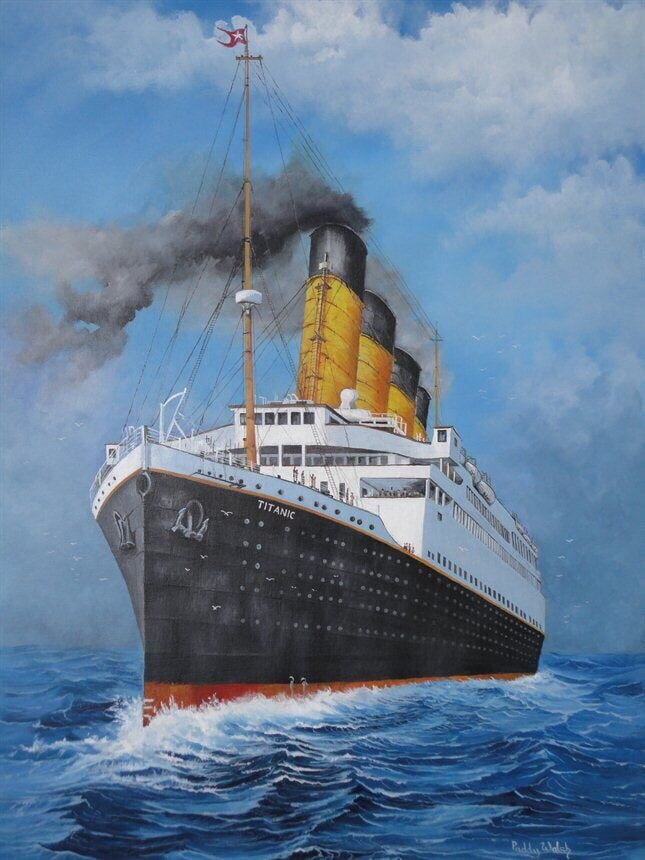
Exactly thirty years ago, on September 1, 1985, the ocean explorer Robert Ballard was faced with what would prove to be the most important discovery of his life: the wreck of the Titanic, lying on the bottom of the Atlantic at a depth of 3,800 meters.
The discovery of one of the most famous wrecks in the world has given rise to years of research, operations to recover the artifacts on the ship and a surge in local tourism, all along with the growing concern to understand how to preserve the remains of the transatlantic.
The Titanic was found some 612 kilometers southeast of Newfoundland, in international waters. Under maritime law, a wreck in these waters is not subject to any national jurisdiction. Since the company that owned the Titanic went bankrupt a long time ago, anyone with the right equipment and experience to reach the ship can dive to visit it. And return to the mainland with the finds found inside.
Visitors have already been able to leave their tracks: in the wreck area you can easily come across modern waste and according to some experts the submarines have damaged the transatlantic liner, stopping on it or going to bump into it. Natural processes are also relentlessly helping to destroy what remains of the Titanic. Some particular mollusks have devoured the wood, while microorganisms have eaten the metals forming rusticles, rust formations with a shape similar to that of stalactites.
Years of legal disputes over the wreck have managed to resolve very little. But according to Ballard, National Geographic explorer, a glimmer of hope begins to glimpse.
What does the future hold for Titanic?
Good news is that the transatlantic liner has been underwater for over a century now. It therefore falls into a new category, that of a UNESCO historical site. The other is that Canada will claim the area on which it is located. Today the wreck lies beyond Canada's Exclusive Economic Zone (EEZ), but the government can request that it be extended. It would be a continuation of the continental shelf: if you can prove that your country's continental shelf exceeds 320 kilometers, you can claim that territory. The Titanic is located on the continental shelf. And, in the end, the recovery operations have reached the point of no return.
What about the ship itself? What is its condition?
Most of the damage is attributable to the human beings who visit the ship. The hull is very strong and the part of the bow is well embedded in the seabed, which allows the structure of the transatlantic liner to remain one.
What you can see instead are the upper parts, more fragile, which are collapsing on themselves. The hull should be able to withstand for a long time, precisely because the bow has hit the bottom, sinking for almost 30 meters. We have the technology to preserve the ship. It can be stored and preserved in situ, but who would do so?
Is it a question of money?
It is, the problem is not the technologies at our disposal. And let's not talk about millions of dollars, the cost would be in line with that required by the operations of conservation and preservation of a building. When I first saw it, I immediately noticed the pink anti-vegetative paint and the fact that nothing was growing on it. A century later, painting still does its job. So why not apply it to the whole hull, so that it does not open up in more than one part?
What can we say about tourism to the Titanic website?
That it has reached its peak, but it doesn't bear enough fruit to be able to bear the costs of the shipments. How many were made this summer? None. Looking at the growth rates of visits in the last 30 years, in practice there have been no new shipments after ours, in 2004. I don't think anyone has gone as far as the wreck in the last decade.
Is this about money?
It is, the problem is not the technologies at our disposal. And let's not talk about millions of dollars, the cost would be in line with that required for the conservation and preservation of a building. When I first saw it, I immediately noticed the pink anti-vegetative paint and the fact that nothing was growing on it. A century later, painting still does its job. So why not apply it to the whole hull, so that it does not open up in more than one part?
What can we say about tourism to the Titanic website?
That it has reached its peak, but it doesn't bear enough fruit to be able to bear the costs of the shipments. How many were made this summer? None. Looking at the growth rates of visits in the last 30 years, in practice there have been no new shipments after ours, in 2004. I don't think anyone has gone as far as the wreck in the last decade.