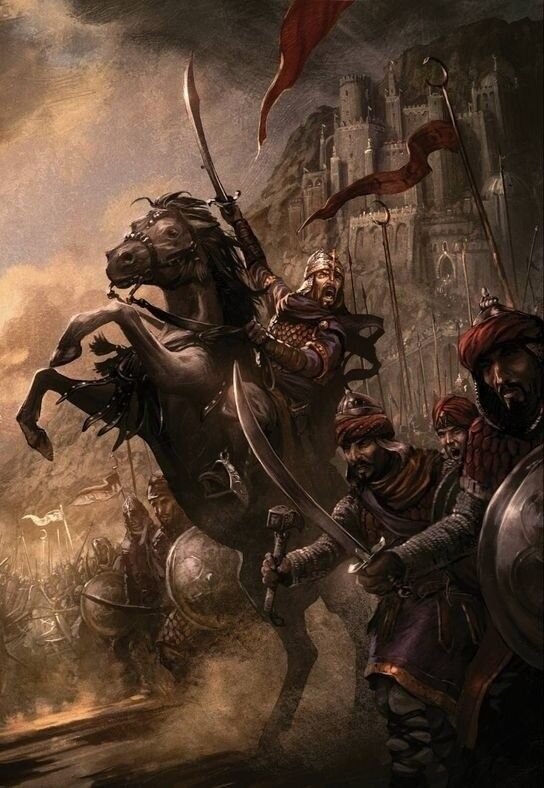
Several such fantastic stories can be found already in the chronicles of the First Crusade. Here is one of these stories.
June 2, 1098, after a grueling siege, the armies of the crusaders captured Antioch. Emir Yagi-Sian escaped from the fortress, and a few days later the numerous troops of Atabek Mosul Kerboga, who arrived at the request of the son of Yagi-Sian, Shams al-Daula, surrounded the city. The Christian knights, who had recently besieged Antioch, themselves found themselves in the position of the besieged. Christian and Muslim troops had to face off.
On June 14, 1098, the Franks defeated the Arabs. All these events were depicted in fantastically transformed form in the chronicles of the Crusades.
Thus, the chronicles describe in detail the visit of the sons of Yaga-Sian to the Atabek Mosul Kerbog. This visit took place shortly after the capture of Antioch by the crusaders. Shams ad-Daula (son of Yagi-Xian), comes to Khorasan in order to ask on behalf of his father “King Khorasan” and Atabek Mosul Kerboga for help in the war against Christians. Chronists retell the conversations between them.
At the headquarters of “King Khorasan” (the Sultan), Kılıç-Arslan and other rulers, talking about the defeats of Muslims and complaining about their deplorable state, paint a picture of decline in the states subject to them: “Our people and army are exhausted, our lands and kingdoms destroyed, our life and everything that we have is in your hands. ”
The Sultan at first with a sneer perceives the complaints of the defeated emirs. He does not believe that Christians who came from far away could attack the Turks. Fueled by pride, he lowly appreciates the valor of Kılıç-Arslan, who has already experienced the strength of Christians. But when the emir Ibn Kutulmush printed the letters of Yagi-Sian, which listed the names of Christian states and the names of rulers, as well as data on the number of Christian troops, the “king” and “noble pagans” (primatus gentilium) were no longer “surprised by the complaints Ibn Kutulmusha “: they were embarrassed by these newses and looked down.
The most noticeable feature of Muslim behavior revealed in these scenes is pride and arrogance. However, the self-confidence of Muslims is quickly replaced by disbelief in their own strengths, they only need to hear about the victories of the Christians or, even more sobering, to measure their strength with the Franks and experience defeat. Those who know the “prowess of Christians” (virtutem Christianorum) behave modestly and restrained. Muslims in general are characterized by a sharp transition from one emotional state to another.
If the sultan who is convinced of the validity of the rumors about the power of Christians is prudent and immediately begins to prepare for war with the Christians, he urges all emirs to go on a campaign, prepares armies, weapons (bows and arrows), carts with provisions, orders them to forge chains in which the Christian captives, Kerboga shows carelessness and does not believe the stories of co-religionists about the strength of Christians.
Atabek Mosul is portrayed by the chroniclers as the most arrogant and arrogant of all Muslim emirs. It is no coincidence that the chronicler calls him “the proud Carboga”, “a stubborn husband full of arrogance and ferocity, underestimating the virtues of Christians,” he puts “boastful words” (jactantia verborum) into the Muslim’s mouth. Karboga gives an arrogant speech in which he talks about his alleged victories over Christians:
“I am surprised ... by the complaints ... of the sons of Yagi-Sian against Christians, whom he allowed to seize their lands ... after all, to repulse them is no more difficult than a miserable unreasonable animal ... At one time, when Kylych-Arslan called me to the aid of the Greek emperor ... near Civito ... I pacified a hundred thousand Christians, chopping off their heads ... and scattering the Christian army ... “.
The meaning of such descriptions of the Muslim’s behavior is to tell about his main sin, the sin of pride (superbia), in a system of Christian values that is clear to the author and the reader, telling about the false and boastful speeches of Karboga.
Telling about what is happening in the enemy’s camp, chroniclers often broadcast monologues and dialogues of Muslim emirs. It is clear that all their pompous speeches were invented by Christian writers who could not hear them. Where, for example, could Albert Aachensky get the content of the speeches of Muslim rulers?
To be continued.