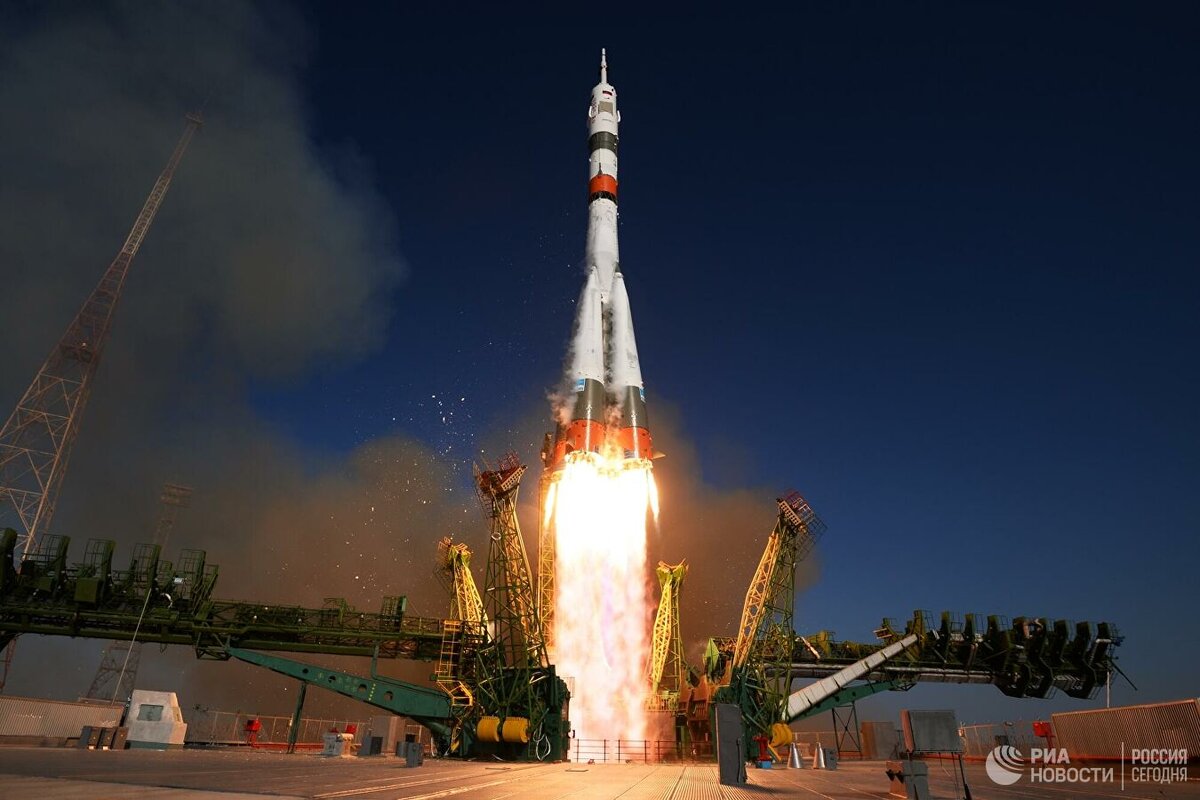
On 22 August 2019, the Soyuz-2.1a medium-range launch vehicle launched the Soyuz MS-14 spacecraft into low-Earth orbit. On August 24, it will have to dock with the ISS. Usually, the Soyuz spacecraft is manned, but this time, for the first time in the post-Soviet period, it flies without a man on board. Instead of people, the role of the payload was performed by the robot "Fedor", which is also unique in its kind.
The launch solves three atypical tasks at once: a set of data on the safety of launches of spacecraft on a new, "digital", "Soyuz" rocket, testing of unmanned spacecraft "Soyuz" and delivery to the ISS "completely" humanoid robot-avatar. If all three innovations prove to be operational, this may have a significant impact on the future of orbital stations and the Russian space industry as a whole.
So far, Russian rockets that launch manned spacecraft into space have been turning the entire launch table to the right angle to enter a particular orbit: the analog control system, coming from the royal family of seven (R-7), did not provide for the possibility of turning the rocket in flight.
The new version of the rocket, "Union 2.1a", thanks to the digital control system can be deployed in the flight itself. This is expected to simplify its operation and replace the Soyuz-FG missile, on which Russia is now delivering people to the ISS.
To make sure that the new control system and the system of emergency rescue of astronauts are compatible, Soyuz MS-14 was sent into unmanned flight. Another reason is the accident in 2015, which happened due to the non-standard operation of the "digital" "Soyuz 2.1a".
That time, after he engines of the third stage, were turned off, the fuel and oxidizer tanks were somehow depressurized, which caused the Progress cargo ship to be in orbit damaged and with an apogee 40 kilometers higher, and even faster spinning around its axis. Naturally, in the end, the truck could not dock to the ISS. Igor Komarov, the then head of Roskosmos, planned to deal with the cause of the loss of "Progress", but over the past four years, it has not been voiced (at least publicly).
Roskosmos is also experimenting with the ship. So far, almost all Russian cargoes to the ISS have been delivered to the ISS by cargo "Progress", the history of which is close to half a century. However, they cannot bring cargo to Earth from the space station itself, such as equipment or experimental materials.
These trucks burn completely in the atmosphere: they do not have a system for landing a descent capsule. Since 2012, Dragon ships from SpaceX have been flying to the station, with the ability to return loads weighing up to 2.5 tons to Earth. It would be optimal to give similar opportunities to domestic space trucks, but to do it without a radical redesign of "Progress" - in fact, the creation of a new spacecraft - is impossible.
There is another way. The Soyuz spacecraft was designed as a manned spacecraft, so it has a descent vehicle with a system of brake parachutes. Theoretically, without people on board, such a device can return a significant amount of cargo from space. Therefore, RSC Energia's designers are planning to adapt Soyuz for unmanned flights. This is especially important in the light of the planned replacement of manned Soyuz with a new, much larger and more comfortable ship, the Federation, which is theoretically capable of even bringing people to the Moon.
The modified 14th MC Soyuz will deliver 670 kilograms of cargo to the ISS, of which 160 kilograms, almost a quarter, is occupied by Fedor, and then it will be able to return several hundred kilograms to Earth.
In the end, based on the unmanned "Soyuz" will create a ship with a modified head fairing, devoid of the system of emergency rescue of astronauts (unnecessary without people on board) and several other components.
Due to this, the ship will be able to deliver to the ISS up to two tons of cargo and take from there up to 500 kilograms. Since the detachable compartment is not removed from its composition, it will be possible to store garbage (weighing up to a ton) generated by the ISS and to be destroyed by combustion in the atmosphere.
The third experiment of Roskosmos, perhaps the most visible to an outside observer, is the flight of the avatar robot Fedor.
One of the most difficult tasks when operating a space station is working in outer space. Sooner or later there is a need for them. Sometimes the docking with the spacecraft leads to damage to the stations (so the Mir station almost died), not so long ago there appeared an incomprehensible hole on the ISS, which had to be inspected from the outside. Sometimes it is necessary to repair or replace external elements of the station, such as solar panels.
Now people are doing it. Such work sometimes lasts for many hours and is rather tedious. Finally, during solar storms, an astronaut outside the station can get a higher dose of radiation than usual.