The Japanese decorate their home, home, place of work and leisure with great art and taste. In Japan, there is the word "ikebana". The most elementary explanatory dictionary of language gives the following explanation: "Ikebana is the art of putting flowers and branches in flower vessels". The special skill is to find the right place for flowers and ornamental plants, to choose a unique combination of shades and patterns of different colours, to choose the appropriate vase or flower bed. These are not vases and flower bowls, but flower pots.
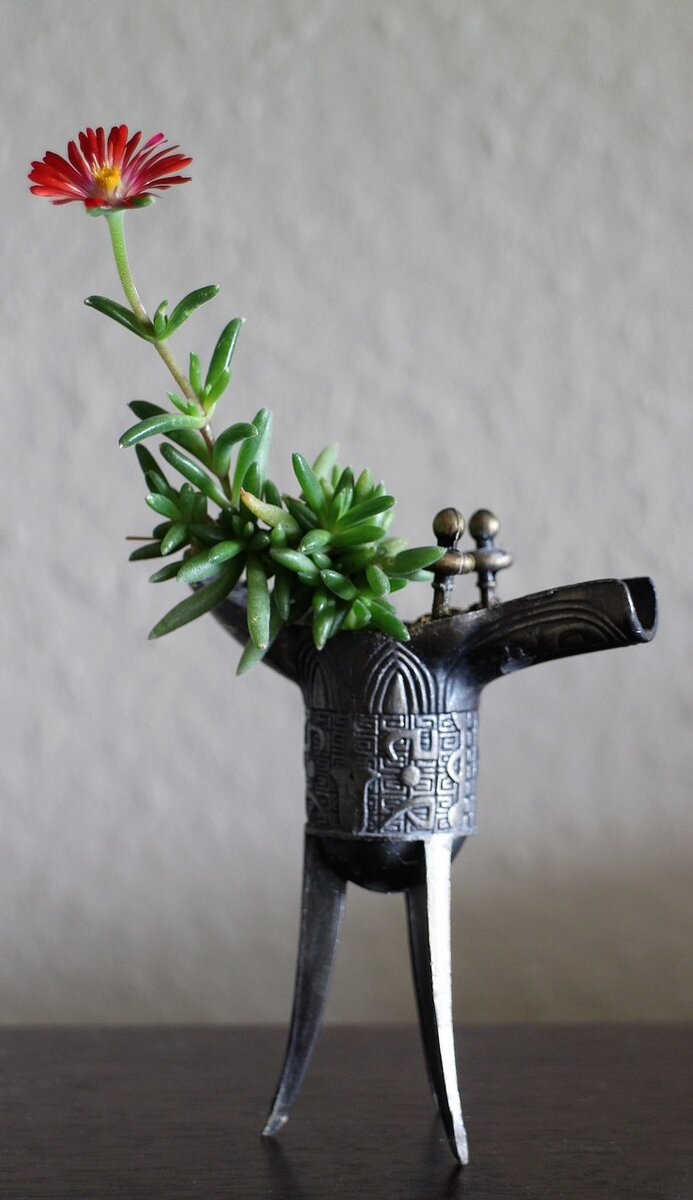
It can be a bronze bowl, all ornamented, on a carved, figured wooden stand, can be copper - various forms - a jug or tripod vessel, can be a cut knee of bamboo, hollow inside, but with a lintel, which makes it possible to pour water into it, can be wicker, basket - different shapes, made of thin plates of bamboo, soaked with a dark composition of ribbons of wood. And least of all - a glass vase ...
Well, it is. Now in Japan, you can sometimes find vases made of plastic ... However, as not without bitterness noticed by the Japanese fall in taste does not happen at all. In the field of the art of decorating with fresh flowers, there are certain artistic principles, peculiar aesthetics, norms of beauty. It has its schools and currents, very different from each other in their principles and techniques.
Knowing the secrets of this art, immediately, at the first glance at how to put flowers and branches, will tell you what school or direction the author of this jewellery belongs to. Flowers and plants are placed in a certain frame and surroundings.
Flowers are most often found in one or two in a vase, not in the form of large bouquets. All the more seldom are flower bouquets on the table or in the halls. The Japanese believe that one or two living flowers on the original stems with leaves, in the appropriate environment, from an aesthetic point of view, can express more than a few or even a whole bouquet. In general, these compounds of flowers and branches, and often only branches, are far from our bouquets. And on a kind, and idea, and functions in life, in a life of the person.
Characteristically, that each flower or branch, in the opinion of the Japanese, should have a certain value. Here the whole philosophy. Often, for example, a high twig means the sky, the middle one means a human being, and the lowest one means the earth. Such a combination of three branches or one branch with specially located branches is called "triad": "sky, earth, man", which has its deep roots in the spiritual life of the people, in their culture and philosophy.
This famous triad dates back to the ancient treasury of thought, the canon of the "I Ching" - the "Book of Changes". the most amazing treatise of Chinese antiquity. It is in this treatise that this triad receives its most complete interpretation: "The sky is above, the earth is below, between them a man" three origins of existence, three of its hypostases, three worlds, three spheres of life - equivalent, equivalent. They are in eternal unity, and at the same time each of them - on its own. They are not separate and at the same time, they are not insignificant. That's what this simple branch says if the branches on it are located properly, meaningfully. The emergence of the original text of "I Ching" According to scientific sources, it dates back to the 11th-7th centuries BC.
Its main provisions were formed on the experience of ancient prophetesses. In the process of its formation, the Book of Changes, which reflected the system of views, a certain worldview of its era, became overgrown with numerous comments and interpretations, acquired philosophical and cultural significance, and then turned into a Confucian canon of ethical, political and cultural nature. The Book of Changes has produced a wealth of literature with many different perspectives on the monument, captivating in its wisdom and mystery.
Sometimes flowers are exhibited on an elegant stand against a wall of a certain colour. Live flowers and ornamental plants can also often be seen next to antiquities, works of art and crafts, calligraphic scrolls or art panels, painted screens.
Typically, these items, which are highly valued and revered in Japan, are usually small in size and are characterized by filigree subtlety and artistic skill.
Miniaturization is a characteristic feature of Japanese aesthetic taste. Actually, not so much, perhaps, miniaturization as such, but what is hidden, is contained in it: the desire for the utmost economy of form with the completeness of the image, all its details.
Undoubtedly, the art of using fresh flowers for decorative purposes, as well as calligraphic painting, images of national architecture, has a certain impact on the spiritual and cultural life of the Japanese people, enriching and enriching the aesthetic taste of man, bringing up in him a love for the true beauty of art, expanding the possibilities of his admiration for the beautiful in life and art, in its various forms of manifestation.