"The plum blossoms, the smell is good, the cherry blossoms, you can't tear your eyes off." Says the Japanese proverb. Here, as at an art canvas, it is necessary to step back a few steps from a subject of admiration to see its proportions, to embrace an eye all frame of live creation. Many people are attracted to these joyful hours by secluded places, mountain peaks, protected corners of pristine nature, where their imagination can be excited by a sudden vision of their favourite spectacle.
Nowhere is there a cult as unique and almost as popular as the cherry tree cult in Japan. Living the cherry branch, which serves as a symbol of the rich and peculiar flora of this island country, perhaps most fully reflects the aesthetic taste of the Japanese people. Among the cherry varieties, mountain cherry flowers - "Kamakura" - occupy a special place. In this word, the Japanese, perceiving it as a whole, at the same time he hears the elements that makeup it: the pit - the mountain, the cherry - the cherry - the cherry, the khan - the flower. And mountains, cherry trees, flowers are the embodiment of "Yamato" - Japan. The name "Yamato" in its mood is close to what is contained in the name "Rus" for Russian.
Plum blossoming is perceived by the Japanese as a sign of the time. With the flowering of plums begins a year, of course, on the lunar, natural, not artificial, astronomical year. In general, all seasons, and their Japanese number twenty-four in the year are connected in Japan with their flowers. The foreshadowing of spring is plum, spring is in full swing is cherry, and one of the autumn seasons is chrysanthemum.
Japanese may resemble our plum tree, but like cherry, it is not fruitful. It is not just a botanical characteristic; it is a factor that determines the semantics of the respective words. For us, the words "cherry" Plum means first of all (if not exclusively) fruit, for Japanese people - plant, flower. By the way, this is where the expression came from, which is very popular among Europeans who have come to know Japan: "In Japan, trees don't give fruit, flowers don't smell" Generally speaking, this is quite true: Japanese flowers in the vast majority of cases do not smell. That's why the Japanese language doesn't even have the expression "smell flowers". They look at flowers. For flowers, the Japanese do not have a nose, but eyes.
Plum flowers are extremely loved by the Japanese people. They are not only a beautiful sight, but also symbolize the irrevocable manifestation of the forces of nature, their awakening from winter sleep, the joyous act of spring. Challenging the winter cold, plum flowers, carrying people a delicate fragrance and beauty, are the embodiment of nobility, the triumph of life-giving forces.
Camellia.
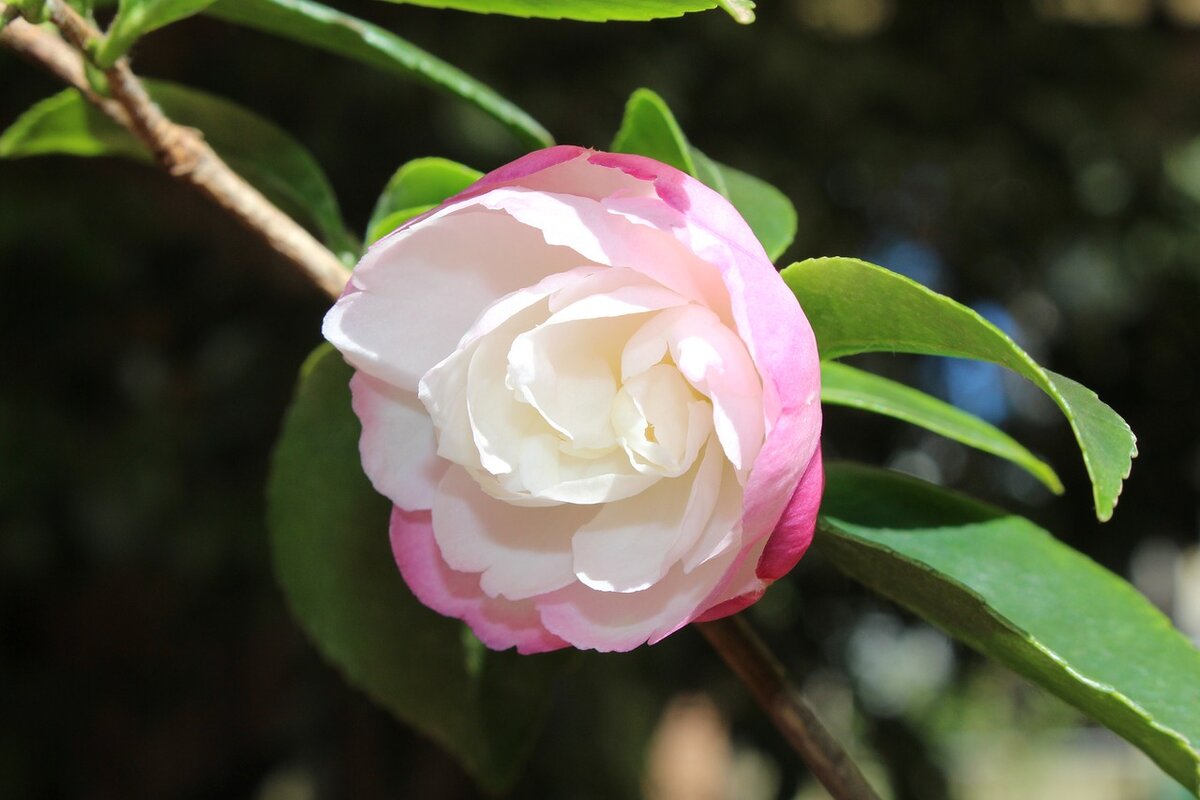
An indelible, charming impression is left by the flowering of Japanese camellias. Ceremonial, festive tree crowns with blossoming camellia flowers, resembling large red agate, and a lot of beautiful freshness, gentle, yet undiscovered buds emphasize the undoubted superiority of this amazing ornamental plant.
The flowers of the camellia are glorified in numerous poetic creations, in the poems of famous artists of the words of different epochs.
Bonsai art.
A great peculiarity of Japanese life is the wide decorative use of dwarf trees and perennial plants. The peculiarity of these plants is that they are often the most unusual forms and configurations, are a bizarre plexus of curves, winding branches.
Sometimes it turns out naturally, but often it is achieved artificially, deliberately by human intervention, forcing the plant to take the most unusual shape. People are always striving to improve, improve wildlife, to subdue the flora of their will and imagination. Japanese people have developed a special art of planting trees - "Ueki" or "bonsai".
For the Japanese, the tree grows spontaneously. If it is raised by man, it is not a natural tree, it is made by man. And what man does is art, or at least it can be art. Also, the distinction between "craftsmanship" and "art" is difficult to distinguish. Therefore, "growing trees" (plants) is both skill and art. From this follows his subordination to the aesthetic aspirations of man.
Dwarf trees are kept indoors, in special tubs, in elegant tiled, glazed, multi-coloured flowerpots, the shape and shape of which correspond to the pattern of the plant, in harmony with it, forming together a complete composition, a kind of a single ensemble.