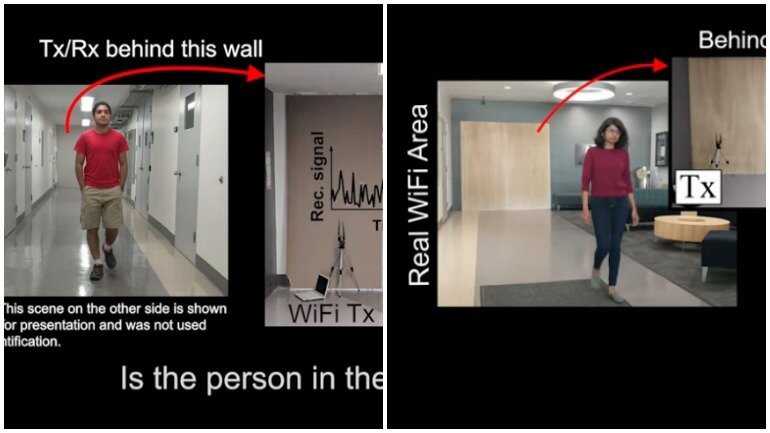
Engineers from the University of California have developed a technology to identify the person behind the wall (or any other similar obstacle) with the help of a regular video camera (or rather a video recording of a person) and signals emitted by Wi-Fi-transmitters. Of course, you shouldn't worry that your neighbors will suddenly start watching you with a router. But the technology looks very curious.
How to identify a person using Wi-Fi
The new method allows us to determine whether the person behind the obstacle is the same person who is on the video. And the video recording does not have to be fresh. Thus, it is too early to start being afraid of Wi-Fi networks.
This new identification system is called XModal-ID, where the first letter is not a letter at all, but a symbol of the "cross", in English cross. Thus the name is pronounced as Cross-Modal-ID. And it can have many applications. Which ones? Well, for example, let's consider a scenario where law enforcement agencies have a video recording of a robbery. They suspect that the robber is hiding inside the house, but there is no confirmation of this. In addition, there may be hostages at home, but you can't "look inside" with cameras. Here XModal-ID will come to the rescue.
Our approach allows us to determine whether the person behind the wall is the same as in the available video materials. All you need is a couple of WiFi transmitters," says one of the authors, Professor Yasamin Mostofi. No preliminary data on the speed of the Wi-Fi connection is needed for this. You don't even need to know exactly where the subject is located. All you need is a videotape of this person.
How does it work? In essence, the principle of functioning is very simple. One Wi-Fi signal transmitter and one Wi-Fi receiver are nearby. Behind the obstacle is a person. The transmitter sends a wireless signal, the power received by which is measured by the receiver. Waves of wireless connection are reflected from the person behind the obstacle. Then, taking into account the existing video recording of a person's gait and movements, the measurements obtained allow you to make a three-dimensional model of the person. It is used to compare the features of behavior with those recorded by the camera.
Identification of a person "through obstacles" is a rather promising technology. Each of us moves uniquely. And to use gait or other features of movement is almost the same as to use biometric data.
In order not to be unsubstantiated, scientists have tested their development on a group of volunteers. Of course, the sample was small - only 8 people. However, this number was enough to prove that the technology was working and that 84% of people were correctly identified.