The best way to promote an esoteric theory or point of view is to create an interesting and impressive analogy, the butterfly effect, which clearly goes into TOP10, although one hundred people who talk about the butterfly effect may actually understand it. None of the people, including the author, did not hinder the popularity of the word. Even Hollywood has used this word to shoot three movies. Of course, the main theme in the movie is a desperate love.
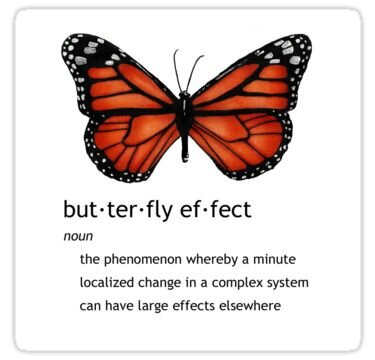
The word butterfly effect comes from the title of a speech in 1979 -
"Predictability: Will a butterfly flapping its wings in Brazil cause a tornado in Texas?",
the American meteorologist Edward Norton Lorenz. The central idea is to demonstrate the impossibility of long-term weather forecasting. No matter what precision is used to obtain the initial data, no matter how complicated the equations are written, the actual weather changes will be more and more deviated from the predictions in the computer. In the days of Lorenz, the weather forecast for more than a week was basically worthless. I don’t know how well the weather forecast for the week is today.
Lorenz's insight into the origins of this mystery is in line with the occasional resentment in the history of science. At that time, Lorenz as a meteorologist studied the weather forecast problem in Oak Ridge and wrote 13 kinetic equations. After inputting the initial parameter values, the supercomputer constantly predicted future weather conditions. Of course, due to the small number of equations. There are not many parameters. The simulation is very rough, but his purpose is not to really predict the actual weather conditions, but to try to gain some insight into the weather changes through simulation.
The equations that can be run on a computer, of course, are decisive systems, exactly the same initial values, and can only give exactly the same result. So one day, Lorenz found that the latest simulation, at the beginning, seemed to be the same as the previous simulation, but when the weather changed slowly, his first reaction was that the program had a problem. Or computer hardware failure (bug). Lorentz, who had nothing to gain after the desperate debug, suddenly realized that one round of calculations were completed, and the ever-changing parameters retained the number of decimal places when running in the computer, more than the number of digits when the parameter was output. He just wants to steal a lazy, not willing to start all over again, because the supercomputer's usage time is limited, so the parameter value outputted by the computer is directly used, but what he never imagined is this insignificant deviation. Actually, the results of the two simulations will be extremely similar from the beginning, and step by step will be completely different.
According to Lorenz himself, he finally realized that he was really fascinated when he ran into a monster hidden in the extremely simple dynamic equation he had written. Suddenly, monsters abound, from the shape of the rising smoke on the cigarette butts to a cup of coffee that is cooling, "chaos" is the essence of the natural dynamics system. This made Laplace's determinism completely bankrupt because this time it was mathematics. Even if the universe is really decisive, it can be unpredictable, because the accuracy of observation is always limited. It is impossible for humans to thoroughly understand the long-term fate of the universe. We can see N steps at most (N depends on the accuracy of the parameters and the equation of the spectrum), but the farther future, is always in the fog, once and for all is impossible. This is a major contribution of Lorenz.
Since Lorenz proposed chaos theory, hidden chaos has been found in many research fields. Take the Newton iteration method as an example. For example, X^5-1=0, there are five solutions. Select an initial value and continue iteratively. Finally, you will get a numerical solution. The closer this initial value is to a solution, the more the solution will eventually be obtained, but if the initial value is on the edge of the five solutions, the singular chaos will occur. If an initial value is finally iterated out of solution A, Then with the initial value immediately adjacent to it, which solution will eventually get chaotic, you can't predict anything except the honest iteration. This area, which is extremely sensitive to the initial value, is the territory of the monster of chaos. This territory is actually related to the game of a mathematician many years ago (fractal).
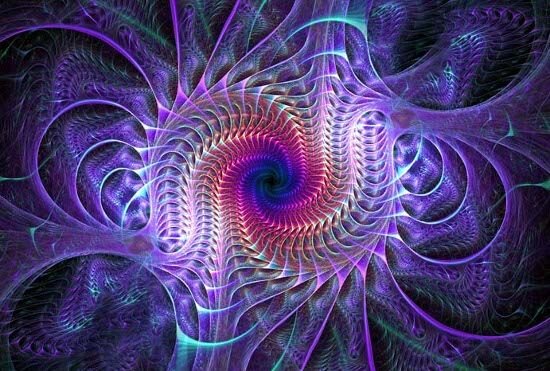
Each point in the picture represents the initial value you took before the iteration began. Since there are only five solutions, each point in the range of the image will eventually and only will iterate out a particular solution. Coloring is performed using five colors, representing the solution from the final iteration of a point. You will see the strange structure in the border zone. This structure is fascinating with typical fractal and self-similar features. In any tiny part of the boundary, the five solutions are entangled with each other. The deviation will jump from one solution to another. The sphere of influence of the five solutions is on the boundary. It is true. You have me and me. , the canine teeth are interlaced five times, huh, huh. Netizens who have done numerical simulation but not this fractal and chaos think.