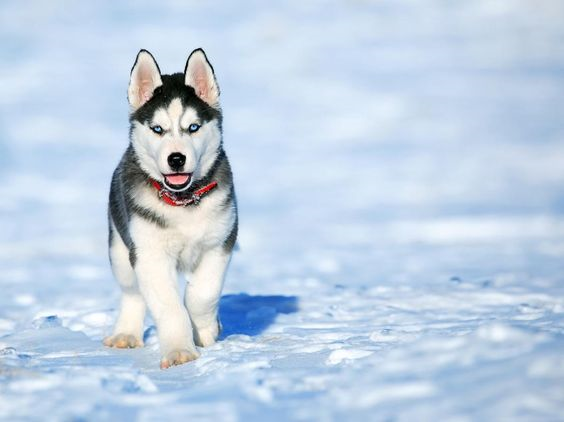
Husky are sled dogs. They contain the blood of northern dogs and wolves. It appeared in the first place in Chukchi, about 4000 years ago. She was a hunting assistant. Originally it was called an "action". Husky" in English means "husky", this dog can't bark, but only growl and howl. Eskimo Husky, or Canadian Laika, is a direct relative of his, they look very similar, so it was given the name of the Siberian Husky. The Russians brought this breed to Alaska in 1907. Dogs had racing qualities, so they began to gain huge demand, they were harnessed into teams and participated in competitions. Then they became less popular, as they were replaced by motorcycles and air transport. In 1934, in the United States, the breed was given a standard.
Husky are stocking and shortbred, fast and enduring. The legs are powerful and muscular. The head has a clear contour, wide from above and narrowing in the eye area. Tail is lowered like a fox, and fluffy. Its hair is unique, very thick, not long, with a soft undercoat, thanks to its structure the dog withstands 60 degrees of frost. Their color is mostly black - white, gray - white, rarely can be found white, brown, white - brown. The eyes are blue or brown, sometimes the eyes are different. They are surrounded by a white or black mask. There are two stripes along the nose. The ears are pointed and triangular in shape.
Cable parameters:
Weight: 21-28 kg;
Height in the withers: 54 - 60 cm.
Females:
Weight: 16 - 23 kg;
Height in the withers: 50 - 56 cm;
Husky has a unique code, which was formed for many centuries. In a sled of 8 dogs, develop speed up to 35 kilometers per hour. They are very enduring and can work well in a team. Thanks to their metabolism, they recover very quickly after races. They cover distances of up to 250 kilometers. So that the dogs do not tear their paws off the snow and ice on them wear special shoes.
The character of these breeds is very willful, they need a host with a strong temperament. They are stubborn and malleable to training, if only to interest them. Dogs are smart and very fond of children and are completely non-aggressive. They live up to 12, 15 years old.
If you decide to start a husku, then be prepared for the fact that very playful. There is a lot of energy in them, so that they do not schoolboy and were obedient to them should be exhausted. They need to walk around a lot and let them run and jump. This is an amazing breed of dog.
Siberian husks come from the vast expanses of Siberia, so people had to tame the dogs, who will be not only friends, but also assistants. In conditions of terrible cold and poor cross-country ability, the Eskimos needed hardy dogs to transport cargo and move in sleigh.
These beautiful and friendly animals, loved by many, come from wild wolves. That's why husks are so wilful! Chukchas had to put a lot of effort into taming them.
Unbelievable, but this breed has survived to this day only because of the interest of Americans who need additional labor. Dogs became particularly popular in the 1930s, during the golden rush. The very name "Husky" comes from a distorted American "Eskimo", which means "Eskimos". Unfortunately, after the revolution of 1917 these dogs were recognized as useless and almost completely removed from Kamchatka.