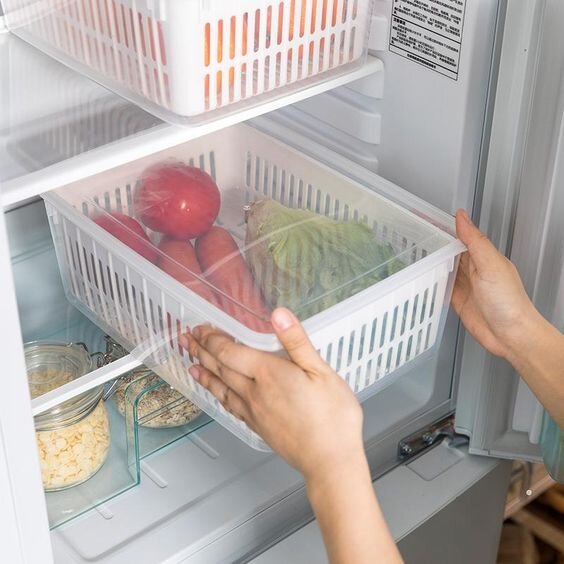
To save food, many people are put into the refrigerator. The food preservation method is very different, and some foods are not suitable for being placed in the refrigerator. Let's share the 20 tips for food preservation.
1. Is the onion always easy to rot? Put the onions in the broken stockings (of course, wash them), hang them up and keep them ventilated, and extend the shelf life for at least 6 months! It is good to cut it when you want to use it!
2. Always store dry ingredients in plastic bags? Try to cut off the bottle mouth and cap of the PET bottle, and put it on the plastic bag to be a good sealing cover!
3. Strawberries bought back not immediately eat afraid of not fresh, rotten? You can use a ratio of white vinegar: water (1:10) to soak the strawberries slightly to keep the strawberries fresh! But still, have to wash it before eating.
4. Where is the custard to be placed? Properly, the cheese should be placed in the most "hot" place in the refrigerator, such as on the gantry of a refrigerator or in a drawer of vegetables.
5. How to prevent potato sprouting? Just keep the potatoes and apples together so that the potatoes are less likely to germinate!
6. Using glass containers to store food is more useful than using plastic containers!
7. Ginger cut too much to use? Just keep a piece of ginger wrapped in plastic wrap and freeze it for at least a week! Note that ginger can't be put into the refrigerator!
8. Bananas are always cooked very quickly? Just wrap the banana head with plastic wrap and extend the shelf life of the banana for 3-5 days!
9. Remember, if there is a broken apple in the fruit basket, you must pick it up quickly, otherwise the other fruits in the same fruit basket will start to rot!
10. Do not put onions and potatoes together to save, otherwise, it will break faster!
11. Lettuce salad if you can not finish, you can put a paper towel on it, then wrap it with plastic wrap and send it in to the refrigerator ice, the paper towel will absorb 1 excess water to prevent damp!
12. Tomatoes that are not yet mature should be placed in paper bags or on separate shelves until they are mature; mature tomatoes should be stored in a cool place and protected from direct sunlight.
13. Bought a baked nut step know how to save? Ice to the refrigerator is right! You can also maintain their flavor, and bake them on a baking tray for 15 minutes at 350 degrees before eating, which will restore their aroma and color!
14. Save the asparagus should first cut off the asparagus stems, and then dipped into the bottle filled with water, then take the plastic bag to put the asparagus into the refrigerator, can be stored for a week or so, not only asparagus, celery can also be the same Kind of preservation.
15. If there are green vegetables with rhizomes, they can be wrapped in aluminum foil and placed in the refrigerator to make the crispness of the vegetables more durable! Remember to make a mark on the aluminum foil paper, you will remember what the bread is!
16. Buy a mushroom into the refrigerator to pay attention to! It is best to use "paper bags" to pack them. If you use plastic bags, the water will not evaporate and the mushrooms will break down faster!
17. Is it necessary to cut the onion every time? You can cut it into a bottle and put it in the refrigerator to freeze it! It is good to use the amount you want to use when you use it.
18. The cut inside the custard will always become hard? Just use a little cream on the cut surface, it will not make the inside of the cheese inside hard!
19. How do you want to save the coriander, the nine-story pagoda, and the leeks that you bought from the market? Stand them in a plastic container, cover them with plastic bags, and put them in the refrigerator to keep them fresh!
20. Food spoilage is very common in life, and it also brings us a lot of troubles. If any kind of food never deteriorates, it will be more worrying to eat. Therefore, the method of preservation of food is particularly important.
- Cryopreservation
Cryopreservation can inhibit the reproduction of organisms and slow down the rate of decay of food, but it does not completely kill microorganisms. Pay attention to temperature control during low-temperature storage. Generally speaking, the lower the temperature, the longer the storage time will be.
- High-temperature sterilization
After high-temperature treatment, the food can kill most bacteria and enzymes. If it is sealed, vacuumed and rapidly cooled, it can effectively delay the spoilage of food and prolong the storage time. For example, we often drink bags of pure milk, beer, and pasteurized milk.
- Dehydration and drying
Dehydration and drying means that the water in the food is reduced below a certain limit, the microorganisms are not easy to grow and reproduce, and the activity of the enzyme is also inhibited. Dehydration methods commonly used in the home are sun exposure, dryness, heat evaporation or freeze-drying, and the like. It is worth reminding that although the method of sun exposure is the simplest, the loss of vitamins is also the most.
- Increase osmotic pressure
This name seems to be difficult to understand, but in fact, most people have used this method. For example, picking food with salt or sugar. When the concentration of salt is 8%-10%, it can inhibit the reproduction of most microorganisms, but it cannot be completely killed. To kill microorganisms, the concentration of salt should be controlled at 15%-20%; the sugar concentration of candied food should be controlled at 60%-65% to inhibit microbial growth. Seal and moisture should be taken when storing. Common candied foods include preserves, preserves, and jams.
- Increase hydrogen ion concentration
Most bacteria cannot grow normally in an environment with a pH of 4.5 or less, so they can be preserved by increasing the concentration of hydrogen ions. Vinegar is the addition of vinegar to food. This method is often used in fruits and vegetables, such as pickles, sauerkraut, and sour bamboo shoots.
Good Luck, Friend ;)