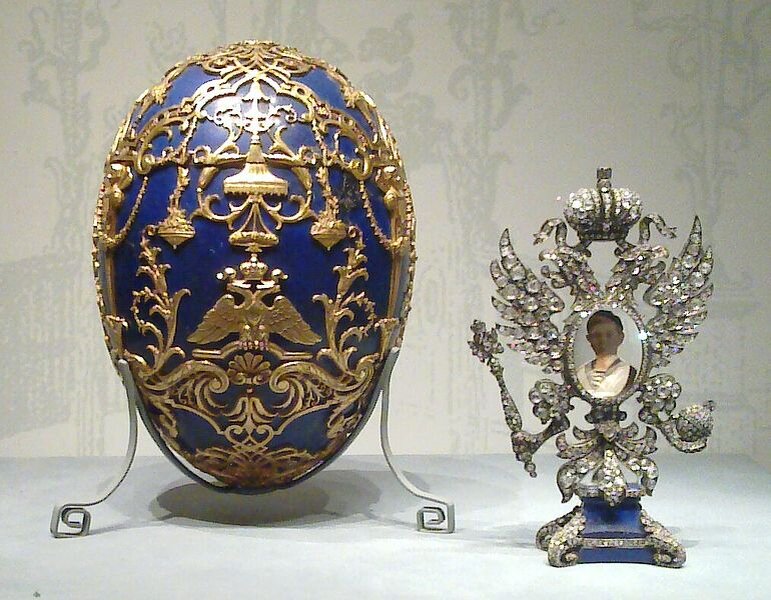
For example, on the occasion of the bicentenary of the construction of St. Petar's, Fabergé made an egg "Peter the Great" for Easter 1903. The body of the egg is decorated with a gold ornament with small diamonds and rubies. On four miniatures on an ivory portrait of Peter I, Nikolay II, kinds of the Winter Palace and the House of Peter the Great are placed. In egg, the tiny replica of the well-known "Bronze horseman" frozen on a rock from a sapphire has settled down. The inner cover over the monument is covered with white enamel as if permeated by sunlight.
The Armoury holds ten Easter eggs, the earliest of which dates back to 1891. In total, Carl Fabergé's company produced more than fifty Easter eggs for the imperial family, but currently, only 48 of them are known to be located.
Some of the Fabergé products were taken abroad by Russian emigrants after the revolution. Abroad was the rarest collection of Fabergé's works from the collection of the Yusupovs, which now forms the core of the Hillwood Museum in Washington. And in Paris, the egg "Gatchina Palace", created by the master Mikhail Perkhin about 1912, was sold. The egg is divided into twelve segments by small equal pearls, covered with white transparent enamel on the guilloché drawing in the form of moire waves and decorated with an ornament from red bows and green leaves. The surprise of egg - a model of the Gatchina Palace, the favourite residence of Maria Feodorovna, from four-colour gold with all architectural details and monument to Paul I before a facade.
Works of art and personal belongings of the royal family of Armand Hammer, Alexander Schaeffer and other "collectors" were bought in batches. And silver items after the revolution were often sold so easily, without regard to their artistic value. Alexander Schaeffer once began working in the Hammer Gallery, and later opened a company in New York City "Russian Villa" - one of the richest and most famous firms in the sale of Russian antiques. The world's second most important collection of Fabergé's products by big businessman Malcolm Forbes was purchased through the "Russian Villa" (about 360 items) for sixty percent.
Fate scattered the work of the company Carl Faberge all over the world. Easter eggs-surprises can be seen in many museums in America - in Washington, New Orleans, Cleveland, Baltimore, as well as private collections in the United States and Europe.
In 1989, at the initiative of Maureen O'Connor, Mayor of San Diego, and the State Museums of the Moscow Kremlin, an exhibition entitled "Fabergé's Art: Easter Surprises" was organized. The exhibition was held in San Diego and Moscow and featured 27 Fabergé Easter surprises from different collections.
Two eggs were kindly presented at this exhibition by Queen Elizabeth II of England. The English Royal Collection of Faberge's works is the largest in the world and includes more than 450 items. Queen Alexander began to collect this collection, and subsequent English monarchs continued to add to it. Of particular interest from the royal collection is an egg called "Mosaic", which amazes with its ingenuity, virtuoso craftsmanship and sophistication of jewelry work. Instead of silk threads, rubies, diamonds, sapphires, and green grenades sparkled on the thinnest platinum stone. The surprise of egg - the oval screen on support with tiny profile portraits of children of emperor Nikolay II. On the other side of the screen, there is a basket of flowers and an inscription with birthdays and names of newborns.
Faberge's special merit lies in the fact that for the first time he used Ural and Siberian gems and gems of the Caucasus in his products of amazing beauty. Sellers of stones were welcome guests in his house, and he himself, naturally, was a recognized connoisseur of minerals, not without reason, he became a gem appraiser at the imperial court. The company's products such as watches, snuff-boxes, cigarette cases, jewelry, souvenir gifts, miniature sculptural figures of people and animals, miniature toys and much more became famous.
The workshop of the famous jeweler Carl Faberge also produced exquisite perfume bottles. One of them, in the form of an owl, is in the collection of jeweler Gez von Habsburg. This is the largest private collection of precious bottles of Fabergé company, it has forty bottles. According to experts, such a collection is estimated at hundreds of thousands of pounds sterling.