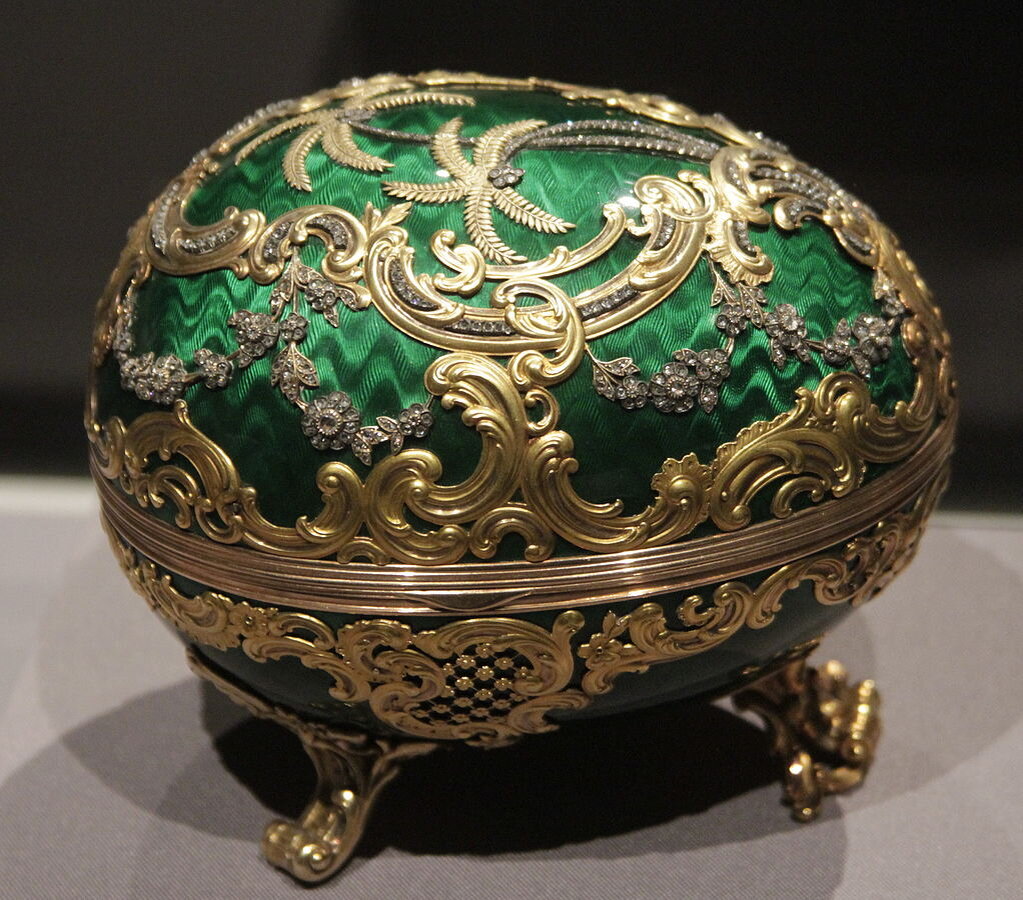
Products with the Carl Fabergé brand are admired by both inexperienced viewers and subtle connoisseurs and collectors. The company began its brilliant journey in 1842 when the well-known jeweler Gustav Faberge opened a small jewelry workshop in St. Petersburg on the Bolshoi Sea Street. At first, the modest workshop and work were carried out in accordance with its size. These were fashionable gold bracelets, brooches and medallions in the form of stones with buckles, more or less skillfully combined at the time. But with the entry into the business of Gustav Faberge's sons, Carl and Agathon, the studio expanded and the artistic side of jewelry production became the subject of their special concerns.
Both brothers received their artistic education abroad. Carl Fabergé, who later became the head of the firm, studied in Dresden at a trade school. After graduating, he set out on a journey through Europe to improve his jewelry skills and at the same time study economics.
In 1870 Carl Fabergé returned to St. Petersburg and immediately put his knowledge into practice. In addition, he had a rare gift from the organizer, was the main source of ideas and the final judge of the implemented ideas. One of the first works that made the Fabergé brothers famous was copies of Kerch jewelry commissioned by German Emperor Wilhelm II. A copy of the famous necklace with amphorae pendants, made by jeweler E. Kollin, attracted the attention of connoisseurs at the All-Russian exhibition in 1882 in Moscow, where she received a gold medal. And the international success of the company's products came to Carl Faberge three years later at the Nuremberg exhibition.
Soon, the products of the jewelry company were noticed by the court circles of Russia, which for many years became the main customers of Carl Faberge. Now the collection of the Armoury Chamber stores about 300 products of masters-jewelers of the famous firm. These are mainly cutlery and tableware, but the most interesting part of the collection are Easter surprises and carved figures made of stone.
Easter in Russia has always been especially revered, and the custom of making gifts in the form of Easter eggs was very common. Not only did they use intricately colored real eggs, but they were also made of a variety of materials: wood, porcelain, papier-mache, and ornamental stones. Here, too, Carl Fabergé's fantasy found its worthiest use, particularly ingenious in creating gifts for members of the imperial family.
In 1885, for the Easter celebrations, Carl Fabergé made the most original souvenir, which preserved the form of traditional folk "dye", but surprised with the novelty of the idea. An ordinary egg at first glance was made of gold and covered with a dense layer of white earth. The hull could be divided into two parts and, having lifted the top half, look inside. There, in the hemisphere of golden yolk, as in the onion on the eggs, sat a little chicken of colored gold. All the details were made so carefully that one could see not only the small scallop or round eyes of a bird but even the smallest of its feathers.
However, miracles did not end there. The chicken, in turn, also contained a surprise, and not even one. It contained two miniature items: a ruby testicle and an imperial crown. This small diva was made by the order of Emperor Alexander III for a gift to his wife - Empress Maria Feodorovna. The surprise made the most favorable impression, and since then the company has been preparing a new gift for each Easter - always unexpected and original.
Emperor Nicholas II ordered two eggs for Easter and gave one to his mother, Empress Maria Feodorovna, and another to his wife, Empress Alexandra Feodorovna. The drawings of Easter eggs were not presented for approval to the highest ladies, Carl Fabergé had complete freedom in choosing the plot. This work was difficult, as it was often necessary to select events from the life of the Imperial House or memorable dates of Russian history.
To be continued in the next part -
https://zen.yandex.ru/profile/editor/id/5d923f5735c8d800b2dec55f/5d95e1ab4e057700b1180f05/edit