Approval of the coat of arms
The coat of arms usually has to be fixed somewhere in a certain way. Of course, heraldry has always been a huge number of unverified coats of arms. But this fact shows that, in theory, the coat of arms should be confirmed. This is done (and so too, of course, did not happen at once), as a rule, the highest authority, the monarch or other head of state, in which there are appropriate institutions engaged in heraldry.
These are heralds (associations of heralds), which can exist under different names. It seems that the oldest currently existing heraldry is English, which exists almost since the War of the Roses. In pre-revolutionary Russia, its own heraldry called Geroldmeisterskaya office was created under the Senate, the supreme governing body, in the era of Peter the Great in 1722. Later it received the status of a board, and then was transformed into the Department of Heraldry of the Governing Senate. In modern Russia, there is a Heraldic Council under the President of the Russian Federation, which is headed by the State Heraldry Master.
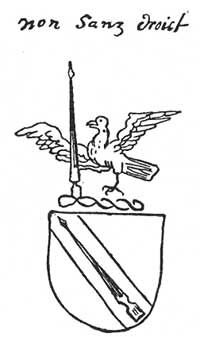
Legal significance of the coat of arms
It is important to understand that a coat of arms has a certain legal meaning: it indicates special rights, a special status of its owner, who distinguishes it from others. Personal and generic heraldry originally testified to the fact that the owner of the coat of arms belonged to a noble class of knights. In old Russia, the right to the coat of arms had only the nobility. Of course, in late medieval Europe appeared coats of arms and non-privileged estates, such as burgherstva, but again they went back to the old tradition of existence of knightly coats of arms and also demonstrated the class status of their owners. In other words, heraldry could only appear in a stratified society, where there are certain classes with their traditions, rights and duties, there is a certain hierarchy, the structure of relations and the like. Such a society was the society of the high Middle Ages. Therefore, it would be strange to talk about any heraldry in Antiquity or in the civilizations of the Ancient East. There, too, could exist and existed their own emblematic systems, but this is not heraldry as such.
Being a phenomenon of medieval origin, heraldry was inherited and later times, where it continued to exist and develop. Like the clan coats of arms, the coats of arms of corporations (universities, religious associations, craft workshops, etc.), the coats of arms of cities, also testifying to their legal status, and, finally, the coats of arms of states, demonstrating their sovereignty, also had a clear status. This legal nature of the coat of arms made it a kind of legal "deputy" owner. Expulsion from the knighthood was achieved by public "execution" of the coat of arms (for example, by turning it over from top to bottom), and the fall of the shield with the coat of arms on the ground was perceived as a ruin of honor. We see the same in the modern world in relation to the state symbols, when their public disgrace means an insult to the state itself.
This important aspect shows us that, for example, in today's Great Britain, which remains a monarchy, personal and tribal heraldry continues its history, because there is a noble title, albeit formally. In modern Russia, however, heraldry may be, in addition to the state one, for example, territorial or urban, but the clan is devoid of any meaning, as legally all citizens of the country are equal in their rights and estates do not exist. Therefore, modern Russian heraldry does not assert, and can not assert, personal and family coats of arms, and their original creation by all kinds of firms and public organizations is nothing more than a pure water profanation and a way to exchange the financial resources of a trusting and not too familiar with the essence of the population to meaningless, albeit beautiful, pictures.