Perhaps the word comes from the ancient Greek (Magnetis líthos), "the stone of Magnesia" - from the name of the region of Magnesia and the ancient city of Magnesia in Asia Minor, where in ancient times were discovered deposits of magnetite.
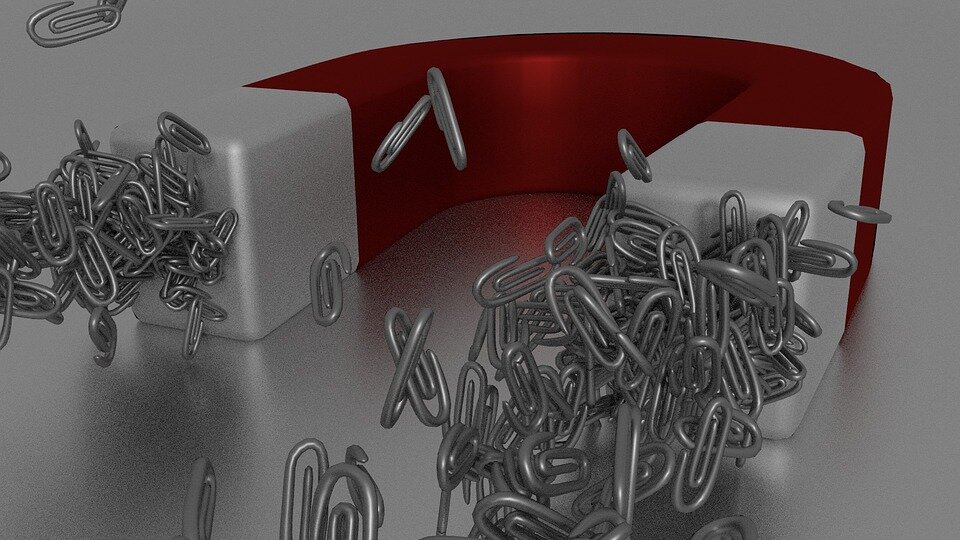
The simplest and smallest magnet is the electron. Magnetic properties of all other magnets are conditioned by the magnetic moments of electrons inside them. From quantum field theory, the electromagnetic interaction is transmitted by a mess-free boson, a photon (a particle that can be represented as quantum excitation of an electromagnetic field).
The ancient legend tells about a shepherd named Magnus (Leo Tolstoy's story for children "Magnet" of this shepherd named Magnus). He once discovered that the iron tip of his sticks and nails of his boots are drawn to a black stone. This stone began to be called the "Magnus stone" or simply a "magnet" by the name of the place where iron ore was mined (the hills of Magnesia in Asia Minor).
Thus, many centuries B.C. it was known that some rocks can attract pieces of iron. This was mentioned in the 6th century B.C. by the Greek physicist and philosopher Thales. The first scientific study of the properties of the magnet was undertaken in the 13th century by the scientist Peter Peregrin.
In 1269 he published his work "The Book of Magnets", where he wrote about many facts of magnetism: the magnet has two poles, which the scientist called northern and southern, it is impossible to separate the poles from each other by breaking. Peregrin also wrote about two types of interaction of poles - attraction and repulsion. By the 12th-13th centuries, A.D. magnetic compasses were already used in navigation in Europe, China and other countries of the world. In 1600 there was an essay of the English doctor William Gilbert "About magnet". To the already known facts, Hilbert added important observations: strengthening the action of magnetic poles with iron armature, loss of magnetism during heating and others.
In 1820, Danish physicist Hans Christian Ersted tried to demonstrate to his students the lack of connection between electricity and magnetism by including electric current near the magnetic arrow. According to one of his listeners, he was literally "stunned" when he saw that the magnetic pointer had begun to oscillate after the current was turned on.
Ersted's great merit is that he appreciated the significance of his observation and repeated his experience. Having connected the long wire of the galvanic battery pole, Ersted pulled the wire horizontally and parallel to the freely suspended magnetic arrow.
As soon as the current was turned on, the arrow immediately deflected, trying to stand perpendicular to the direction of the wire. When the direction of the current was reversed, the arrow tilted to the other side. Ersted soon proved that the magnet is acting with some force on the wire that carries the current.
The discovery of the interaction between the electric current and the magnet was of great importance. It was the beginning of a new era in the teaching of electricity and magnetism. This interaction played an important role in the development of physical experiment techniques.
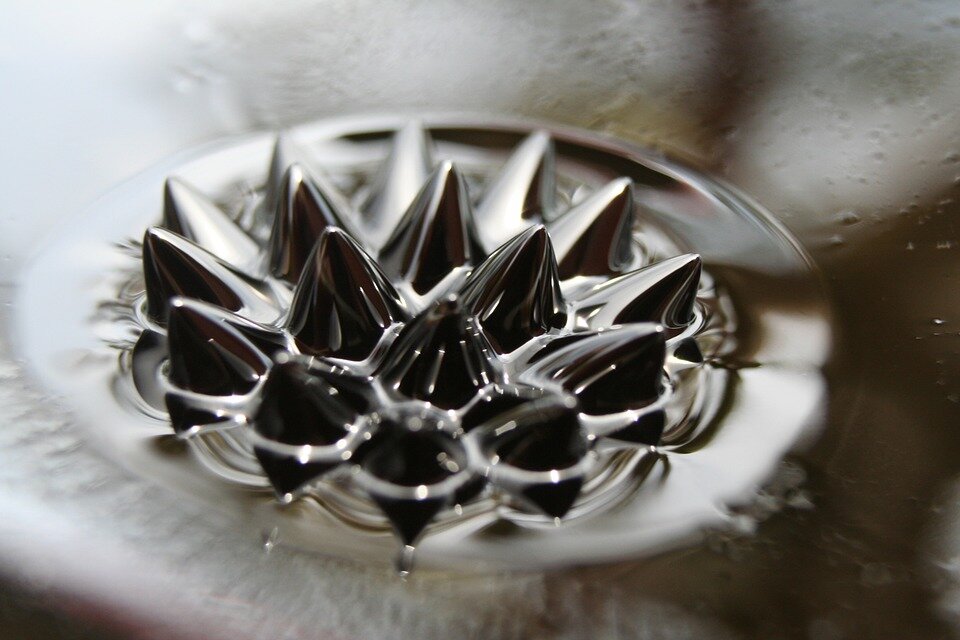
After learning about the discovery of Ersted, French physicist Dominique François Arago began a series of experiments. He wrapped a glass tube with copper wire and inserted an iron rod into it. As soon as the electrical circuit was closed, the rod was heavily magnetized and the iron keys stuck to its end; when the current was switched off, the keys fell off.
Arago looked at the conductor that carries the current like a magnet. The correct explanation of this phenomenon was given after the study of the French physicist André Ampere, who established an internal connection between electricity and magnetism. In September 1820, he informed the French Academy of Sciences of his findings.
Then Ampere replaced the frame with a freely suspended spiral conductor in his "machine tool". This wire acquired the property of a magnet by passing a current through it. Ampere called it a solenoid. Based on the magnetic properties of the solenoid, Ampere proposed to consider magnetism as a phenomenon due to circular currents.
He believed that a magnet consists of molecules with circular currents. Each molecule represents a small magnet, being located by the same poles in the same direction, these small magnets form a magnet. Conducting a magnet along the steel strip (several times in the same direction), we make the molecules with circular currents to orient themselves in space equally.
Thus, the steel plate will turn into a magnet. The Arago experience with a glass tube wrapped in copper wire is now clear. The iron rod inserted into it became a magnet because of the current flowing around it. It was an electromagnet.
In 1825, English engineer William Sturgeon made the first electromagnet, which is a bent soft iron rod with a thick copper wire winding. The rod was varnished to isolate it from the winding. The iron rod acquired the properties of a strong magnet when the current was transmitted, but lost them instantly when the current was interrupted.
It is this feature of electromagnets that allowed them to be widely used in the technique.