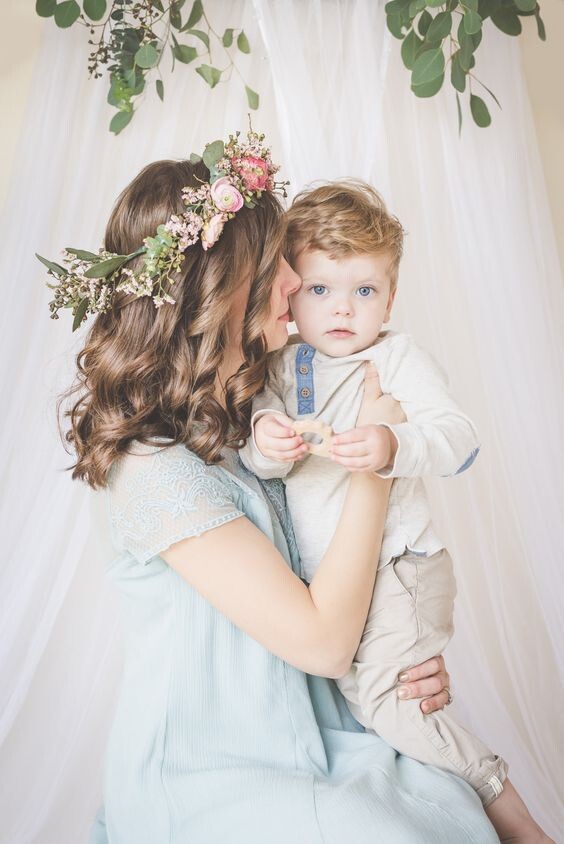
Think about it: when you're in the shops who pull out of the stack of black clothes that one orange shirt and says: "Mom with this color would you look great?"
When your makeup in a different way or wear something colored, who compliments you and says "how beautiful are you, mum?"
I'm sure you think, "she's telling me because it's my baby dress, Mommy's heart!"
That's not true! He tells you because he's your best image consultant.
Children have a greater capacity than adults to recognize color combinations.
Your children know that happiness is in color.
Your children are happy to see you more colorful.
Your children are happy to see you beautiful.
Your children are happy to see you shine.
And above all, your children recognize the magic of image counseling.
Think about it: what is the most common color in your wardrobe?
I'll try to guess: black, beige, grey, blue, maybe blue.
When you were a child, what was your wardrobe like?
Colorful! I still remember my orange period full of optimism.
If as children we look for colors, why do we forget them with time and become beige, gray, black?
Children don't need to do the color analysis with me, they already know which colors make them feel better and illuminate their personality.
Children don't buy for duty, they are not influenced by rules or must-have, they follow the instinct and joy of wearing something that causes them positive emotions.
Children follow their feelings to decide how to present themselves to the world.
Children are looking for clothing that speaks of their personality.
Children want to buy and wear what looks like them, without thinking of anything but a genuine expression of what they are.
Children with fashion enjoy themselves and use it as a tool.
When they realize that they are individuals and begin to claim their individuality, one of the first things they do is to decide how to dress.
They understand that being able to choose is an opportunity for communication.
They invest time in understanding if they want a shirt rather than another, they build the looks with precision, they get angry if someone else chooses for them (mom noo that shirt nooo) and they pay attention to their decision.
They understand that the choice of what to wear will define them and appreciate the possibility of having a whole new tool to communicate and tell their uniqueness.
And in fact, fashion allows them to say: this is me and if I decide to wear two shoes of different colors I can do it because I am unique and I have the right to think differently from anyone else.
If then I also match the different colors in my dress even better.
Children can admire themselves in the mirror with their new clothes, they can see the folds of the shorts, the embroideries and the designs on the t-shirts.
The children fall in love with their clothes.
I still remember my favorite clothes as a child and the feeling of well-being that it gave me to put them on me.
Children understand that wearing the clothes they love will give them the confidence they need to face the world.
Children understand that wearing the clothes they love will make them smile more and help them recognize their beauty.
Children also understand that with clothes they can tell their passions.
When they exclaim "I want the Peppa Pig T-shirt" they don't talk about trends, they don't want a particular design on the shirt because it's fashionable or because friends have it too.
They want that design on the jersey because they identify with a certain character and/or appreciate the values that the character communicates to them.
Wearing the shirt with Peppa Pig will be like saying to others: I love Peppa Pig, it's fantastic, it makes me feel good when I look at her, she talks about friendship, she smiles, she makes me feel happy, and I want to have on me, on me, like a second skin, all these positive things.
The children know that the dress does not make the monk but they also know that if you are a princess the best way to show it to others is to dress as a princess.
Children understand the magical power of accessories: all they need is a crown on their head to make it clear who you really are. An accessory will immediately explain the best of you even when you're in your pajamas.
"I want a tulle skirt to be a dancer" is not a futile desire or a tender phrase, it is the will to assert myself through clothing.
It's having the strength to use a very powerful visual means to give me importance, to believe in what I can be, in what I can become.
We who are adults have lost this strength a bit but, fortunately, there are our children who, still pure and without superstructures, can help us to find a new relationship with our clothes.