Parachute - from the French parachute (from the Greek para - "against" and the French chute - "to fall") - the device for braking the object at the expense of atmospheric resistance. It is used for safe descent from the height of people, cargoes, spacecraft, reduction of mileage when landing planes, etc.
It is believed that for the first time the idea of creating a parachute came to the Italian Leonardo da Vinci. In his manuscript of 1495, it is possible to find the following text: "If a man has a tent made of starchy canvas, each side of which has twelve elbows in width and the same amount in height, he can throw himself from any height, without exposing himself to any danger. The manuscript also contained a sketch of a man tied to a sail and falling from the tower. The sail at four corners is grabbed by ropes and has a bulge upwards. This is the first mention of a safe descent from a height.
At the beginning of the seventeenth century, another Italian scientist, Faust Verancino, described a lowering apparatus similar to Leonardo da Vinci's invention and pointed out that the size of the sail depends on the gravity of the person. Frenchman Lavin first used a similar design in the twenties of the seventeenth century. Being imprisoned in a fortress, he decided to flee. Sewing out of a sheet tent, he attached to his bottom plate of whale mustache and rope. Holding on to the ropes, he jumped from the wall of the fortress into the river flowing downstream and was safely brought in.
In 1777, another Frenchman, Jean Daumier was sentenced to death and was to experience the flying cloak of Professor Fontanzh. If he was lucky, he was promised to give life. He also jumped off the roof of the prison tower and survived.
The practical application of the parachutes began with the development of balloon flight. The first parachute was invented and put into practice by Louis Sebastian Lenorman. In 1783, he made a successful attempt to jump out of the ground floor window, holding two umbrellas of 30 dm in diameter with the ends of the ribs drawn by ropes to the handle. Then, together with Abbot Bertolon, he made several similar experiments on various animals.
According to Lenorman's calculations, the 14-foot diameter umbrella would have been sufficient for the safe descent of a man if he and the umbrella had not weighed more than 200 pounds. In December 1783, Lenorman threw himself on a similar parachute from the tower of the observatory. He called his invention "parachute" by French franc - "parachute". Although his design did not find practical application because of the inconvenience of attaching it to the balloon basket, he approved the name for such devices.
The drawback of the parachutes of those times was the constant swaying of the dome when it was lowered. This problem was solved by the British. Cocking in 1836 made the device in the form of a cone, turned downwards with its tip and spread out with a light frame; he believed that with such a device, the gravity suspended from the tip, will make the device fall, and in the cavities of the cone formed a thin space, which will cause a significant difference in pressure on the lower and upper surface of its parachute, which will slow down its fall. The result of the experience was the death of the inventor, due to too fast fall.
Another scientist, Laland, offered to make a hole for the air to escape from the dome. This principle is applied in many parachute systems today.
In the 20th century, aviation began to develop rapidly. Parachutes were needed to rescue pilots. Parachutes of the previous design were cumbersome and could not be used in aviation. A special parachute for pilots was created by Russian inventor Gleb Kotelnikov. In 1911 he registered his invention - a free-action backpack parachute. The parachute had a round shape and was placed in a metal backpack located on the pilot using a hanging system. At the bottom of the backpack under the dome, some springs threw the dome into the air stream after the jumper pulled out the exhaust ring. Later, the rigid backpack was replaced by a soft one, and on the bottom of it, there was honeycomb for stacking slings in them. This rescue parachute design is still in use.
In 1919, Leslie Irwin designed the parachute, which was placed in a shoulder bag. His idea was also realized by G.E. Kotelnikov, who developed 2 more models with different bases.
After the revolution, Kotelnikov continued to work on parachutes for Soviet aviation. For the first time in the USSR, the rescue parachute was used by test pilot M.M. Gromov. This happened on June 23, 1927, at the Khodynka airfield. He deliberately put the car in a corkscrew, could not get out of the corkscrew, and left the plane at an altitude of 600 m. It is known that the parachute of the American firm made of pure silk was used. Then all the pilots who escaped with the help of the parachutes of this company were given a distinctive sign - a small golden figure of mulberry silkworm.
In the same year, the parachutes saved the lives of two more test pilots V. Pisarenko and B. Buchholtz. Soon, a special service for the rescue of pilots in flight appeared in the aviation. Its organizer was L.G. Minov. In 1929 he went to America to get acquainted with the work of the parachute rescue service. There he performed several parachute jumps. Upon his return, he led the first training jumps in the Soviet Union aviation.
The increase in the speed of the planes made the flights more dangerous. Therefore, ejection systems with parachutes gradually began to appear. They were first tested in 1947 by G. Kondratov.
Also, several design offices were created, which designed parachutes. In a short time, several new parachute systems were created, which allowed to start training pilots in parachute jumping technique. And on July 26, 1930, a group of military pilots led by Minov for the first time performed jumps from a multi-seat aircraft. This day is considered the beginning of mass development of parachuting in the USSR.
In 1936, the Doronina brothers invented the world's first automatic parachute opening device. This device has made a real revolution in parachuting. With these devices, parachutists could jump from any height in the most difficult weather conditions.
Nowadays, electronic devices are used to facilitate the tasks of parachutists and protect their lives. Parachutes have become very popular. There are several types of parachutes: stabilizing, braking, cargo, rescue, military, sports, etc.
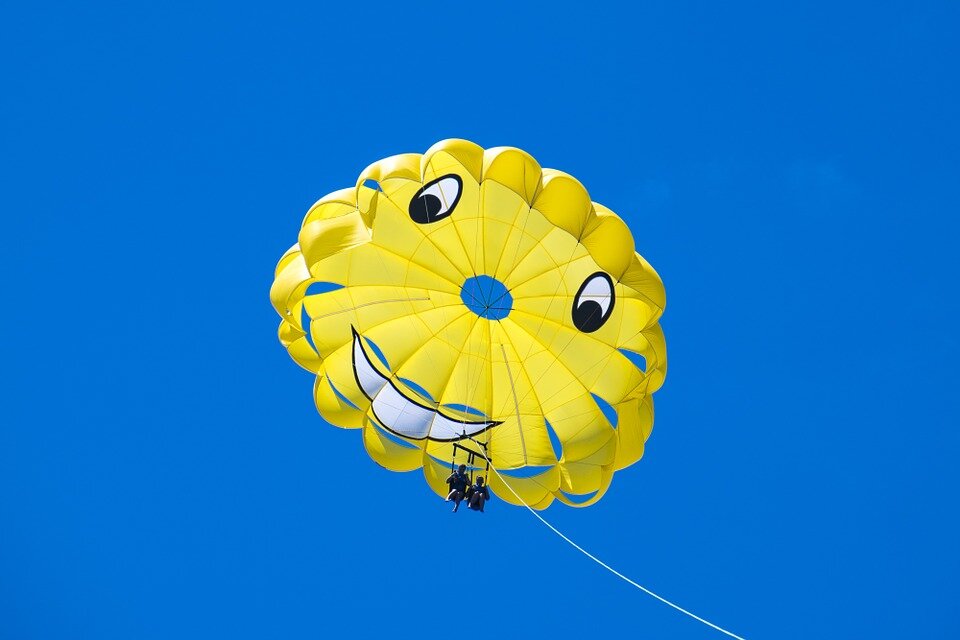
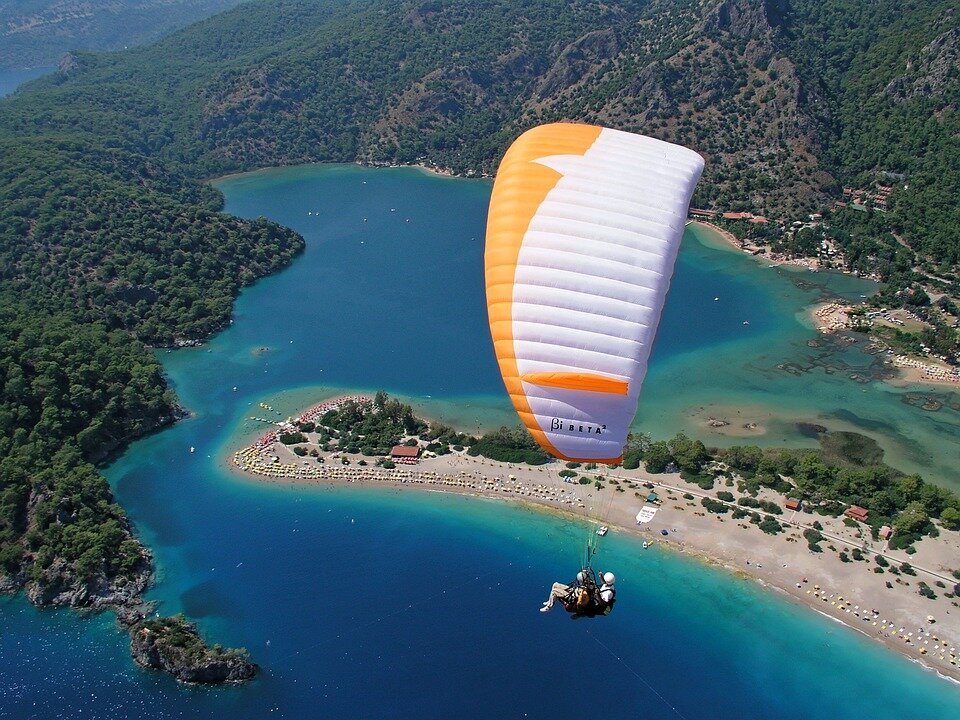
Round and oval domes from the sport gradually replaced the domes of the new generation. These domes are "wing" type, first appeared in the 70's, they have good maneuverability and stability. Modern parachutes develop horizontal speed up to 20-27 m/s at a weight of only some kg, and the area up to 16 square meters. These domes do not have stabilizing parachutes and are designed for more experienced athletes.
It is difficult to overestimate the importance of parachutes today. They are used to ensure the safety of pilots and passengers, to organize entertainment events, and for independent jumps.
Parachutes have become much more reliable and durable. It is practically impossible to have any interruptions in their functioning.