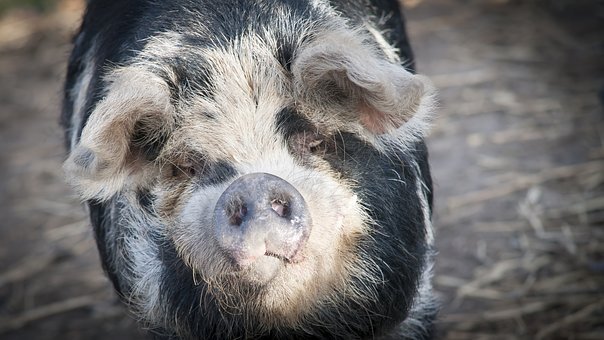
We've all heard the expressions "sweating like a pig" or "I'm sweating like a pig" sometimes. We've probably used it ourselves. But are you sure that the expression corresponds to reality?
Is it true that pigs don't sweat? If popular myths are based on real facts or if it is just an exaggeration or a false belief about pigs.
So why don't pigs sweat? We have to know that these mammals lack the sweat glands responsible for the generation of sweat (which we humans do). For this very reason a pig cannot sweat.
This causes pigs to use other methods of body thermal regulation, such as rolling in mud or immersion in water. It is even known that, in desperate situations where they do not have a wet cooling medium at their disposal, they can roll in their excrements and urine to survive the heat and lack of moisture on their skin.
What animals do they sweat? Do cats and dogs sweat?
In general, mammals tend to have self-regulating body temperature mechanisms. However, the methods vary considerably from one method to another.
Primates, uridians or humans have glands, sweat glands, which are responsible for the secretion of sweat, which has the function of refreshing our body. However, not all mammals have them, this is the case of dogs or cats, as well as rodents, these animals year other tactics to control their body temperature.
How do cats sweat?
They do it through pads, chin, anus and lips. Also, one of these self-regulatory strategies is grooming. Thanks to their saliva, they keep the coat and skin moist, which allows them to cool down.
How do dogs sweat?
Yes, they do too, through their tongue and pads.
On the contrary, amphibians and reptiles in general are animals that do not have internal mechanisms to regulate their temperature, so they need the heat of the sun or other external sources to keep their bodies at a suitable temperature.
Where does the expression come from?
As we've seen, pigs can't sweat, so where does this famous expression come from? To know the origins of this phrase, we must go back in time, in the United Kingdom. It is here that the expression was born, because it does not refer to the pig as an animal, but to what in English is known as pig iron, that is, a product obtained by melting iron in a special furnace.
The English expression would be "Sweating like a pig" and refers to the fact that when the iron is melted, at very high temperatures, it is subsequently poured into molds so that it takes the desired shape and a mold called pig is used. The name comes from the similarity of this mold with the shape of the pig's udders. "Sweating" meant that, to know if the iron had solidified, you had to check that there was a layer of liquid on its surface, the sweat of the pig.
Is the pig the cleanest animal?
False myths about pigs not only concern sweat but some also deal with their hygiene. One of these, and perhaps the most widespread, is the one that alludes to the fact that pigs are dirty animals.
Again, this is a reckless belief, because pigs are clean animals, provided they have sufficient space and a good environment.
Furthermore, we must not forget that pigs are very intelligent and sensitive animals, so they must always be treated with respect and with decent living conditions.
Pig breeds
Some of the most frequent and widespread breeds of pig are:
Vietnamese (cup belly pig or Thai pig): it is known to be a small pig and very popular until recently as a pet. They are a good choice only if we know their needs well and keep in mind that, although smaller, it is still a pig.
Black Iberian: this Spanish breed is famous all over the world for its use in the meat industry, but it is a particularly friendly breed. Its hair is usually red or black.
Yorkshire: from the county of York to England is a pink pig with a long and wide body. It has a great reproductive capacity (litters of over 12 pigs).
Danish Landrace: European breed, originally from Denmark, is white and has the longest body of all breeds.
Hampshire: its coat has a pattern that mixes black and white. These animals have a white stripe on the front of the body, which also covers the front legs.
Duroc: of American origin, has a rustic anatomy and great adaptability, its skin is of a tone ranging from yellowish red to dark red.