In the countries of Western Europe, stone-cutting art has passed a long way of development to the XVIII century, and many museums of the world possessed masterpieces of Ancient Egypt, classical antiquity and the Renaissance. In XVII-XVIII centuries the art of stone processing was famous for masters of Florence and Milan, France and Saxony, England and Sweden. And though in XVIII century the technique of processing of a color stone in Russia to has reached certain successes so that stone-cutting business for the first time began to play an essential role in domestic jeweler culture, Russian masters had to catch up with the foreign brothers in the shortest terms.
One of the Russian stone-cutting centers was created in Altai, but it was preceded by a long period of study of the richest bowels of this region. The earliest information about the presence of colored stones in this area was collected in 1744-1745, and in the spring of 1745, a large search expedition was sent to Altai, which delivered to St. Petersburg the first samples of ornamental stones. And in the spring of 1786, nine search batches of colored stones suitable for "processing columns, vases, and tables" were sent to the poorly studied areas of the Altai River Aley. Then, several more expeditions visited these regions, and in the Russian capital was born the idea of the possibility of not only mining but also processing the stone in Altai.
The choice fell on the Loktevskiy copper and silver smelting plant, which was located on the elbow (bend) of the river Alei. Not far from this radiated deposits of magnificent ornamental stone - black porphyry - were found. By the end of 1787, another 210 varieties of ornamental stones had been discovered, and thus the raw material base for stone-cutting in the Altai was well prepared by nature itself.
In the summer of 1786, simultaneously with the extraction of the first blocks of black porphyry, the construction of a grinding mill (modeled after Peterhof) began at the Loktevskiy plant. As a rule, stone products were created by order of Her Imperial Majesty's Cabinet, and, of course, this imposed a special responsibility on all the work of stone-cutting masters. At first, the vases were made in one piece, without the "taken out gut", but then there was an opportunity to drill the inner cavity of the product.
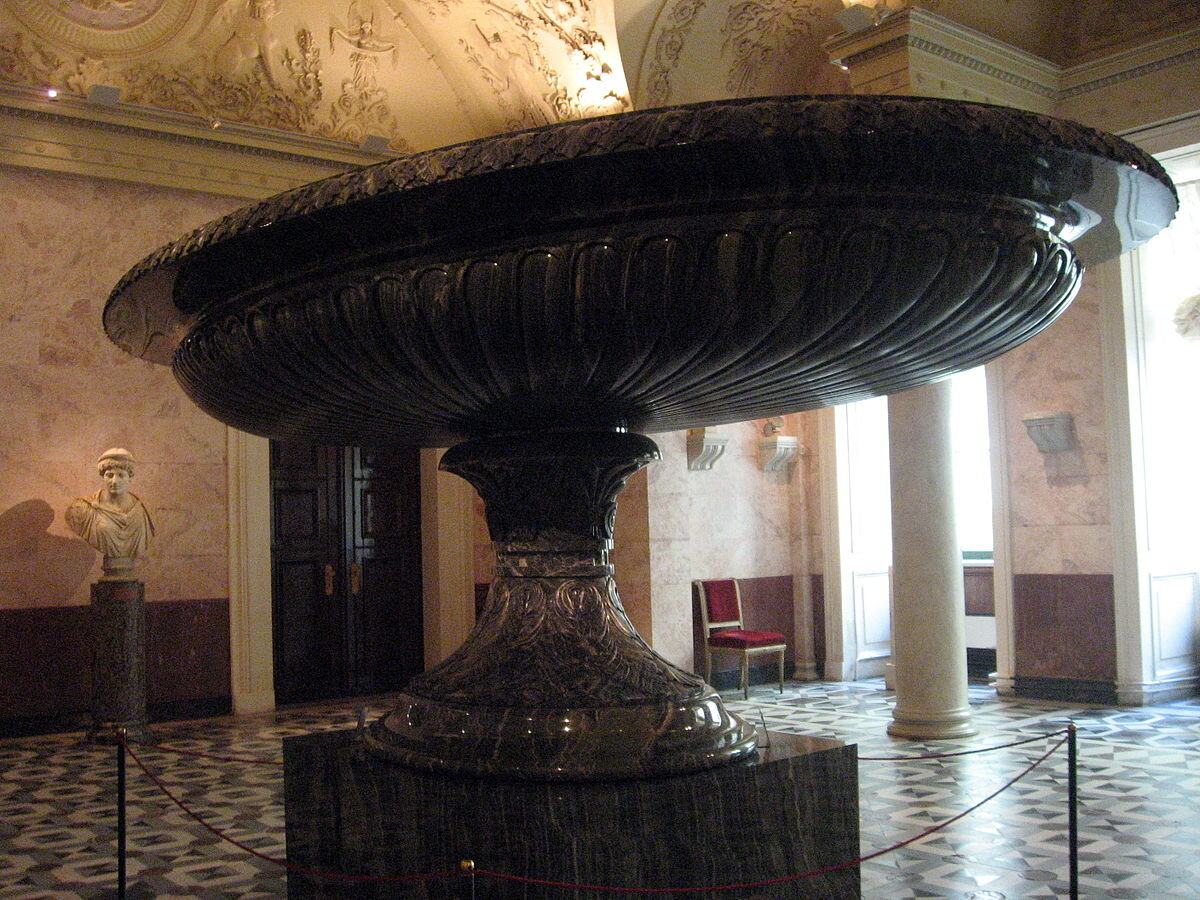
An exceptional place among the Altai products is occupied by the famous Kolyvanskaya vase - the largest vase in Russia. And not only Russia! The "Queen of Vases", made of jasper and weighing 19 tons, is the largest vase in the world.
In 1819 Unterschitmeister I.S. Kolychev, mining blocks for columns at the Revnevskaya quarry discovered a jasper block of about ten meters long. When the block was separated, it turned out to be bifurcated, and most of it reached five and a half meters. After a while, the factory manager sent to the Mining Department description and a model of the extracted block: "The plan and profiles of the stone piece extracted from the green-wave Rhubarb jasper, with which the wooden model of 1820 was made according to the same scale".
The fact that it was possible to sharpen a five-meter-long jasper monolith was a wonderful event in itself. The processing of this breed is an unusually difficult process, because jasper, with its high hardness, but at the same time very fragile, can not stand the impact, which sometimes leaves many cracks on it. It is known that two pedestals intended for the vase bowl, in the process of processing died. But the Altai masters were able to work with jasper, and that's what one of the archive documents says about it: "The local masters are used to working with this rock and know all the methods of handling it without damaging the stone in case there are small cracks.
In September 1824, M.S. Laulin, the factory manager, reported to the head of the Kolyvano-Voskresenskie plants that the block after cleaning can be used on the product "Hellenic form of 7 arses length". Obviously, at this time, the vase drawing was also ordered. The project of architect A.I. Melnikov was approved by the highest authority in October 1824, and a month later it was sent to M.S. Laulin with the instruction "that the bowl was started to work according to this drawing, according to the suggestions... of the size, but with that only difference, that the spoons appointed on the bottom end of the bowl were made convex, not deepened". However, this project was not yet final, after three years at the factory was created the final drawing, and before that the factory was sent a plaster model of the vase-bowl.
During the summer of 1828, the jasper block was processed under the guidance of I.S. Kolychev, and in September 230 people dragged it to the stonecutter's shed and placed it, raising it about one meter above the ground, on special stands. In 1829, about 15 centimeters of rock was taken out of the stone with "rough edging", and "its lower ground was removed with a facet up to half its diameter".