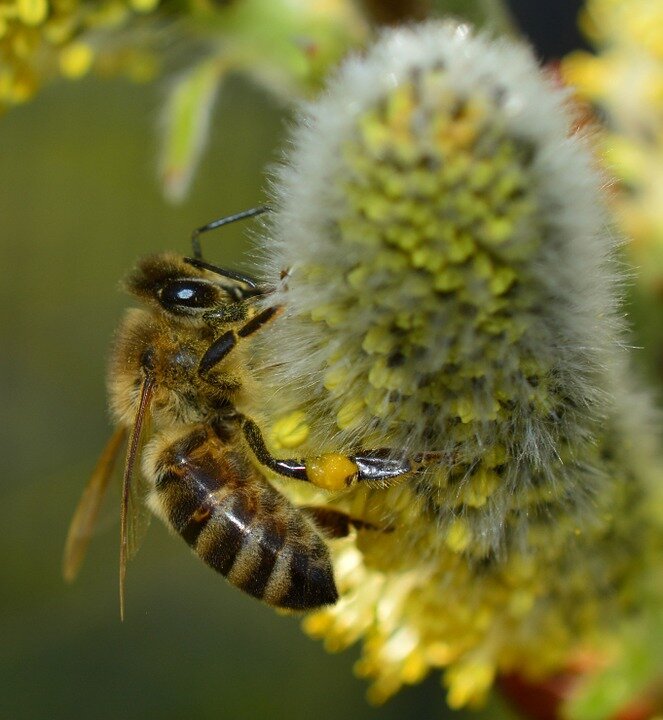
Increasingly worrying reports continue to spread about the decline in the bee population. Ecological groups, knowing the importance of bees, continue to put pressure on governments to protect them. Government institutions prohibit only part of the products that are toxic to bees. Besides, climate change continues to accelerate and the habitat in which bees live continues to decline.
Role of bees
Bees are hymenoptera insects of the Apoidea super-family, as well as another important pollinating insect, the hornet. The best known species of bees and the most important for humans, is the Apis mellifera, one of the European types of bees. It is a domestic species used for the production of honey, also the artificial hives are placed in the vicinity of fields and crops to encourage pollination of plants. This is undoubtedly one of the most important roles played by bees.
The use of pesticides, some of which are prohibited by the European Union, is responsible for the death of these bees, as well as wild bees. This has led to the appearance of bees resistant to certain pesticides, which have led to a decrease in the population of wild bees and bumble bees, which are less resistant.
In many cases beekeepers move their hives to places quite far from the original area. They are contracted by farmers to have their bees pollinate their plants. This behaviour leads to the spread of foreign diseases and parasites, which mainly affect wild bee populations.
Importance of bees in the ecosystem
All types of bees are important for the balance of the ecosystem. We do not only have to worry about domestic bees. It is thanks to bees that many plant species are pollinated in forests, grasslands and several other ecosystems, allowing the formation of fruits that will serve as food for many other animals.
Not all bees are sociable insects, in fact many species are solitary. There are also nocturnal bees that pollinate certain plants that only bloom at night. Finally, bees are part of the diet of many birds and other animals. Some species, such as the bee-eater (Merops apiaster), feed almost exclusively on bees, although as an insectivore it can feed on many other insects.
Usefulness of bees
Without the contribution of bees in this world many species of plants would cease to reproduce, as they could not pollinate. Many fruits and seeds would cease to exist, including the plants that humans feed on. There would not even be plants used to feed livestock, with obvious consequences. Therefore, the importance of bees is fundamental for agriculture, and ultimately for life.
But then, what would happen if the bees disappeared? Without them in the fields and forests we would not have food. A world without bees is a world without food. Bees also produce honey, propolis, royal jelly... foods known and appreciated throughout the world for their benefits and properties used from nutrition to pharmacology.
The disappearance of bees
We are increasingly aware of the importance of bees and their fundamental role in human nutrition, but this does not seem important enough to find a solution to how to save bees.
It is precisely the human being who is most responsible for the decline of this species.
Bees are not disappearing for one reason only, but for a combination of factors that are contributing to the current situation. The first and most important factor is the loss of habitat, due to the degradation of ecosystems or their destruction, or the replacement of forests and fields with intensive farming. Another important and consequent factor is the fragmentation of the habitat, which causes the genetic isolation of the various groups of bees and therefore increases the phenomenon of consanguinity.
The invading species are another factor that favours the disappearance of the bees, due to the appearance of new parasites and diseases. Climate change is also having a major impact on bees, as well as many other animal and plant species.
All these factors do not act independently but are all related and feed on each other in a vicious circle that is mainly due to the human being.
The life cycle of bees is incredible, for this reason many people wonder how to build a beehive and contribute as much as possible to the increase of the population of the different existing species, especially those in critical danger of extinction, such as the Megachile cypricola or the Bombus rubriventris.