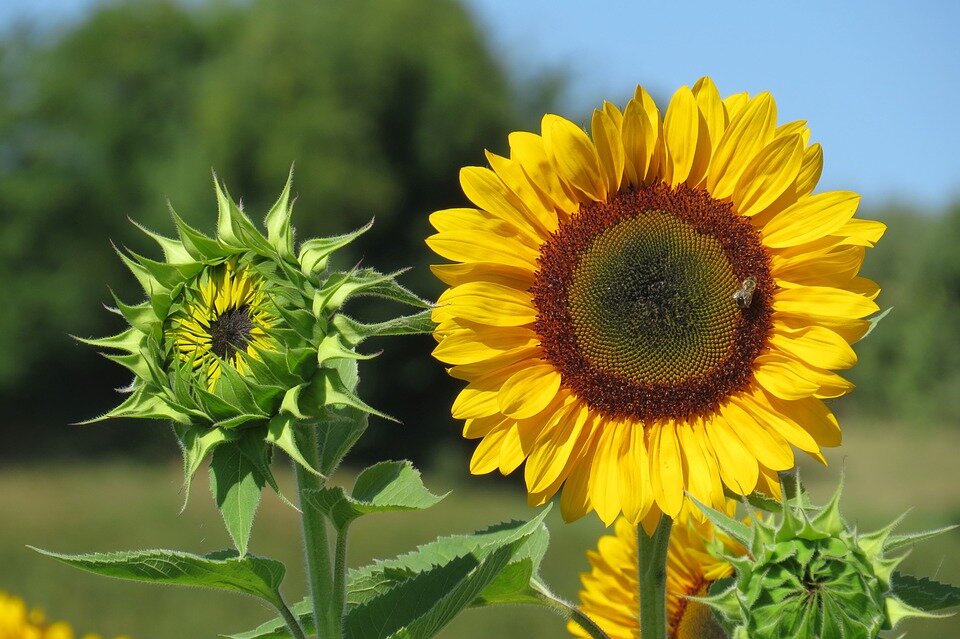
Sunflower is an annual herbaceous flower. It usually blooms in summer. Sunflowers can purify the air. Sunflower is an ornamental plant. It is medicinal. It likes sunshine.
Introduction of sunflower
Sunflower is a sunflower family, annual herb.
Sunflowers are native to South America, and domesticated species were brought from Europe to Europe in 1510 by the Spaniards, initially for ornamental purposes. At the end of the 19th century, it was again brought back to North America from Russia. It is cultivated in China. Sunflower seeds are called sunflower seeds. They are often fried and eaten after eating. They are delicious. You can also use sunflower oil for food. The oil residue can be used as a feed.
Morphological characteristics of sunflower
Sunflower is a 1-year-old herb with a height of 1.0 to 3.5 meters and a hybrid of half a meter high. Stems erect, stout, rounded and angular, white bristles.
Flower head, very large, 10 to 30 cm in diam., solitary on the top or branch of the stem, often dip. The total bracts are multi-layered, leafy, imbricate, pubescent, flowering in summer, yellowish ligulate flowers at inflorescence margins, not sturdy. The middle part of the inflorescence is a bisexual tubular flower, brown or purple, firm.
Achenes, obovate or ovate-oblong, slightly compressed, corrugated, gray or black, commonly known as sunflower seeds.
The sunflower plant is composed of five parts: root, stem, leaf, flower, and fruit.
root
The roots of sunflower consist of the main root, lateral roots, and fibrous roots. The main roots are deep into the soil, the lateral roots are born from the main roots and grow horizontally; there are many fibrous roots on the lateral roots. Root roots and roots are rooted. The roots of sunflower are developed and distributed widely and deeply in the soil. The growth rate of sunflower roots is always faster than that of stems. The roots grow fastest before and after the formation of the disk. When the seeds begin to mature, the roots no longer grow, and then gradually wither. In addition, a large amount of water roots (gas-like aerial roots) can be grown under suitable conditions.
stem
The stems are round and erect, have a rough surface and are bristled. The stem is composed of cortex, xylem and spongy marrow. In the late growth stage, the stems are lignified, while the pith in the stem forms a hollow. The height of stems varies greatly among different types of varieties. The same variety, plant height is affected by sowing date and cultivation conditions, and the difference is also great. The growth rate of stems is the fastest from flowering to flowering. At this time, the height of growth is about 55% of the total height, and the growth rate is slowed down, accounting for only about 5%. The branching nature of sunflower, one of which is determined by heredity and the latter is caused by environmental conditions.
leaf
The leaves of sunflower are divided into cotyledons and true leaves. A pair of cotyledons. True leaves are often opposite in the lower part of the stem from 1 to 3 knots, and the above are alternate. The true leaves are relatively large, with short, hard bristles on the leaves and petioles, and a layer of wax. The number of leaves varies from species to species, with early maturing species generally ranging from 25 to 32 and late maturing species ranging from 33 to 40. The lower leaves of the stem produce nutrients before flowering, mainly for root growth, and their functions are basically completed by flowering. The nutrients produced by the middle and upper leaves are mainly supplied to the disk to promote seed formation.
flower
Sunflower is a flower head, growing on the top of the stem, commonly known as the flower disk. Its shape has three types: convex, flat and concave. There are two kinds of flowers on the disk, namely lingual flowers and tubular flowers. The lingual flower is 1-3 layers and is placed on the edge of the disk. It is an asexual flower. Its color and size vary from species to species, with orange-yellow, yellowish and purplish-red colors, which have the effect of attracting insects to collect honey for pollination. Tubular flower, located on the inside of the lingual flower, is a bisexual flower. The color of the corolla is yellow, brown, dark purple, and the like.
fruit
The fruit is achene, which is used to be called seeds and melon seeds. It is commonly known as sunflower seeds and is edible. The fruit includes three parts: the peel, the seed coat, and the embryo. The edible seeds are longer, the black and white stripes of the peel are the majority, the peel is thick, accounting for more than 40% of the seed weight, and the 1000-grain weight is 100-200 grams.
to be continued... https://zen.yandex.ru/media/id/5d7a02d8c31e493cc4208489/sunflower-part-2-5d95d0b843fdc000ae925481