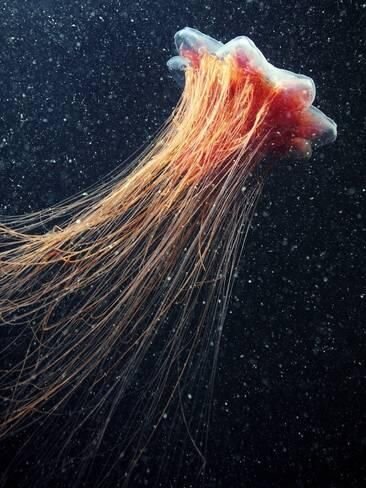
Did you know that the longest animal in the world is a jellyfish? It is the Cyanea capillata, most commonly known as the lion's mane jellyfish, and is even longer than the blue whale.
The largest specimen known to exist was found in 1870 on the coast of Massachusetts. Its bell (or umbrella) was 2.3 meters in diameter and its tentacles reached 36.5 meters in length.
The common name, jellyfish lion mane, comes from the physical appearance and similarity it has with the mane of the king of the forest. Inside the mane of the jellyfish you can find other animals such as shrimps or fry of zaprora silenus that are immune to its poison and that find in it an excellent source of power and protection against other predators.
The jellyfish lion's mane has eight bunches in which the tentacles are grouped. It is thought that they can reach up to 60 meters in length and have a color ranging from red to purple to yellow.
The lion's mane jellyfish feeds on zooplankton, small fish and other species of jellyfish that are trapped in the tentacles, to which it injects the paralyzing poison through its stinging cells. This paralyzing effect facilitates the ingestion of the prey.
Habitat of the world's largest jellyfish
The jellyfish lion's mane lives mainly in the icy and deep waters of the Antarctic Ocean up to the North Atlantic area and the North Sea.
There have been few sightings of this jellyfish because it lives in the abyssal zone, which is an area that goes from 3000 to 6000 meters deep and rarely comes close to the coast.
Behavior and reproduction of the Cyanea capillata
Like the rest of jellyfish, their ability to move depends directly on ocean currents and is limited to vertical and almost never horizontal movements. Given the limitations of its movement, it cannot follow prey and the only weapon it possesses are tentacles.
In most cases, the jellyfish lion mane stings are not fatal for people but can cause severe pain and rashes. In extreme cases, if a person were trapped in the tentacles of this jellyfish, the sting could be fatal due to a large amount of poison absorbed by the skin.
Lion mane jellyfish reproduce in summer and autumn. Even if they mate, they are known to be asexual, so they can produce both eggs and sperm without needing a partner. The mortality rate of this species is very high during the first days of life of the specimens.
Curiosities about the largest jellyfish in the world
In the aquarium The Deep in Hull, in England, you can see the only specimen of jellyfish Cyanea capillated in captivity. It was donated to the aquarium by a fisherman who caught it on the east coast of Yorkshire. The jellyfish measures 36 cm in diameter and these dimensions make it also the largest jellyfish kept in captivity.
In July 2010, about 150 people were bitten by the lion's mane jellyfish in Rye, USA. The stings were caused by the remains of a jellyfish that were transported to the shore by the current.
Sir Arthur Conan Doyle was inspired by this jellyfish to write the story The Adventure of the Lion Mane from the book The Notebook by Sherlock Holmes.
Jellyfish are 99% water (as opposed to 60% human) and have an almost gelatinous consistency, which is why they are called jellyfish. This characteristic, together with the shape, is recognized by marine predators such as turtles, but sometimes these reptiles inadvertently swallow plastic bags floating in the sea, mistaken for jellyfish. To prevent these animals from becoming extinct due to human impact on water, biodegradable plastics that are quickly disposed of in the environment are being used.
Despite their bizarre shape and a large amount of water in their tissues, jellyfish have complex anatomical structures: a hat, called an umbrella, which can be covered with a veil (for protective purposes), and from which tentacles branch out that can reach considerable lengths (up to several meters).