It's time to talk about animals once considered legendary.
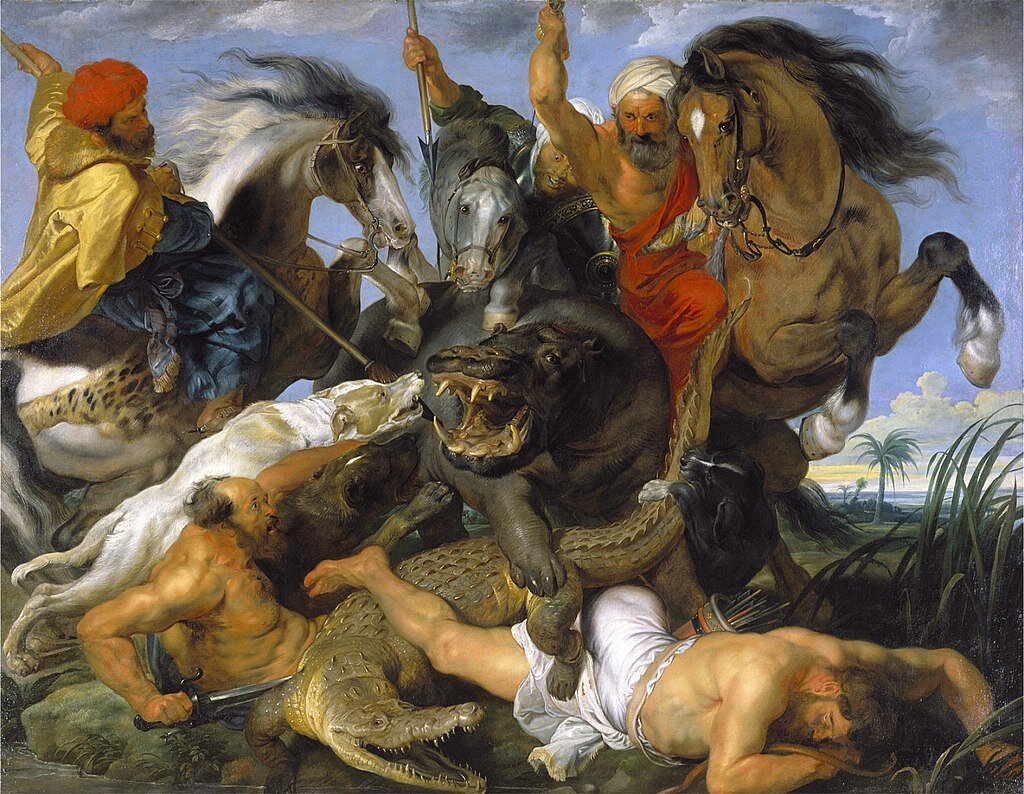
Try to imagine what the sailors of the 1500's had to think about being in front of an angry hippo. It was certainly easier to imagine him as a monster born from hell.
Here are some practical examples.
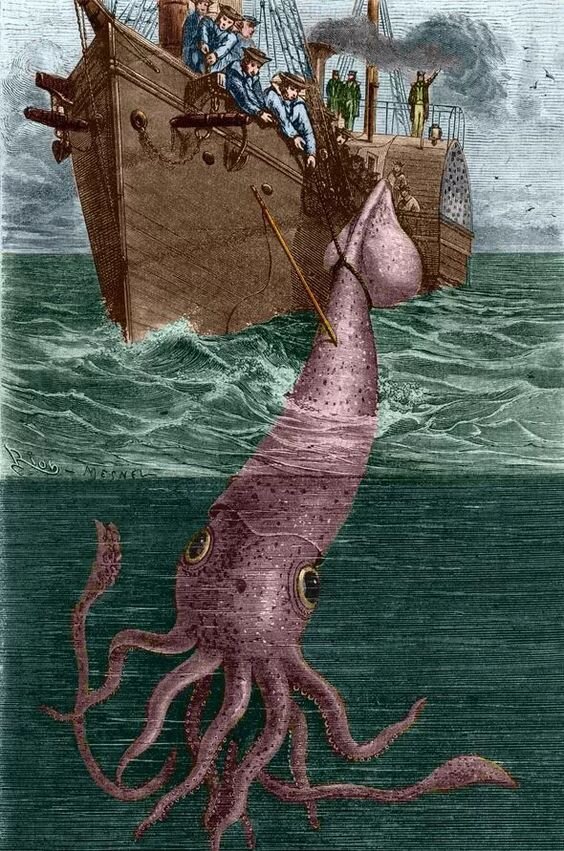
Giant squid
Giant squid can reach a length of 13 metres: from the caudal fin to the end of the two long tentacles.
Giant squid tales have been common among sailors since ancient times and may have led to the Norwegian kraken legend. It is thought that even sightings of other sea monsters, such as the sea snake, may have been misinterpretations of encounters with giant squid.
Hippopotamus
Hippos once lived in the lower Nile valley. For the ancient Egyptians, their round and massive appearance evoked a goddess of fecundity, and under these features they were often represented in bas-reliefs.
An accurate description taken from the bestiary known as Liber monstrorum (8th century AD) describes them as follows: "It is said that in India there are hippos, beasts larger than elephants, who, they say, live in a river of unstoppable water. And it is said that once in just one hour three hundred men were drawn into the birds of prey by the whirlpools and that they devoured them into a cruel death.
Indian Rhinoceros
The oldest western source that cites this mythical creature by name is On the Nature of Animals, a zoological work in seventeen volumes written by Claudio Eliano, a Greek-language writer of the early third century.
Elianus describes it as a unicorn the size of a horse, with the legs of an elephant, the goat's tail, and a single central black horn twisted on the forehead. The fast and warlike creature lives in the arid and mountainous regions of India.
A central character of the myth of the unicorn, especially in the European Middle Ages, is the healing virtues of its frontal horn, but the kartazon has no magical or supernatural character.
We meet the rhinoceros/unicorn of Islamic literature in the journey of Sindbad the sailor contained in The Thousand and One Nights of the tenth century, which describes a creature called karkadann.
The karkadann is a bitter enemy of the elephant that loads on sight and, often, horns to death, but failing, subsequently, to extract the horn from the body of the elephant ends up succumbing to him, blinded by the fat that runs from the wound because of the heat of the sun.
Varanus of Komodo
The Komodo Varan or Komodo Dragon (Varanus komodoensis) is the largest living saurian, a reptile that can reach lengths of more than two meters.
In the 19th century, sailors and fishermen on the islands of Flores and Sumbawa often told fantastic stories of men and animals being assaulted and slaughtered by large dragons living on the small island of Komodo.
which led to Peter A. Ouwens, director of the Botanical Garden of Buitenzorg (Java), organised an expedition to the island in 1912, with the primary aim of observing and capturing some specimens of the mythical reptile that so feared the local populations. Ouwens succeeded in this task: his meticulous research, carried out in various localities of Komodo, brought him four individuals of the supposed dragon. This was actually a monitor lizard of impressive size and belonged to a species new to science, which was given the name of Varanus komodoensis.
The clamour aroused in scientific circles by the news about the discovery of the Komodo dragon was great, and in 1926 also the staff of the Museum of Natural History in New York decided to organize an expedition to Komodo, in order to study the biology of the great monitor lizard and to capture some specimens of the same species. Thanks to the capture of twelve dead and two alive specimens, it was also possible to undertake in-depth studies on the anatomy and morphological and chromatic characteristics of the giant saurian of the small Indonesian island.