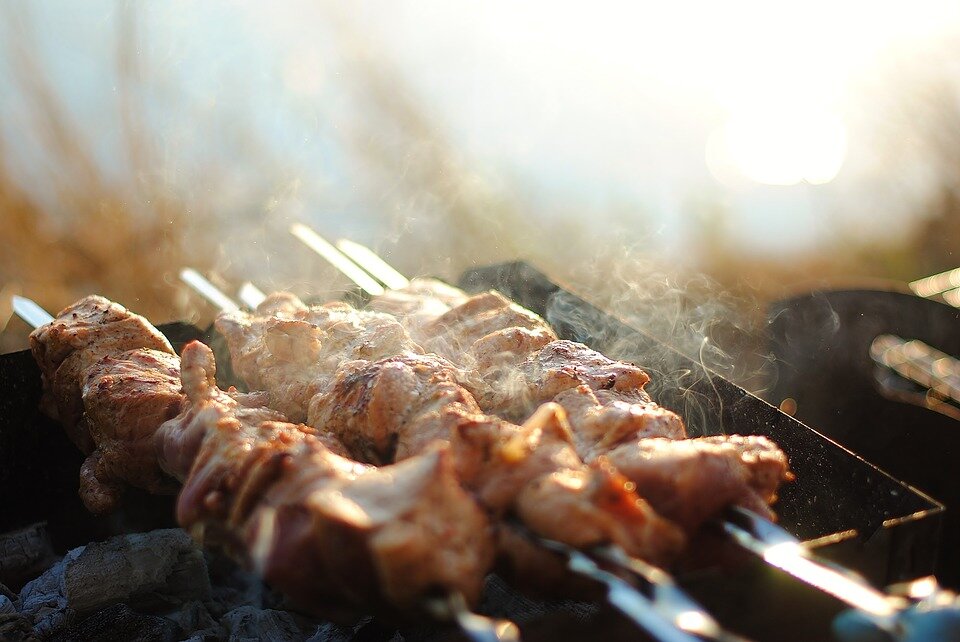
Shish kebab preparation is a complex process in terms of chemistry, with a large number of fine and interrelated reactions at each stage. If dealt with intelligently, the recipe for a good barbecue is comparable to, if not superior to, individual organic synthesis techniques. And, as in a full-fledged scientific experiment, in the preparation of kebabs, there are many details on which depends the optimization of the process - and thus the taste and aroma of the final product.
So, to prepare a kebab, it is necessary to perform two main actions: to marinate the meat and fry it on coals. But first, let's understand what meat is - in terms of chemistry.
Meat
What we call meat and buy in a shop under the guise of pork and beef is actually a skeletal, cross-striped animal muscle. Unless, of course, we will consider offal, such as heart, which is not used for kebabs. In addition to the muscle tissue itself, meat also includes fat and connective tissue, which is adjacent to them.
Muscle tissue has a curious structure. We are accustomed to the fact that the cells of our body are usually very small, indistinguishable by the eye. The structural unit of the muscle is a muscle fiber - and it is one big cell with a length of several centimeters and a diameter of hundreds of micrometers. It is formed by the fusion of thousands of other cells, which can result in several thousand nuclei in the muscle fiber.
The main property of muscle fibers is their ability to contract. This is how we (and other animals) move our limbs - and not only. This is provided by special proteins - actin and myosin. These are elongated molecules that form long bundles inside cells. Under the influence of external factors (nerve impulse), these bundles begin to move relative to each other, being pulled to the center. All the fibers are broken down into separate links - sarcomeres bound together.
Marinating
The meat is marinated in order to solve several problems at once: to make it softer, to give it an additional aroma and to carry out the primary antimicrobial treatment.
Collagen molecules, which determine the hardness of meat, normally form strong fibers and fibers. This assembly takes place under the action of hydrogen bonds - the attraction between partially charged (polarized) amino acid fragments. Exactly the same bonds arise between water molecules - between the hydrogen atom of one molecule and oxygen of another.
Frying
Marinating, by denaturing a large part of the proteins, significantly speeds up the meat cooking process. This avoids the prolonged exposure to heat and the evaporation of too much water. Along with the acceleration of protein denaturation, cooking on coals initiates many other chemical processes in the meat.
Many marinades have acidic reactions due to the presence of acids - most often acetic (e.g. wine, mayonnaise or vinegar), lemon and milk. Soy sauce, as well as teriyaki sauce, have an acidic environment - they contain a large amount of pyroglutamic acid as well as an amber, citric, ants and acetic acid. This means that there are a lot of hydrogen cations in the marinades, which are able to bind to protein molecules and protonate them. This changes the distribution of charges in the molecules and disrupts the fine structure of hydrogen bonds, which leads to changes in the geometry of protein molecules. As a result, proteins are denatured: collagen and actin fibers swell, soften, and collagen gradually dissolves.
The first is the famous Mayar reaction. It is responsible for the formation of highly smelling organic substances that give a special smell to roasted meat. This reaction includes amino acids in the meat and sugar. As a result, complex heterocyclic compounds, derivatives of furan, thiophene, alkyl pyridines, and pyrazines are formed.
The taste and aroma of kebabs are given not only by amino acid, sugar and fat decomposition products but also by coal combustion products. Syringes (by the way, its name comes from the Latin name of lilac, Syringa vulgaris) and guaiacols - they are formed during the decomposition of lignin, a binding agent for cellulose molecules in wood. These substances give the kebab (or barbecue) a characteristic smell of smoke.
The ratio of fragrant substances in the finished kebab is influenced by dozens of technical details of the cooking process: temperature, roasting time, choice of coal, meat, marinade, marinating time. And this is a great opportunity to find the best recipe for shish kebabs, and maybe even write a scientific article about it - with a particularly succulent description of the experimental part.