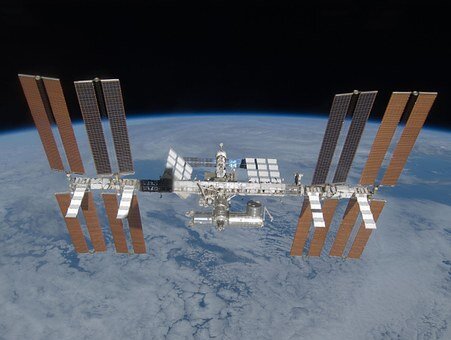
Work on the creation of space manned stations began in the U.S. and the U.S.S.S.R. almost simultaneously - in the early 1960s.
But since the Americans later focused on the prestigious Apollo program, the extensive program of space exploration in addition to Apollo left them with only the Skylab orbital station, launched on May 14, 1973 and the Space Shuttle, which is now the only operational manned spacecraft of the United States. The space station (SC) orbital block was built on the basis of the S-4B rocket, the third stage of the Saturn 5 launch vehicle, which once took a man to the Moon. Its (the missiles) hydrogen tank was converted into a spacious two-storey three-person crew room. The full internal volume of the Skylab CS together with the modified Apollo's main unit docked to it is about 330 cubic meters (the volume of a small two-bedroom house). Astronauts breathed a mixture of oxygen and nitrogen at a pressure of 0.35 at 21 g. C.
For the period from May 1973 to February 1974, 3 crews worked at the Skyleb CS. The last crew of Gerald Carr, Edward Gibson and William Pog worked for 84 days on board.
On July 11, 1979 the station entered the dense atmosphere and ceased to exist.
In the USSR, work under the orbital station program began in the late 1960s. On April 19, 1971, the first in the world "Salut-1" orbital launch vehicle was launched into orbit. The station consisted of three main compartments - transition, working and aggregate ones, which were cylinders with a diameter of 2.9 m, 4.15 m and 2.2 m, respectively. The total length of the Salyut-1 - Soyuz orbital complex is 21.4 m, and its weight is more than 25 tons.
One crew consisting of G. Dobrovolsky, V. Patsayev and V. worked at Salut-1 CS. Volkov, who died when he returned to Earth. After 175 days after the launch of the command from the Earth triggered the braking engines and CS "Salut-1" fell into the Pacific Ocean. In total, seven "Salut" series stations successfully operated in orbit. The last of them "Salut-7" has worked till the end of 1985. In February 1986 in the USSR the new generation orbital station "Mir" was launched into space. Unlike its predecessors, "Salutov", this station embodies a fundamentally new approach to settlement near the Earth's space. If "Salutes" served both as a home and a place of work, "Mir" has become a basic unit, that is, the link around which the large specialized satellites are grouped - scientific modules. In these large laboratories, saturated with scientific instruments and installations, research is carried out. The Mir station serves not only as a link between the different satellites, but also as a center from which the crew manages the entire orbital complex. The first module, the Quantum Astrophysical Observatory, docked at the Mir in the spring of 1987. - It is slightly smaller than the station itself. The volume of the entire station is 40 cubic meters.
We have entered only the fourth decade of the space age and have become quite accustomed to such miracles as satellite communication and weather monitoring systems, navigation and assistance to those on land and at sea, which have covered the whole Earth. As if it were something quite ordinary, we listen to a report about the work of people in orbit for many months, and we are not surprised by the footprints on the Moon, the photographs taken at point-blank range of distant planets, the first time the spacecraft of a comet's core was shown. In a very short historical period of time, astronautics has become an integral part of our lives, a faithful assistant in economic affairs and knowledge of the world around us. And there is no doubt that the further development of earthly civilization cannot do without the development of the entire near-Earth space. The exploration of space - this "province of all mankind" - continues at an increasing rate.