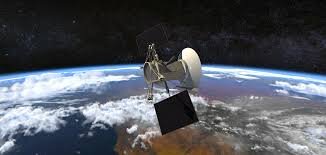
Within a short period of time since the beginning of the space age, man not only sent automatic space stations to other planets and set foot on the surface of the Moon, but also revolutionized space science, which has not been equal in human history. Along with the great technological advances brought about by the development of cosmonautics, new knowledge about planet Earth and the surrounding worlds has been acquired. One of the first important discoveries made by a method other than the traditional visual method of observation was to establish the fact that there had been a sharp increase in the height from a certain threshold height of the intensity of the previously considered isotropic cosmic rays.
This discovery belongs to the Austrian W.F. Hess, who in 1946 launched a gas ball probe with equipment at high altitudes.
In 1952 and 1953, Dr. James Van Allen conducted research into the low energy cosmic rays of launches of small rockets at the northern magnetic pole of the Earth at a height of 19-24 km and high-altitude balloons. After analyzing the results of the experiments, Van Allen proposed to place on board the first U.S. artificial Earth satellites quite simple in design cosmic ray detectors.
With the help of the "Explorer-1" satellite launched by the U.S. into orbit on January 31, 1958, a sharp decrease in the intensity of cosmic radiation at altitudes of more than 950 km was found. At the end of 1958, the AMS Pioneer-3, which covered a distance of more than 100,000 km per day of flight, registered a second radiation belt above the first one, which also surrounds the entire globe, with the help of sensors on board.
In August and September 1958, at an altitude of more than 320 km, three atomic explosions were carried out, each with a capacity of 1.5 kt. The purpose of the tests, code-named "Argus", was to study the possibility of radio and radar communication loss during such tests. The study of the Sun is a major scientific task, to which many of the first satellite and AMS launches are devoted. American "Pioneer-4" - "Pioneer-9" (1959-1968) from near-solar orbits transmitted the most important information about the structure of the Sun by radio to Earth. At the same time, more than twenty Intercosmos satellites were launched to study the Sun and near-solar space.
AMS flights to the Moon and planets
At the beginning of the 60s in the USA and the USSR were designed, manufactured and launched to the Moon a number of AMS. The most successful for Americans was the launch in July 1964 of "Ranger-7", which transmitted to Earth more than 4300 high quality TV images of the Moon, received before contact with the surface. The last image taken from a height of 1600 m covered the area of 30x50 m. Craters of up to 1 m in diameter were clearly visible on it.
In the USSR, for the first time, opportunities were created for soft landing on the Moon with the creation of new AMS series "Luna" in 1963. These stations weighing up to 1.8 tons were designed to deliver an instrumented container weighing 100 kg to the surface of the Moon. When the Luna-9 AMS was launched in February 1966, a soft landing on the Moon of the object made by human hands was successfully carried out for the first time. The second "moored" station was Luna-13.
A mechanical soil meter and a radiation density meter were used to obtain unique information about the density and composition of the soil surface. When the Luna-17 AMS was launched, it was for the first time that the task of moving around the lunar surface was set. After a successful landing the Lunokhod-1 spacecraft was launched from the landing stage. Within 10 months the Lunokhod-1 spacecraft, controlled from the Earth by radio, passed through the lunar surface more than 10.5 km.
One of the brightest lights of the night sky - the cloud-covered planet Venus - became one of the first targets of AMS flights. For the first time the possibility to launch AMS appeared in the end of 1960, when the first rocket-launch vehicle A-2-e was created in the USSR. In February 1961, the first A-2 rocket was launched in the USSR.
Using the "window" for launches to the Venus of the USSR launched AMS "Venus-1", which was held at a distance of 100 thousand km from Venus and entered into a near-solar orbit. On November 12, 1965, it was launched in order to reach its surface "Venus-3". On March 1, 1965, the station reached the surface of Venus with the first AMS flight to another planet. In 1967, the Venus 4 station successfully flew directly to the planet. At a distance of 45,000 km from Venus, a spherical descent vehicle (CA) of 1 m in diameter separated from the station, which withstood an overload of up to 300 g during its entry into the planet's atmosphere. The parachute system further provided an atmospheric descent that lasted 94 minutes. It was reported that at an altitude of 25 km the atmospheric temperature was equal to 271 g and the pressure of 17-20 atmospheres. On the surface of the planet the temperature is equal to 475 g and the pressure is 15 atm.
It has been established that the atmosphere of Venus is almost entirely made up of carbon dioxide. Subsequently, several launches were carried out to dive into the atmosphere of Venus.
The first space station to be launched to Mars on November 1, 1962 was the Soviet Mars-1 AMS. The United States launched the first two Mariner spacecraft in 1964. The launch of Mariner 3 was unsuccessful and three weeks later Mariner 4 was placed into orbit.
On July 14, 1965, it flew 9600 km away from Mars without detecting any radiation belts or magnetic field around the planet. It has been established that the pressure at the surface of the planet is less than 1% of the earth's pressure above sea level and corresponds to the pressure in the Earth's atmosphere at an altitude of 30-35 km. Craters similar to the lunar craters were found on the surface of Mars.
The first Soviet AMS to land on Mars was "Mars2", weighing 4650 kg. In the soil was found: 15-20% silicon, 14% iron, calcium, aluminum, sulfur, titanium, magnesium cesium and potassium. In the air, 95 % of carbon dioxide, 2.7 % of nitrogen and signs of oxygen, argon and water vapour were found. Mercury was first visited by the Mariner-10 AMS, originally sent to Venus in 1973. On March 29, 1973, the spacecraft reached its destination, the planet Mercury, passing at a distance of 690 km from its shady surface. During each mission, the surface of the planet was studied. Traces of argon, neon and helium were found in the atmosphere of Mercury, a trillion times less than on Earth. The range of surface temperatures from 510 to -210 grams, the magnetic field strength of 1% of the Earth, and the mass of the planet is 6% of the mass of the Earth.
Also AMS were sent to Jupiter and Saturn.