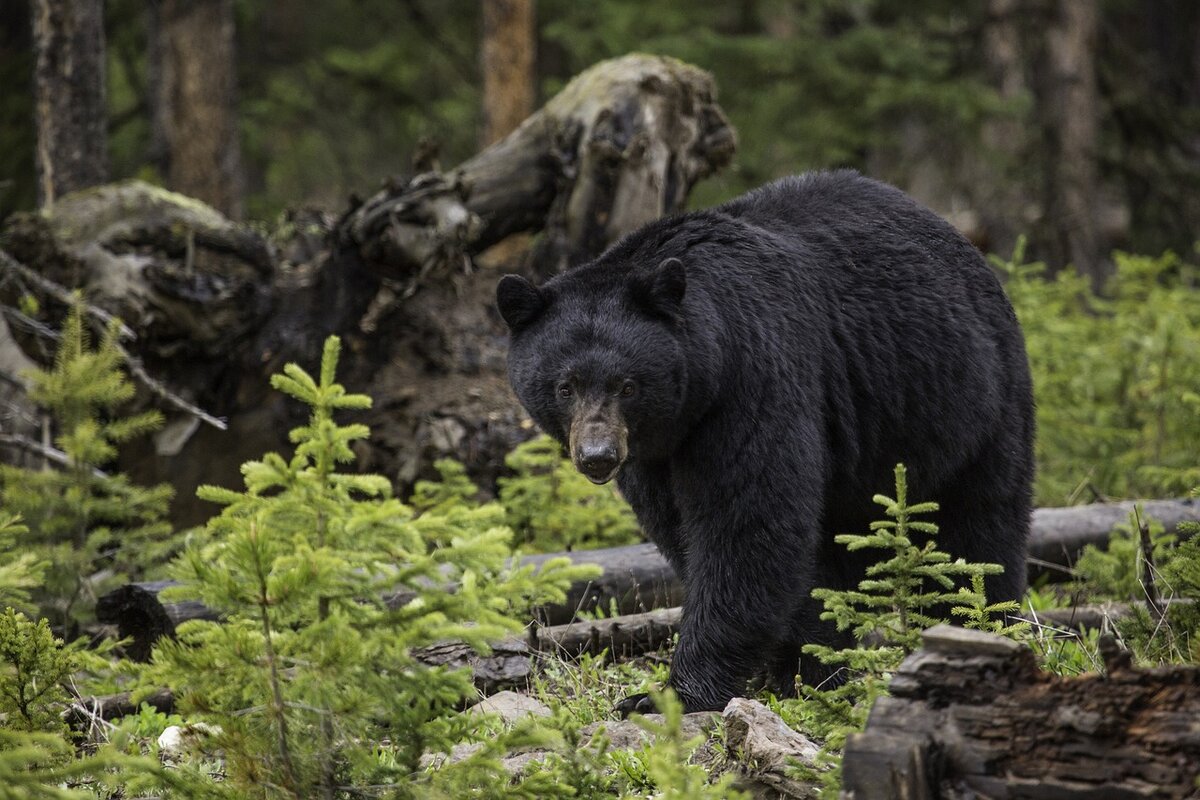
The Himalayan bear (other names: polar bear, black Himalayan bear, black Ussurian bear) is a predatory species of mammals from the bear family. The Himalayan bear is often referred to as the "moon bear" because of the white spot on the chest that has the shape of a crescent moon. In this article, you will find a description of the Himalayan bear and a photo, learn a lot about this unique animal.
Description of the Himalayan bear.
The description of the Himalayan bear should begin with a story about its unusual mark on the chest. It is the bear that allows you to accurately distinguish this bear from other members of the Bear family. The wide breast of the moon bear is decorated with a particular spot of white color, sometimes with a slight yellowish appearance, reminiscent of a crescent moon or the letter V. Since the main color of the Himalayan bear is black, this mark is very striking.
The description of the Himalayan bear has other, but not so bright, distinctive features. This polar bear looks much smaller than a brown bear and has a slimmer physique. Also, the moon bear has large round ears and a thin pointed face, which can be slightly lighter than the main color. The Himalayan bear has a very thick and shiny black or black-brown wool. His coat is silky but short. It looks especially magnificent on the sides of the head, forming a kind of mane, of course, not as chic as the king of animals.
The Himalayan bear, although smaller than a brown or polar bear, is still impressive in size. Females look much smaller than males. The body length of an adult male varies within 150-180 cm, with a bodyweight of 100-140 kg, an adult female has a body length of 120-150 cm and a weight of 80-120 kg. The height in the withers of these bears is about 80 cm. They also have a short tail, which is only 11 cm long. The average life expectancy of a Himalayan bear is about 25 years.
The polar bear is very strong . The width of the shoulders of an adult bear can reach 1 meter. It has a special power of legs, which are equipped with sharp claws. With their help, the Ussurian bear can easily move around the trees and dig holes. In addition, the bear has quite impressive teeth that allow it to chew even the hardest species of trees. The Himalayan bear has a good memory, a truly unique and very interesting animal.
Where does the Himalayan bear live and how does it live?
The Himalayan bear lives in mountain and mountain forests from Iran to Japan, passing through Afghanistan, Pakistan, the Himalayas, and Korea. In addition, the Himalayan bear also covers areas of China, the Khabarovsk Territory, Yakutia, and Vietnam. The Himalayan bear even lives on Taiwan Island. In the mountainous areas, these bears rise to a height of up to 4 kilometers in summer and descend closer to the foot of the mountains in winter.
The Himalayan bear lives mainly in trees, where it feeds itself and hides from enemies, preferring deciduous or mixed forests, avoiding open and marshy places. The polar bear is an experienced climber who climbs a tree in seconds and also descends it quickly.
Despite the fact that the Russian bear spends most of his life on trees, it does not prevent him from moving confidently on the ground and swimming well. Climbing to the top of the tree, this bear often breaks branches to eat the fruit. However, he does not throw away broken branches, but puts them under him, building a kind of huge nest for rest. In particularly quiet weather in the forest, you can hear a crunch of broken branches.
The Himalayan bear lives on a saddle and prefers loneliness. The only exception is the mating season and places of great abundance of food, where several individuals can gather simultaneously. In both cases, a strict hierarchy remains, and older people have an advantage over younger people. Otherwise, the Himalayan bear lives alone. These animals are very territorial and prefer to follow the same routes. They mark their possessions with signs and leave the developed territory only in case of food loss.
In winter, the Himalayan bear hibernates in winter, hibernating in the hollows of old trees at a height of at least 5 meters. In the middle of autumn, the bear starts to cook its hole. Usually, the animal chooses a lime tree or poplar where it chews on the desired size of the hole and processes the interior space according to its size. If there are no suitable trees, he will settle down in a cave or any other place convenient for this purpose. Interestingly, these bears do not have a single den, but there are a few where you can hide in case of danger.
Before falling into hibernation, which usually lasts from November to March, the Himalayan bear gets fat. During hibernation, all the processes of the animal's life are slowed down. In spring, the bear comes out of its home and immediately begins to look for food, because its reserves during the hibernation period have been significantly depleted. Himalayan bears are quite noisy animals and make many different sounds, through which express their mood. They growl, snarl, whine, grunt, click and hiss.
The Himalayan bear lives the most active in the twilight and at night, preferring to rest in the daytime in the crowns of trees or caves. But during the maturation of favorite delicacies, these animals can be active during the daytime as well. The Himalayan bear tries to avoid people and usually does not show aggression against them. However, there are known cases of this bear attacking a person. Therefore, you should be extremely careful when meeting him and remember that he is a wild predator, which can be very unpredictable.
The Himalayan bear has a good memory of both good and evil. Man is first and foremost the enemy for this beast. In addition to humans, the brown bear, the Amur tiger, and some other large cat species pose a threat to these brawlers, and young animals are often attacked by wolves. The Himalayan bear prefers to hide from people for a reason. After all, it is a valuable object of hunting because of its fur and has healing properties of bile.
In some countries, there are special farms where these bears are bred to produce gallbladder for use in pharmaceuticals. But mostly Himalayan bears suffer at the hands of hunters. Uncontrolled poaching has led to the fact that the Himalayan bear was listed in the Red Book. Also, deforestation and other human activities have a detrimental effect on the number of bears, depriving them of their natural habitat and food supply.
What does the Himalayan bear feed on?
Like the big panda, the Himalayan bear's diet is largely made up of plant foods. The Himalayan bear feeds on nuts, berries, fruits and vegetables, shoots, kidneys, mushrooms, seeds, bulbs, roots, cones and acorns. Honey and cherry are the favourite delicacies of these bears, and the beast will go to the end of the world for the sake of their prey. The natural agility and strength allow them to get any kind of delicacies.
Despite the vegetarian diet, the Himalayan bear can hunt, but does it quite rarely. If a polar bear has decided to go hunting, then most often its victims can be deer, wild boars or livestock, which the bear just snaps his neck with his strong paws. But this is not often the case, and beetles, ants, larvae, molluscs, frogs, eggs and even bees are the poet's main prey.
Himalayan bear cub.
The Himalayan bear's mating season is midsummer and usually goes fairly smoothly. These bears can reproduce at the age of 3-4 years. The Himalayan bear is pregnant for about 7 months. By the middle of winter, the Himalayan bear cubs are born in the den. Usually 1-2 cubs are born, only occasionally 3-4 babies can be born. The female brings offspring no more than once in 3 years.
The Himalayan bear cub is born helpless, blind and weighs no more than 400 grams. Newborn bears have almost no woollen cover, but after a month they are covered with a grayish cannon, gradually replacing it with black wool. Bear cubs develop rather slowly and by May they weigh no more than 3 kg. Therefore, the bear comes out of the den later than usual, allowing the babies to get stronger.
All this time she is with them and feeds them with her milk. When a bear with cubs leaves the den, the Himalayan cubs are gradually switching to vegetable food. The babies stay with their mother, who protects and protects them, until about 3 years of age. When they reach the age of three, the Himalayan cubs become fully independent.