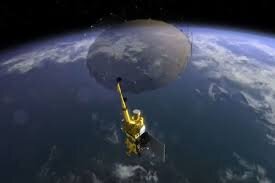
It was only a few years after the space age that man first assessed the role of satellites in monitoring agricultural land, forests and other natural resources on Earth. The beginning was in 1960, when the meteorological satellites Tiros were used to obtain a map of the shape of the globe lying under the clouds. These first black-and-white TV images gave very little insight into human activity, and yet this was the first step. New techniques were soon developed to improve the quality of observations. Information was extracted from multispectral images in the visible and infrared (IR) spectral regions. The first satellites to make the most of these capabilities were Landsat-type satellites. For example, Landsat-D, the fourth in a series, observed the Earth from an altitude of more than 640 km by means of advanced sensors, allowing users to obtain much more detailed and timely information. One of the first applications of Earth surface images was cartography. In the pre-satellite era, maps of many areas, even in developed areas of the world, were not accurate. Landsat images enabled some of the existing U.S. maps to be corrected and updated. In the USSR, the images received from the "Salut" station turned out to be irreplaceable for the alignment of the BAM railway line. In the mid-1970s, NASA, the U.S. Department of Agriculture decided to demonstrate the capabilities of the satellite system in forecasting the most important crops of wheat. Satellite observations that proved to be rarely accurate were later extended to other crops. Approximately at the same time, in the USSR, crop observations were carried out from the satellites of the "Cosmos", "Meteor", "Musson" series and "Salut" orbital stations.
The use of information from satellites revealed its undeniable advantages in the assessment of the volume of construction forests in vast areas of any country. It became possible to manage the process of felling and, if necessary, to give recommendations on changing the contours of the felling area from the point of view of the best preservation of the forest. Thanks to satellite images, it has also become possible to quickly assess the boundaries of forest fires, especially "crown-like" fires, characteristic of the western regions of North America, as well as the regions of Primorye and southern regions of Eastern Siberia in Russia.
The ability to observe the World Ocean of this "forge" of weather almost continuously is of great importance for mankind as a whole. Hurricanes and typhoons, which cause numerous victims and destructions for the inhabitants of the coastline, begin to emerge above the ocean water layers. Early warning of the population is often crucial for saving the lives of tens of thousands of people. The identification of fish and other seafood stocks is also of great practical importance. Ocean currents are often curved, changing course and size. For example, El Nino, a warm southward current off the coast of Ecuador can in some years spread along the Peruvian coast up to 12g. When this happens, plankton and fish die in huge quantities, causing irreparable damage to fisheries in many countries, including Russia. High concentrations of unicellular marine organisms increase fish mortality, possibly because of the toxins they contain. Satellite observations help to identify the "whims" of such currents and provide useful information to those who need it. According to some estimates by Russian and American scientists, fuel savings, combined with "additional catch" from infrared satellite data, generate an annual profit of $2.44 million. The use of satellites for survey purposes has made it easier to navigate the course of ships.
The Russian nuclear-powered icebreaker Siberia has used information from four types of satellites to develop the safest and most economical routes in the northern seas. Information from the Cosmos-1000 navigation satellite was used in the ship's computer to determine the exact location. Meteor satellites provided cloud cover images and forecasts of snow and ice conditions, which made it possible to choose the best course. Lightning" satellite was used to communicate with the ship with the base. Also with the help of satellites oil pollution, air pollution and mineral resources are found.