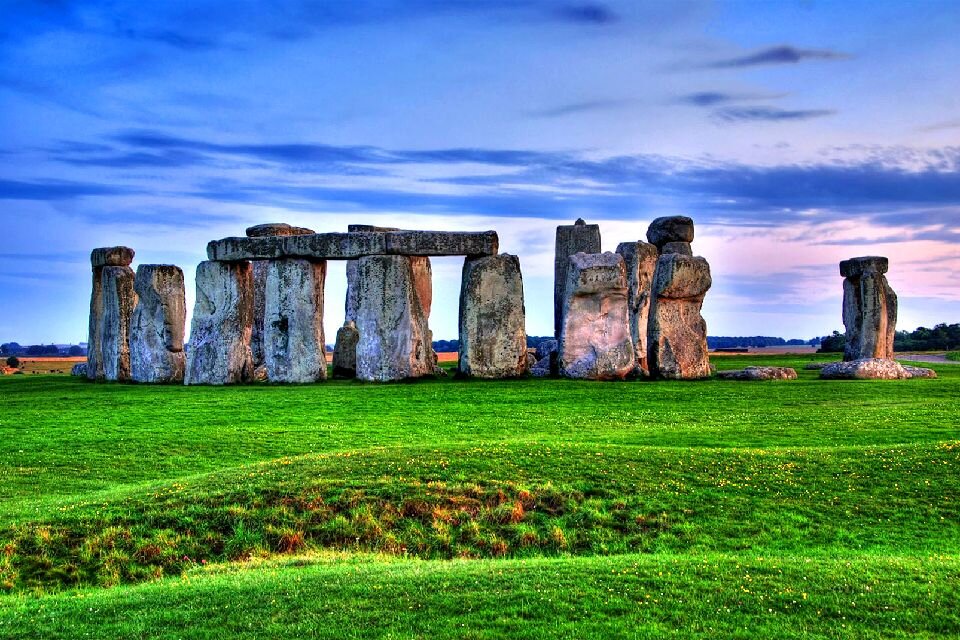
Stonehenge, towering in proud seclusion over the grassy Salisbury Plain in South England, is probably the world's most famous prehistoric monument. Attended by hundreds of thousands of people annually, feeding the minds of generations of historians and archaeologists, Stonehenge has become a synonym for ancient mystery. Huge sarsens - vertically placed blocks of dense gray limestone reaching 13 feet in height, roughly fringed and connected by horizontal slabs - are the first thing that strikes the eye of visitors. From the northeast, the megalithic circle is accessed by an alley with shallow ditches on both sides.
Having passed the Heel Stone (a free-standing sarsen), you cross two little visible earth ramparts separated by a ditch and forming a double ring around Stonehenge. Inside the megalithic circle there is another circle of smaller stones called "blue stones". In the circle of "blue stones" there is a number of megaliths in the form of horseshoeshoeshoes, turned in the northeast direction. The sarsen trilithons (a pair of standing stones with a horizontal bar connecting their tops) rise above the tourists by 20 feet. Inside the megalithic horseshoe there is another one consisting of "blue stones".
As the megaliths are the most visible element in the Stonehenge complex, they play a major role in the long history of its research. The first written mention of Stonehenge is found in the work of cleric Henry of Huntington, who described the history of England around 1130. It was the only ancient monument he considered worth mentioning:
"Stanjes (Stonehenge), whose stones of amazing size were erected in the manner of doors, is one of the wonders of antiquity, no one can understand how such huge stones were raised above the ground and why they stand in this place.
Henry of Huntington, who prudently avoided speculation on the subject of Stonehenge, did not impress his contemporaries, who preferred a colourful description of Galfrid of Monmouth, who saw the light of day a few years later. Galfrid attributed the construction of Stonehenge to the wizard Merlin, who carried out the order of Aurelius Ambrosius (according to legend, it was King Arthur's uncle). The monument was erected in memory of unarmed Britons killed by treacherous Saxons. It is interesting to note that, according to Galfrid of Monmouth, the stone circle was already in Ireland, but was moved to England by Merlin's sorcery. The story of Galfrid of Monmouth, full of convincing details, contained the date of construction of the stone circle and explained the reason for its construction. Not surprisingly, it was a huge success. As Dr. Chris Chippendale, who was studying the works of Stonehenge, noted, Galfrid "wrote about what the English readers wanted to hear: the amazing adventures, valor, magic and chivalry with a clear patriotic hue. The idea of Stonehenge in the Middle Ages was based mainly on the history of Galfrid of Monmouth.
By the 17th century, researchers needed new arguments to support the theory of Galfrid of Monmouth, in addition to the claims that he used "one very ancient book in Brittany. The first excavations at Stonehenge were commissioned by King James I, who visited the monument in 1620. Duke of Buckingham offered the landowner Robert Newdike a large sum of money for Stonehenge, but was refused. However, Buckingham received permission to dig a hole in the center of the monument. No information about the result of the work has been preserved, and the founder of systematic research Stonehenge John Aubrey, who asked the locals in 1666, found that they remember only about the discovery of "deer and cow horns, as well as charcoal. The more annoying were the hints of more important discoveries:
"Something was found, but Mrs. Mary Trotman (one of the interviewees) forgot what it was.
The king asked his chief architect Inigo Jones to describe the remarkable monument. Based on his observations, Jones concluded that the builders of Stonehenge followed Roman architectural planning rules, but he died before he was able to publish the results of his reflections. Taking advantage of the notes left by Jones after his death in 1652, his assistant and devoted student John Webb wrote a voluminous work entitled "The Most Famous Ancient Landmark of Great Britain, in Simply Speaking, The Called Stonehenge on the Salisbury Plain: Reconstruction".
The author of the book concluded that Stonehenge was built in the I-IV centuries A.D., in the era of peace and abundance, when England was part of the Roman Empire.
A continuation of this fascinating story in the next article.