Part 2
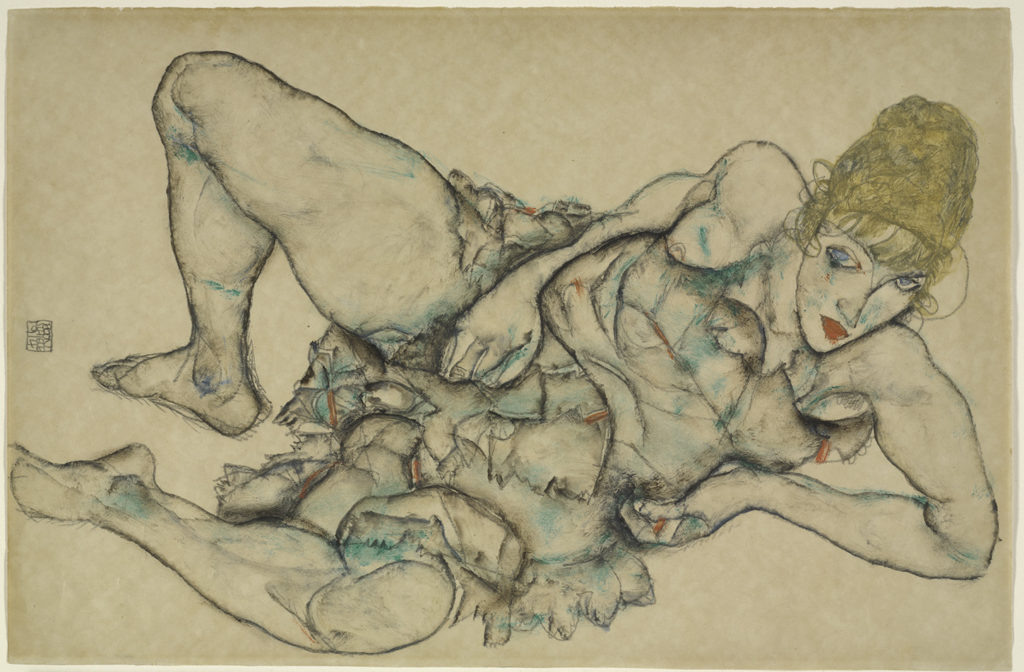
So here he is in front of the mirror, which retracts while masturbating, with an immense phallus in his hands (Eros, 1911). The end of ideal beauty, of the microgenitomorph of the elders, theorized by Polychaetes: sex is painted visually, in its raw reality, exalted and represented according to nature. We are in 1910, at a time when onanism is considered a disease, the cause of dementia, and Freud, who considers it as a primary addiction, refuses to mention it on his teenage son, who is treated by a colleague.
Schism, which Freud never met and whose works he ignored, is the artist who best illustrated the reform of consciences and forms in Viennese culture, a reform that was both an affirmation of self and a destruction, a postulate of modernity and a criticism of modernity itself, as Jean Clair recalls in his beautiful text. Is not the modern man the master of his own house, the one who does not control himself? Is it at the mercy of a mysterious energy, of Eros, of libido, of the instinct of death that pushes us to compulsive repetition to find pleasure and suffering?
Schism depicts here the drama of the modern ego in his double pencil self-portrait on paper, where a calm looking ego is in the company of another ego, which on the contrary has spiral eyes, wrinkled forehead, head covered with hair, hands stretched, long fingers open, while the other still holds it behind his shoulders and looks down on him (Double self-portrait, 1910). In another self-portrait, Schism paints himself with a mass of shapeless hair, as if shaken by an electric shock, and with his high wrinkled forehead, his curved eyebrows, his absent eyes, his gaze turned inward, towards an unfathomable black hole, and his intertwined lips (self-portrait, head, 1910).
The same year, Schism returned to the double self-portrait with the Selbstseher, the spectator of himself, showing the black demon who pushed him from behind to do obscene acts, the only one responsible for his perversions (Self-Seer, 1910). He thus expresses his poorly asleep anger, anxiety and anxiety devoted to introspection. It is as if he wanted to rediscover the traumas of childhood, the impulses of the soul: Have adults forgotten what they were like when they were little? How were they led and relieved by the sexual impulse? Have they forgotten the terrible passion that burned in them and tortured them when they were children? Not me, I haven't forgotten, because I suffered terribly from it, Schiller wrote. And in his research, he also involves Serti, his four-year-old little sister, who poses naked for him and organizes long clandestine anatomical sessions, in which other street children also participate, as well as models arranged by professionals for the most challenging poses. Little by little, the ornamental line, Klimt's line, master of Jugendstil fluidity, began to break into a contracted, angular, expressionist line. In 1912, Schism left for Krumau, the medieval town of Bohemia, less than two hundred kilometres from Prague, where his mother was born and where he lived with the Wally Neural model. Shortly afterwards, the two moved to Neulengbach, fifty kilometres from Vienna, in a small house with a garden where Wally was the hostess and Schisme painted their portraits and The Hermit (1912), a large painting with two characters, in which he represented himself next to Klimt. His success came to him. Schism exhibited in Vienna, Munich, Cologne and Budapest, but his fortune turned his back on him the day he was accused of indecent exposure: arrested, he was confiscated about a hundred erotic drawings, and after three weeks in prison and a swift trial, he was released. In prison, Schism writes a diary, reflects on art, When modern breast nests. When is uraemia (Art cannot be modern, it forever returns to its origins), tries to paint on the walls with saliva, before obtaining colours and brushes with which he makes thirteen watercolours, including a view of the narrow cell, his chair, his clothes, soaking his life in living objects, and four magnificent self-portraits, where he represents himself in a vertical position, as if suspended from the void. To obstruct the artist is a crime, it is to kill life in the cradle, he writes in cubic characters next to the first. Pouring on the straw yellow, squeezed into his red coat with huge pimples, without showing his feet or hands, the prisoner casts a begging glance from the bottom of his dilated eyes, to say outrage, indignation, humiliation (Io Ami l'antitheses, 1912). In another portrait, the hands reappear, contracted as if they wanted to grasp the void, clinging to the coat until the fabric wrinkles (I will be happy to endure for art and for those I love, 1912). They are the symbol of the return to life.
The artist returns to freedom and begins a series of ascetic drawings alone, or next to Wally, his muse, whom he holds in a comforting embrace. But meanwhile, another me is restless and tormented, frowning, scarlet hair, red cheeks, hands stretched in a defensive gesture, while his body spreads a strange reddish halo. At the end of 1913, he invented a new logo, enclosing his signature in two lines in a rectangle in capital letters: it was as if, after a long exploration of his existential void, he wanted to barricade himself, observes Alessandro Commune, and try a less conflictive relationship with the world. Thus, on the occasion of the exhibition in Vienna in December 1914, Schism depicted himself as a modern martyr, persecuted and tortured like San Sebastian (Self-portrait in a green shirt with closed eyes, 1914). The abstract, angular and broken expressionist line reaches its apogee.
Schism followed the laws of anatomy to the grotesque, treated the faces of models as the heads of models, but its geometry was always based on the organic structure. When Klimt tried to get out of his despair and resentment, he came to his rescue and convinced the Hungarian industrialist Augusta Liberal to entrust Schism with the portrait of his sons. However, it is not only the precision of the contour that counts, the definition of the line, but above all the reflection of the inner life. His paintings are selling well. In 1913, he moved to a new house, lives in a pentose at 101 Hellinger Hauptstrasse, and has a studio on the ground floor. Opposite are the sisters Harems, Adele and Edith, 23 and 21 years old, daughters of a German woman who worked for the Austrian railways. Schism began to court Edit on the eve of the First World War.
In February 1915, he was mobilized, but postponed for health reasons. He was called back to arms in May and left for Prague on 21 June 1915, four days after marrying Edict, not without renouncing Wally, who nevertheless left him with indignation, leaving as a volunteer nurse in a military hospital. Three years later, on October 28, 1918, shortly before the armistice, Edict died of Spanish fever, and Schism, already ill, depicted two lovers lying on his bed in a tender embrace (Lover, 1918, unfinished). Three days later, on October 31, 1918, he also died.